
Breaking news
China’s Ex-Agriculture Minister gets death Sentence

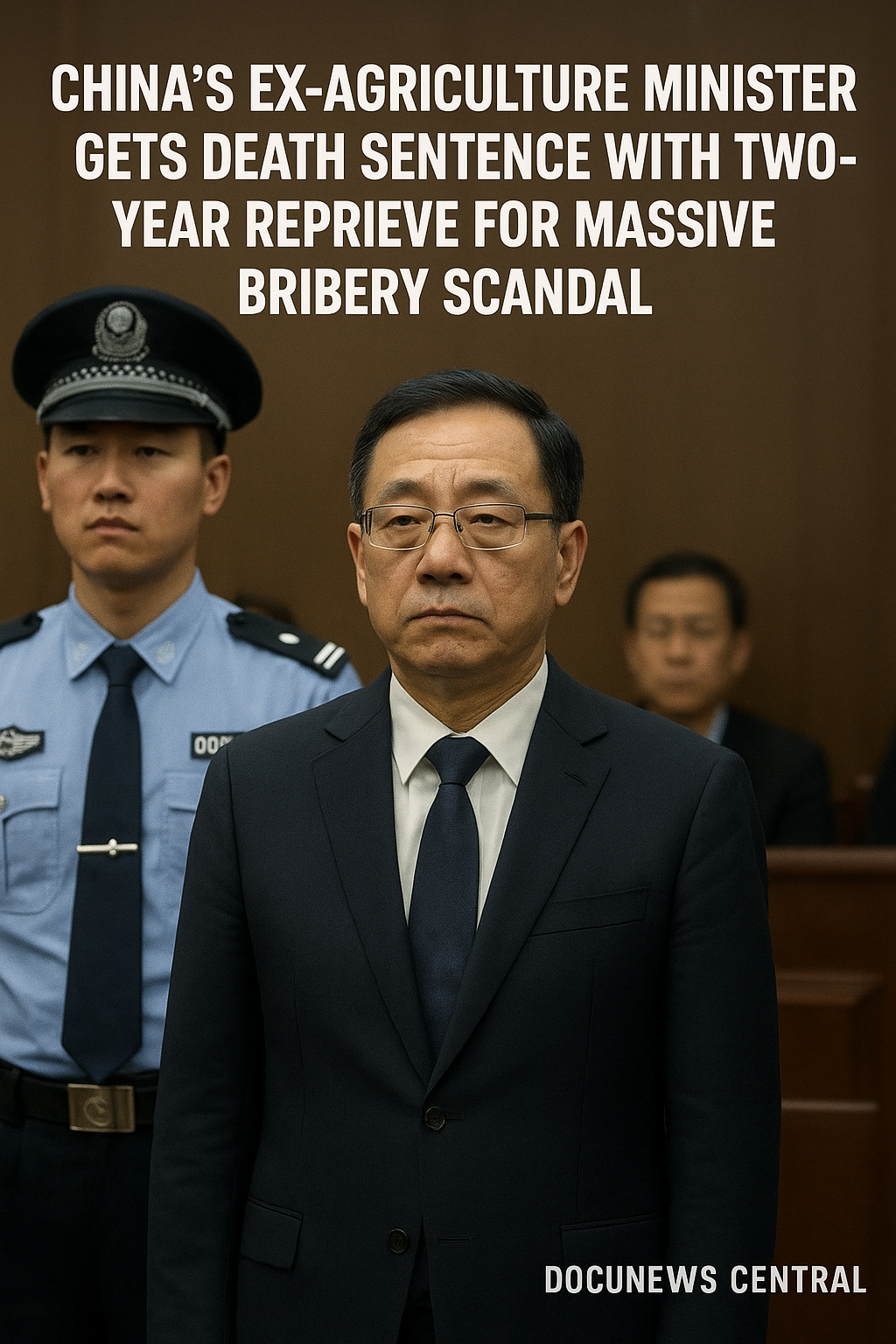
CHINA’S EX-AGRICULTURE MINISTER GETS DEATH SENTENCE WITH TWO-YEAR REPRIEVE FOR MASSIVE BRIBERY SCANDAL
A Shocking Verdict Rocks Beijing
China has delivered one of its harshest corruption rulings in years. On Sunday, a top court in the northeast city of Changchun sentenced Tang Renjian, the nation’s former Minister of Agriculture and Rural Affairs, to death. The court attached a two-year reprieve, a unique feature of Chinese law that gives the accused a narrow window to avoid execution.
The verdict has sent ripples across the country’s political landscape. Tang, once a trusted voice in China’s drive for food security and rural growth, now stands as the newest symbol of Beijing’s unrelenting anti-graft drive. read also Nigerian Government Approves Pension Increase docunewscentra;.com
The Scale of the Bribery
Investigators revealed that Tang took bribes over a span of nearly two decades, beginning in 2007 and continuing until 2024. The total sum reached an astonishing 268 million yuan, or roughly 37 million United States dollars.
Prosecutors stated that the bribes came in many forms. Tang accepted cash, expensive gifts, and favors from powerful business figures and regional officials. In return, he allegedly gave key approvals, government contracts, and promotions.
This pattern of misconduct, the court said, weakened public trust and distorted state policy in critical areas such as agriculture and rural development.
Lifetime Ban From Politics
The Changchun court also stripped Tang of political rights for life. This means he cannot hold any government position, join political discussions, or vote in any official capacity ever again.
In addition, all of his personal assets will be confiscated. Bank accounts, properties, and any luxury goods obtained through illegal means will now be taken by the state. The message is clear: no one, no matter how high their office, is beyond the reach of justice.
What a “Death Sentence with Reprieve” Means
China’s criminal system allows a unique penalty known as “death with a two-year reprieve.” In practice, this sentence means that if the convict shows good behavior and commits no further crimes during the two-year period, the death penalty is typically reduced.
After the two years pass, courts may convert the sentence to life imprisonment. Sometimes, it can be further reduced to a fixed prison term, but that depends on the severity of the case and whether the person continues to cooperate with authorities.
Legal experts point out that this form of punishment serves as both a severe warning and a chance for rehabilitation. It reflects the government’s intent to punish corruption strongly while avoiding unnecessary executions if the offender demonstrates change.
A Career Once Marked by Promise
Tang Renjian’s fall from grace is striking because of the high profile he once enjoyed. He built a reputation as an expert in rural economy and agricultural policy. Over the years, he held several senior positions in regional governments before rising to become the Minister of Agriculture and Rural Affairs.
During his tenure, Tang promoted strategies to modernize farming and to secure China’s food supply for its vast population. He was often praised for advancing rural development and guiding key reforms.
Yet behind that public image, investigators say, a hidden network of illegal payments grew steadily. The discovery of this long-running scheme shocked many who once worked closely with him.
Part of a Wider Crackdown
The harsh ruling is not an isolated case. For more than a decade, China’s central government has waged an extensive anti-corruption campaign.
President Xi Jinping made the fight against graft a central pillar of his administration, vowing to target both “tigers and flies.” That phrase signals the intent to catch both high-ranking officials and lower-level bureaucrats.
Since the campaign began, thousands of officials have been investigated, removed from office, or jailed. A few, like Tang, have faced death sentences or life imprisonment when the scale of their wrongdoing was considered extraordinary.
Observers note that the campaign has reshaped Chinese politics by reinforcing public confidence in the state’s commitment to clean governance.
Public and International Reactions
The announcement of Tang’s sentence quickly spread across Chinese social media platforms. Many citizens voiced support for the ruling, praising the government for striking hard at corruption.
Some users expressed disappointment that such a senior figure betrayed public trust. Others debated whether the death sentence with reprieve was too lenient, given the massive sums involved.
Outside China, analysts highlighted the ruling as a reminder of the government’s firm grip and its willingness to punish even top officials. International news outlets described the case as one of the most significant corruption judgments of the year.
Legal and Ethical Debates
Legal scholars inside and outside China say that the death sentence with reprieve is a carefully balanced penalty. It shows the state’s readiness to deliver a severe punishment without immediately carrying out an execution.
Critics of the death penalty, however, argue that even a suspended death sentence can be seen as excessive. Human rights groups continue to call for broader reforms of China’s criminal justice system.
Supporters counter that the scale of Tang’s bribe-taking justifies an extraordinary response. They emphasize that public office in China is a position of trust, and abuse at that level demands the strongest deterrent.
What Happens Next
Tang will now begin his two-year probation. During this period, he will be closely monitored. If he follows all prison rules and cooperates with any further investigations, the law provides for a possible commutation to life in prison.
If, however, he breaks the rules or commits any additional crime while serving the reprieve, the death sentence could be carried out.
Officials have not released details of the prison where Tang will serve his time, but it will be under strict security and surveillance.
Message to Other Officials
This case sends a warning to every level of Chinese government. The sentence underlines the leadership’s message that corruption will be punished regardless of rank or past achievements.
Political commentators suggest that the ruling will make other officials think twice before accepting bribes or using their office for personal gain.
For ordinary citizens, it reinforces the idea that the government is serious about creating a cleaner and more transparent administration.
Economic and Policy Impact
China’s agricultural sector has faced numerous challenges, from maintaining grain reserves to supporting rural incomes. Tang’s downfall raised brief concerns about policy continuity.
However, the Ministry of Agriculture and Rural Affairs has already assured the public that core programs will continue without disruption. Other senior officials have stepped in to ensure that projects for food security, farming technology, and rural modernization stay on course.
Analysts believe that the verdict will not slow down key agricultural reforms. Instead, it may even strengthen the credibility of future policies by showing that corruption will not be tolerated in vital sectors.
A Warning Echoes Beyond Borders
China’s tough stance on high-level graft sends a signal beyond its own frontiers. Many developing nations grappling with corruption may view this as a model for deterrence.
Yet China’s system remains unique. The two-year reprieve reflects a legal tradition not common in other countries. It combines strict punishment with the possibility of clemency, a blend that attracts both praise and criticism worldwide.
Closing the Chapter
The death sentence with a two-year reprieve for Tang Renjian closes a dramatic chapter in China’s ongoing fight against corruption.
Once celebrated for his leadership in agriculture and rural policy, Tang now stands as a cautionary tale. His story shows how a long career of public service can be undone by the lure of illicit wealth.
China’s leadership has made clear that the anti-graft drive is far from over. For officials who still believe they can hide illegal dealings, the verdict serves as a stark reminder: the law will catch up, and the punishment will be swift and severe.
In the end, the case is not only about one man’s fall from power. It is a demonstration of the Chinese government’s resolve to protect public resources, maintain trust in governance, and ensure that corruption, whether hidden or brazen, will not go unpunished.