
Security
‘Don’t Stop Now’: Benue Leaders Urge Trump to Expand Air Strikes Beyond North-West

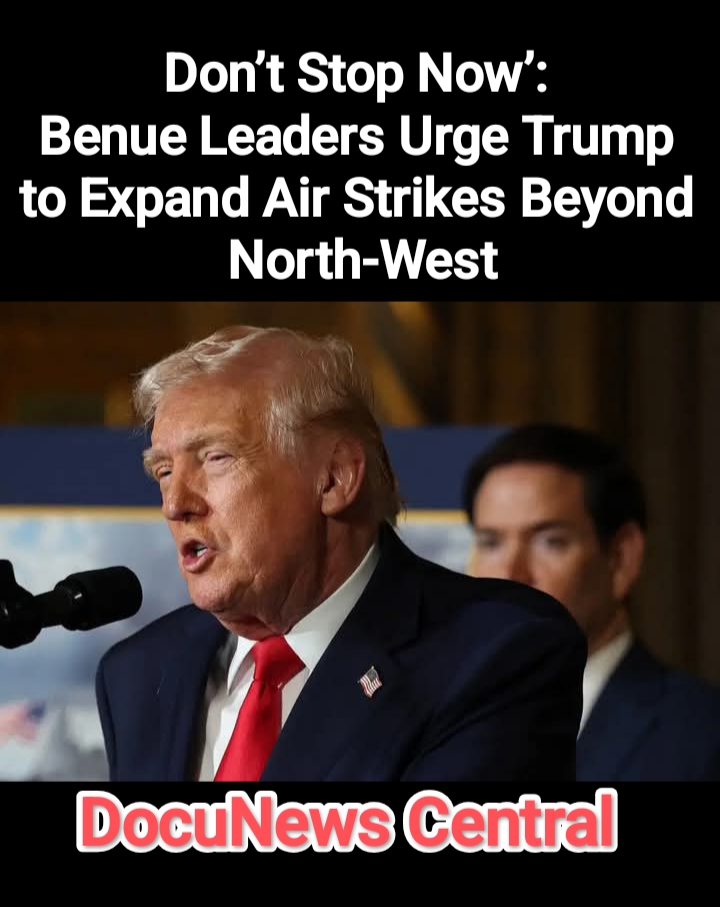
‘Don’t Stop Now’: Benue Leaders Urge Trump to Expand Air Strikes Beyond North-West
Don’t Stop Now’: Benue Leaders Urge Trump to Expand Air Strikes Beyond North-West Prominent leaders of tribal groups in Benue State have openly praised United States President Donald Trump for what they described as a decisive and courageous military action against terrorist groups operating in Nigeria’s North-West region. However, beyond their commendation, the leaders have made a strong appeal for the expansion of the air strikes to other troubled regions, particularly the North-East and North-Central zones, where violent attacks continue to claim lives and displace communities.
According to these leaders, the recent air operations have restored a sense of hope among Nigerians who have endured years of insecurity, fear, and uncertainty. They believe that sustained international military support, if properly coordinated with Nigerian authorities, could significantly weaken terrorist networks that have destabilized large parts of the country. Moreover, the leaders emphasized that immediate action would prevent terrorists from regrouping in other vulnerable areas.
This statement comes amid growing frustration among local communities who feel abandoned by prolonged security failures. Therefore, the endorsement from Benue leaders reflects a broader sentiment shared across several regions affected by insurgency, banditry, and communal violence. Furthermore, many residents have expressed that decisive intervention, combined with strategic planning, is the only way to restore normalcy to affected communities. Read also Terrorists from Mali Burkina Faso Storm Nigeria, Triggering U.S. Military Action
Benue Leaders Break Silence on Foreign Military Support
Speaking through a coalition of tribal and community leaders, representatives from Benue State noted that the air strikes carried out in the North-West sent a clear and strong message to terror groups that their activities would no longer go unchallenged. They stressed that decisive military action remains one of the most effective tools against heavily armed groups that exploit difficult terrains. In addition, they argued that the air strikes demonstrate what can be achieved when political will meets strategic military planning.
Moreover, the leaders encouraged wider international collaboration, noting that Nigeria’s security challenges have grown beyond local capacity, particularly given the sophisticated weapons now in the hands of non-state actors. Consequently, they emphasized that a combined effort between international partners and Nigerian authorities would deliver the most effective results. For more context on regional security efforts, readers can view our earlier coverage here.
While addressing journalists in Makurdi, a senior community leader observed that the strikes demonstrated what political will and advanced military intelligence could achieve. According to him, such actions must not remain limited to one region if Nigeria is to regain long-term stability. Furthermore, the leaders urged the federal government to continue strengthening collaboration with international allies while ensuring transparency in military operations. Read also “We Hit Them Hard”: Trump Confirms Lethal Military Strike Against Islamic State in Nigeria
“Don’t Stop Now” — A Clear Message to Washington
The phrase “Don’t stop now” featured prominently in the leaders’ appeal, capturing their desire for continuity rather than symbolic intervention. They argued that stopping at the North-West would allow terrorists to simply relocate and regroup in other vulnerable regions. As a result, the leaders urged that similar air operations be extended to the North-East, where insurgent groups such as Boko Haram and ISWAP have maintained a persistent presence.
At the same time, attention was drawn to the North-Central region, which has witnessed repeated attacks on farming communities. According to the leaders, ignoring these regions would undermine any gains achieved in the North-West. Furthermore, expanding air strikes would send a clear message to terrorists that no part of Nigeria is beyond reach. Consequently, broader action could reduce displacement, protect civilian lives, and restore public confidence.
Impact of Terrorism on Benue Communities
Over the years, Benue communities have endured waves of violence that forced thousands of residents to flee their homes. Villages were abandoned, farmlands destroyed, and livelihoods disrupted. According to community leaders, these attacks have eroded trust and weakened social cohesion. Moreover, repeated attacks have left psychological scars on residents, particularly children and women who bear the brunt of displacement.
In addition, many internally displaced persons remain in overcrowded camps with limited access to basic services. The leaders stressed that while humanitarian aid remains important, security must come first if displaced residents are to return home safely. As a result, the leaders emphasized that protecting civilians must remain a central priority in any military campaign. For insight on humanitarian responses, visit here.
Furthermore, fear has become a daily reality for farmers who once cultivated their land freely. Food shortages and rising prices have affected not only Benue but also neighboring states. Consequently, restoring security is essential not only for the safety of residents but also for the nation’s food supply and economy. Indeed, protecting agricultural zones in Benue ensures both social stability and national economic resilience.
Why the North-East and North-Central Matter
The leaders highlighted that the North-East remains one of the most volatile regions in Nigeria despite years of military campaigns. They explained that insurgents have adapted their tactics, often blending into civilian populations and exploiting porous borders. Moreover, these tactics make conventional military operations challenging, thus requiring advanced intelligence and precision air strikes.
Similarly, the North-Central region has become a hotspot for violent attacks, with clashes frequently reported between armed groups and rural communities. Ignoring these regions would undermine any gains achieved in the North-West. Therefore, the leaders argued that a comprehensive strategy, supported by international intelligence and air capabilities, could disrupt terror networks across multiple fronts. Furthermore, coordinated operations would prevent terrorists from exploiting weak points in national security.
Balancing Sovereignty and Security
While praising Trump’s actions, the leaders emphasized the importance of respecting Nigeria’s sovereignty. They stated that any foreign military involvement should occur through cooperation with Nigerian authorities and security agencies. Moreover, international support should strengthen Nigeria’s capacity rather than replace it. Training, intelligence sharing, and advanced surveillance were highlighted as key areas where the United States could play a constructive role.
At the same time, the leaders urged the Nigerian government to remain transparent and accountable in managing such partnerships. Clear communication and visible results, they argued, are essential for building public trust. Consequently, combining local oversight with international assistance would enhance operational effectiveness and legitimacy.
Public Reaction Across Nigeria
Reactions to the Benue leaders’ statement have been mixed across the country. While some Nigerians welcomed the call for expanded air strikes, others expressed concern about the long-term implications of foreign military involvement. Supporters argued that extraordinary security challenges require extraordinary measures, pointing to examples where international coalitions weakened terrorist groups elsewhere.
On the other hand, critics cautioned against overreliance on external forces. They stressed the need for institutional reforms within Nigeria’s security architecture to address root causes of insecurity. Therefore, many analysts suggest a dual approach: strong international collaboration alongside long-term domestic security reforms.
Internal Political Implications
The endorsement of Trump’s actions by Benue leaders also carries political implications within Nigeria. Analysts suggest that the statement reflects growing pressure on the federal government to adopt more aggressive and coordinated security strategies. Consequently, the call for expanded air strikes may influence public discourse ahead of key policy debates on defense spending and international partnerships.
As insecurity continues, political leaders face increasing demands to deliver tangible results. Therefore, the Benue leaders’ appeal could reshape conversations around security priorities at both state and federal levels. Moreover, it underscores the urgency of proactive governance in addressing threats before they escalate.
Expert Views on Air Power and Counterterrorism
Security experts have long debated the role of air power in counterterrorism operations. While air strikes can disrupt militant camps and supply routes, experts warn that they must be combined with ground intelligence and community engagement. According to analysts, air operations work best when supported by accurate intelligence and local cooperation.
Without these elements, the risk of civilian harm increases, potentially fueling further resentment. However, experts also acknowledge that air power provides critical support in areas where ground access is limited. Therefore, a balanced approach that integrates precision strikes, intelligence, and humanitarian considerations remains essential. For international perspectives, see BBC Africa and Al Jazeera Nigeria.
Regional Stability and International Interests
The leaders also pointed out that Nigeria’s security challenges have implications beyond its borders. Instability in one region can easily spread across West Africa, affecting trade, migration, and regional cooperation. As Africa’s most populous nation, Nigeria plays a key role in regional stability. Consequently, international partners have a vested interest in supporting efforts to restore peace.
Expanded air strikes, if carefully managed, could contribute to broader regional security objectives. In addition, sustained intervention would demonstrate global commitment to curbing terrorism and protecting human lives. Therefore, coordinated efforts are crucial for long-term stability in West Africa.
Humanitarian Concerns and Civilian Protection
Despite their support for military action, the Benue leaders stressed the need to protect civilians. They urged that any expanded air campaign prioritize precision and accountability. Additionally, they called for increased humanitarian assistance to communities affected by violence. According to them, rebuilding trust requires addressing both security and social needs.
Military action, they explained, should go hand in hand with reconstruction, reconciliation, and development initiatives. Consequently, a comprehensive strategy combining security, humanitarian relief, and social reconstruction would achieve lasting peace.
Looking Ahead: What Comes Next?
As calls for expanded air strikes grow louder, attention now turns to how policymakers in both Abuja and Washington will respond. The coming weeks may reveal whether the appeal from Benue leaders gains traction beyond public statements. Moreover, communities living under constant threat hope that decisive steps will prevent further loss of life and restore confidence in security institutions.
Ultimately, the situation highlights the urgency of a comprehensive approach that combines military strength, political will, and community resilience. Furthermore, it underscores the importance of balancing international assistance with Nigeria’s sovereignty and long-term stability goals.
DocuNews Central
