
Security
Sheikh Gumi Slams FG: ‘Why Run to the US When Pakistan, Turkey Are There?’

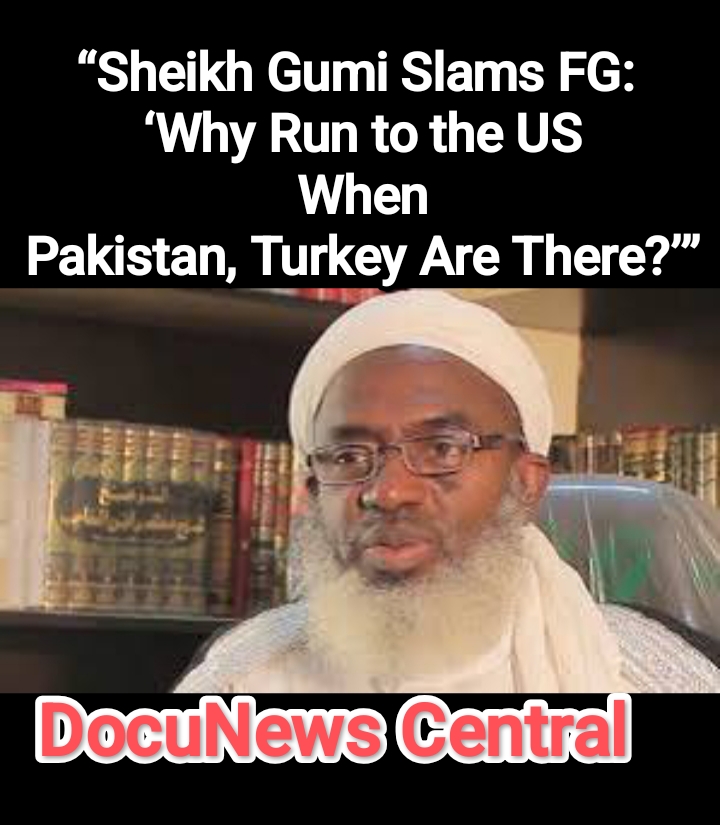
Sheikh Gumi Slams FG: ‘Why Run to the US When Pakistan, Turkey Are There?’
By DocuNews Central
Controversial Islamic cleric, Sheikh Ahmad Gumi, has once again ignited national debate after openly questioning Nigeria’s growing security engagement with the United States. According to the outspoken cleric, the Federal Government missed a strategic opportunity by seeking American military support instead of turning to countries like Pakistan, Turkey, and other nations with deep experience in counter-insurgency warfare.
Although Nigeria continues to battle terrorism, banditry, and cross-border insurgency, Sheikh Gumi believes the choice of allies matters as much as the weapons deployed. Therefore, his comments have sparked strong reactions across political, military, and civil society circles.
Importantly, this latest statement comes at a time when Nigeria’s security situation remains fragile, especially in the North-West and North-East. As a result, questions surrounding foreign military cooperation now dominate public discourse.
Sheikh Gumi’s Argument Against US Military Assistance
Speaking during a recent public engagement, Sheikh Gumi argued that the Federal Government rushed into partnerships with Western powers without fully evaluating alternative options. In his view, Pakistan and Turkey possess real-world experience that directly mirrors Nigeria’s security challenges.
According to Gumi, Pakistan has spent decades combating insurgent groups in difficult terrains, while Turkey has refined its military tactics through conflicts involving both internal and external threats. Consequently, he insisted that such nations understand asymmetric warfare better than the United States.
Furthermore, Gumi maintained that Western military involvement often comes with complex political conditions. Meanwhile, countries like Pakistan and Turkey, he said, approach cooperation from a more practical and culturally aligned standpoint.
This perspective, therefore, places Nigeria’s security diplomacy under intense scrutiny, especially as the country seeks sustainable solutions rather than short-term tactical wins. Also read this Gunmen Storm Odo-Ere Community In Kogi, Kidnap Four Residents
Why Pakistan and Turkey?
Sheikh Gumi explained that Pakistan’s military has long confronted extremist groups operating within civilian populations. As a result, Pakistani forces developed intelligence-driven methods that reduce collateral damage while weakening insurgent networks.
Similarly, Turkey has modernized its defense industry and invested heavily in drone technology, surveillance systems, and rapid-response units. Consequently, Turkish forces now operate with flexibility across diverse terrains.
Because Nigeria faces similar threats from mobile, lightly armed groups, Gumi believes such expertise would translate more effectively on Nigerian soil.
Moreover, Turkey’s growing defense exports to Africa further support his argument. In recent years, several African nations have adopted Turkish military hardware with measurable success.
For context, readers may recall similar debates raised in earlier security analyses published by DocuNews Central.
Read related analysis on foreign military involvement and Nigeria’s security challenges
Criticism of Western Military Strategy
Beyond naming alternative countries, Sheikh Gumi openly criticized Western military doctrine in African conflicts. According to him, Western nations often rely on overwhelming firepower rather than deep community engagement.
As he explained, such an approach sometimes worsens resentment among local populations. Consequently, insurgent groups exploit these grievances to recruit and expand.
In contrast, Gumi claimed that Eastern and Middle-Eastern military partners prioritize intelligence gathering, negotiation channels, and cultural sensitivity.
Although critics dispute this claim, the argument continues to gain traction among Nigerians frustrated by years of insecurity. Read Also US Airstrikes in Sokoto Push Terrorists to Flee here at www.docunewscentral.com
Government Silence and Public Reaction
So far, the Federal Government has not issued an official response to Sheikh Gumi’s remarks. Nevertheless, reactions across social media and traditional media platforms have remained intense.
While some Nigerians applauded Gumi for speaking frankly, others accused him of oversimplifying complex geopolitical realities.
Security analysts also weighed in, noting that military partnerships often involve long-term diplomatic considerations. Therefore, choosing allies extends beyond battlefield tactics alone.
Still, the timing of Gumi’s comments ensures they will remain part of the national conversation for weeks.
Historical Context of Nigeria’s Foreign Military Partnerships
Nigeria has historically worked with Western nations on defense cooperation. From training programs to intelligence sharing, these relationships date back several decades.
However, recent years have witnessed a shift as Nigeria explores broader partnerships. For example, Nigeria has increased defense engagement with China, Russia, and Turkey.
Therefore, Gumi’s comments align with a broader global trend where nations diversify security alliances to reduce dependency on a single power bloc.
Experts Weigh In
Defense experts argue that no single country holds all the answers to Nigeria’s security crisis. Instead, they recommend a balanced approach combining local intelligence, regional cooperation, and selective foreign support.
Nevertheless, many agree with Gumi on one point: Nigeria must prioritize partnerships that deliver measurable results.
As one analyst noted, “Military aid should solve problems, not prolong them.”
Religious Leaders and Security Discourse
Sheikh Gumi’s influence extends beyond religious circles. Over the years, his views on security matters have consistently generated national attention.
Although controversial, his interventions often force policymakers to confront uncomfortable questions.
Therefore, regardless of agreement or disagreement, his latest statement reinforces the growing role of non-state voices in national security debates.
Regional Implications
Nigeria’s security challenges affect the entire West African region. As insurgents move across porous borders, regional cooperation becomes essential.
Countries like Pakistan and Turkey, according to Gumi, understand this interconnected threat landscape.
Thus, he urged Nigeria to adopt a strategy that emphasizes regional intelligence sharing and cross-border coordination.
Global Perspective
Globally, many countries now reassess traditional military alliances. From the Middle East to Africa, governments increasingly seek partners based on operational success rather than historical ties.
Consequently, Sheikh Gumi’s remarks resonate beyond Nigeria, reflecting a broader geopolitical recalibration.
For additional global context on counter-insurgency strategies, readers can consult international defense analyses.
BBC World News – Global Security and Defense Coverage
Conclusion
Sheikh Gumi’s criticism of Nigeria’s reliance on US military assistance highlights deeper questions about strategy, sovereignty, and effectiveness.
While opinions remain divided, his call to consider Pakistan, Turkey, and similar nations underscores the urgency of finding solutions that work.
Ultimately, Nigeria’s security future depends on informed decisions, transparent policies, and partnerships that prioritize peace over politics.
As the debate continues, one fact remains clear: Nigerians demand results, not rhetoric.
DocuNews Central will continue to monitor developments.
