National
Police Arrest Prophet Over False Global Flood Alarm

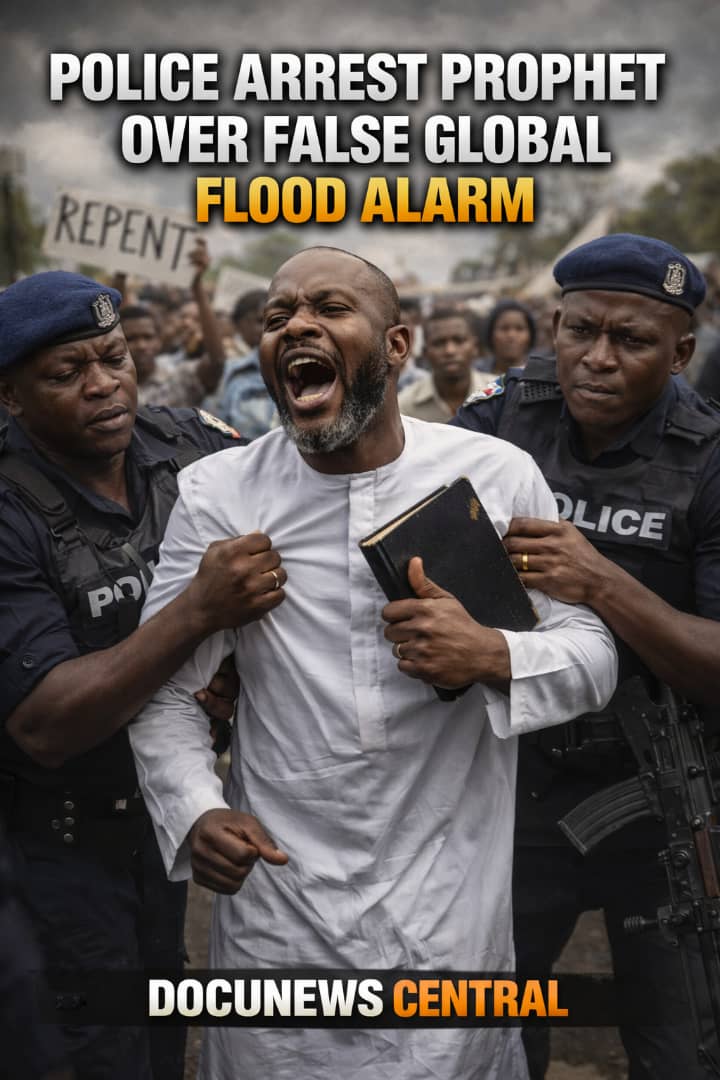
The arrest of a Ghanaian cleric following a failed prophecy has sparked widespread debate across religious, legal, and social circles. After a dramatic warning of a looming global flood circulated online, fear spread rapidly among followers and the wider public. When the predicted disaster failed to materialize, attention shifted sharply from prophecy to accountability. And this made a headline on DocuNews Central. Police Arrest Prophet Over False Global Flood Alarm
Authorities moved swiftly, citing concerns about public safety, misinformation, and emotional manipulation. Although prophetic messages remain common in many religious spaces, this case has reopened discussions about limits, responsibility, and the law.
As events unfolded, the issue grew beyond one man and one prophecy. Instead, it became a broader reflection of how faith, social media, and public order now intersect in modern Ghana. Read also Nigerian Air Force Deals Heavy Blow, Kills 2,351 Terrorists
How the Global Flood Alarm First Emerged
The controversy began when Prophet Ebo Noah released a message warning of a catastrophic global flood expected to begin on December 25. Through sermons, online videos, and shared audio messages, the prophecy spread quickly across WhatsApp groups, Facebook pages, and church networks.
At first, many listeners treated the message with caution. However, as the date drew closer, anxiety increased. Families reportedly canceled travel plans. Others stocked food and water. In several communities, fear replaced festive anticipation.
Meanwhile, the message gained international attention after Ghanaian diaspora communities began resharing the warning. As a result, what started as a local religious claim evolved into a viral global alarm.
Public Reaction to the Flood Prediction
Reactions varied widely. While some followers expressed unwavering belief, others voiced skepticism. Nevertheless, the emotional tone of the prophecy pushed many toward concern rather than calm reflection.
Importantly, several followers reportedly made financial donations after being told they were supporting spiritual preparations. Although donations were described as voluntary, critics later questioned the pressure placed on vulnerable believers.
As December 25 approached, tension intensified. News outlets began receiving inquiries. Social commentators joined the discussion. Religious leaders outside the prophet’s circle urged calm and discernment. People are reacting to this headline Nigerian Military Recovers Boko Haram Spy Drone in Borno
December 25 Comes and Goes Without Incident
When December 25 arrived, no unusual flooding occurred in Ghana or anywhere else in the world. Normal holiday activities continued. Weather agencies reported no abnormal patterns. Daily life resumed as expected.
For many followers, relief replaced fear. However, confusion followed closely. Questions surfaced almost immediately, particularly from those who had taken drastic actions based on the prophecy.
Shortly afterward, Prophet Ebo Noah addressed his followers again. This time, he claimed that God had postponed the flood after intercession and prayer.
Claim of Postponement Raises More Questions
The explanation of divine postponement failed to calm critics. Instead, it intensified scrutiny. Legal analysts, religious scholars, and civil society groups began examining whether such claims crossed ethical or legal boundaries.
While faith-based predictions often involve interpretation, public officials emphasized that fear-inducing messages could trigger real-world harm. Consequently, attention shifted from theology to public responsibility.
At this stage, the Ghana Police Service reportedly began monitoring the situation closely.
Police Arrest Prophet Over False Global Flood Alarm
Security authorities eventually detained Prophet Ebo Noah, citing allegations of causing public fear and spreading false information. According to police sources, the arrest followed complaints from concerned citizens and community leaders.
Law enforcement officials emphasized that freedom of worship does not include the right to incite panic. Therefore, the case was framed as a matter of public safety rather than religious persecution.
The arrest triggered mixed reactions. Supporters described it as an attack on faith. Meanwhile, others viewed it as a necessary step to discourage misinformation. Read also 8 Dead as Zamfara IED Blast Sparks Security Operation
Legal Grounds Behind the Arrest
Under Ghanaian law, individuals may face consequences for actions that deliberately or negligently create public disorder. Legal experts noted that spreading alarming falsehoods, especially during sensitive periods, could fall within that scope.
Although investigations remain ongoing, officials stressed that the case would follow due process. No formal conviction has been announced, and the prophet retains legal rights.
For more on Ghana’s legal framework, visit the Ghana Police Service official website.
Role of Social Media in Amplifying Fear
Analysts widely agree that social media played a central role in spreading the prophecy. Within hours, clips crossed borders and platforms. Algorithms rewarded engagement, not verification.
As a result, emotionally charged messages reached millions before authorities or fact-checkers could respond. This pattern mirrors similar incidents across Africa and beyond.
According to a report by BBC News, unchecked viral claims increasingly challenge public order in the digital age.
Religious Freedom Versus Public Safety
The arrest reignited an old debate. Where should society draw the line between belief and accountability? Religious freedom remains protected under Ghana’s constitution. However, that protection does not extend to actions that harm others.
Church leaders from various denominations urged balance. Many called for self-regulation within faith communities, emphasizing responsible preaching and ethical leadership.
Some pastors also reminded congregations that discernment remains essential, even within spiritual spaces.
Impact on Followers and Communities
Beyond legal implications, the incident left emotional scars. Some followers reported embarrassment and financial strain. Others struggled with shaken faith.
Community leaders have since organized counseling sessions and public discussions aimed at healing divisions. These efforts highlight the human cost of fear-driven messaging.
Importantly, trust once broken often takes time to rebuild.
Lessons for Religious Leaders
This episode serves as a cautionary tale for spiritual figures operating in the digital era. Words now travel faster than ever, and influence carries greater responsibility.
While prophecy remains a core belief in many traditions, transparency and humility help prevent harm. Religious scholars suggest that leaders should avoid fixed dates and catastrophic language.
Ultimately, credibility depends not only on faith but also on wisdom.
Government and Civil Society Response
In response to the incident, civil society groups renewed calls for digital literacy campaigns. They argue that citizens must learn how to evaluate extraordinary claims critically.
Meanwhile, government officials reiterated their commitment to protecting both freedom of worship and public safety.
Some advocacy groups have proposed clearer guidelines for online religious content, although such measures remain under discussion.
What Happens Next in the Case
As investigations continue, legal observers expect authorities to clarify charges and procedures. The outcome could set an important precedent.
Regardless of the final ruling, the case has already reshaped conversations about prophecy, influence, and accountability in Ghana.
Readers can follow broader regional developments through our internal coverage on public safety at Africa Security Updates.
Final Reflections on the Flood Prophecy Incident
The arrest of Prophet Ebo Noah did not occur in isolation. Instead, it reflected growing tension between belief systems and modern governance.
As society navigates faith in the age of viral content, responsibility becomes essential. Messages that inspire hope strengthen communities. Those that provoke fear risk breaking them.
Ultimately, the episode underscores a simple truth: words matter, especially when millions are listening.
