
Security updates Nigeria
U.S. Puts Nigeria on Notice Over Possible New Strikes.

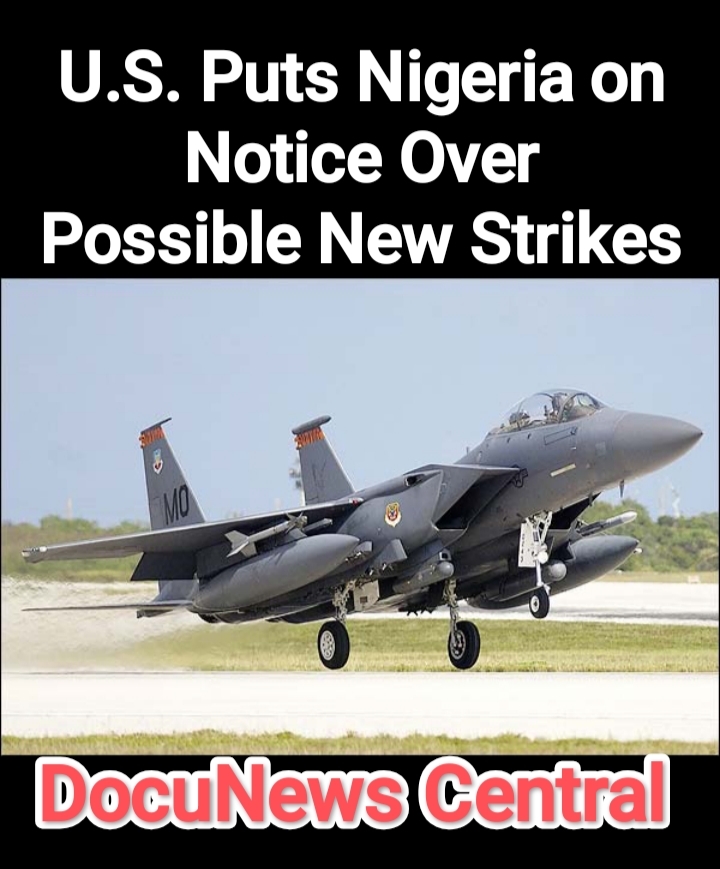
U.S. Puts Nigeria on Notice Over Possible New Strikes
By DocuNews Central | January 2026
The United States has placed Nigeria under renewed international attention after issuing a warning that suggests further military action could occur if emerging security threats persist. Although American officials avoided dramatic language, the message carried weight. It signaled a shift from routine cooperation toward firmer strategic positioning. And this made this headline. U.S. Warns Nigeria: Possible New Strikes on the Horizon
Across diplomatic circles, the statement immediately triggered debate. Security analysts, regional observers, and policy experts began assessing what the warning means for Nigeria’s sovereignty, counterterrorism efforts, and foreign relations. More importantly, Nigerians now face questions about how such external pressure could reshape internal security decisions.
While Washington stopped short of confirming any timeline or targets, the notice reflected growing impatience over unresolved extremist threats operating within parts of the country. As a result, both governments now walk a delicate line between collaboration and confrontation.
This report examines the context, implications, and potential outcomes of the U.S. warning, while separating verified facts from speculation. Read also Tragedy in Plateau: 7 Killed in Ongoing Jos Shooting
Why the U.S. Puts Nigeria on Notice Over Possible New Strikes
To understand the significance of the warning, one must examine the evolving security relationship between Nigeria and the United States. For years, both countries have maintained cooperation focused on intelligence sharing, training, and logistical support. However, recent developments appear to have strained that framework.
American officials have repeatedly expressed concern over the persistence of armed groups operating across northern and central regions. Despite Nigerian military operations, these networks continue to adapt, relocate, and recruit. Consequently, U.S. strategists worry about spillover risks affecting broader West African stability.
According to public briefings, Washington believes some threats now pose transnational dangers. That belief often triggers a more assertive posture. In similar past cases, such warnings preceded targeted actions rather than full-scale intervention. Before we moved on, have you seen this? Fresh U.S. Airstrike Reportedly Wipes Out 300 Terrorists in Zamfara
Still, analysts caution against jumping to conclusions. A notice does not automatically translate into imminent strikes. Instead, it often serves as leverage aimed at accelerating local action.
For background on U.S.–Nigeria defense cooperation, readers can explore this internal analysis on bilateral security ties.
Security Implications as the U.S. Puts Nigeria on Notice
The immediate impact of the warning lies in its psychological and strategic weight. Security agencies across Nigeria reportedly increased internal reviews, reassessing operational readiness and intelligence gaps.
When a global power signals potential action, it alters calculations at multiple levels. Military commanders evaluate vulnerabilities. Political leaders weigh diplomatic responses. Communities in affected regions brace for uncertainty.
Moreover, such notices can influence the behavior of armed groups themselves. Some factions may attempt to disperse or hide. Others could escalate activity to demonstrate resilience.
Experts emphasize that unintended consequences often accompany external military pressure. Airstrikes, even when precise, carry risks of civilian displacement and propaganda exploitation. For that reason, Nigerian authorities continue to stress the importance of sovereign-led solutions.
A detailed regional security overview is available via our internal West Africa security briefing.
Internationally, organizations such as the United Nations and African Union closely monitor such developments. Their positions often shape diplomatic outcomes following major security warnings.
For broader context, see reporting from Reuters and BBC News.
Diplomatic Reactions After the U.S. Puts Nigeria on Notice
Diplomacy now plays a central role in what follows. Nigerian officials responded cautiously, reaffirming commitment to counterterrorism while rejecting any implication of external enforcement.
Sources within diplomatic circles describe ongoing back-channel discussions. These talks aim to clarify expectations, timelines, and red lines. Such engagement often determines whether warnings de-escalate or harden.
Historically, Nigeria has resisted unilateral foreign military action within its borders. That stance reflects both constitutional principles and public sentiment. At the same time, Abuja recognizes the value of international partnerships.
Balancing these realities requires careful messaging. Strong rhetoric could inflame domestic opinion. Silence, however, might signal weakness.
Observers note that similar warnings in other regions ended with enhanced cooperation rather than conflict. Joint task forces, improved surveillance, and targeted arrests sometimes replaced air operations.
Statements from the U.S. State Department, available at state.gov, often provide clues about preferred outcomes. Many people are reacting to this headline Gunmen Invade Kwara Palace, Abduct Monarch, Son
What This Means for Nigerians on the Ground
Beyond diplomatic halls, ordinary Nigerians feel the ripple effects of international security decisions. Communities in vulnerable regions already live with uncertainty shaped by past violence.
A warning from the United States can heighten anxiety, even without immediate action. Rumors spread quickly. Markets react. Travel patterns shift.
Civil society groups urge transparency from authorities. They argue that clear communication reduces fear and prevents misinformation. In recent years, false reports have caused panic in several states.
Media literacy also plays a role. Responsible reporting helps citizens distinguish between verified announcements and exaggerated claims.
For updates on verified developments, readers can follow DocuNews Central’s security updates.
Regional and Global Stakes
Nigeria’s position as Africa’s most populous nation gives any security shift regional importance. Neighboring countries watch closely, aware that instability rarely respects borders.
Trade corridors, migration routes, and joint security initiatives could all feel secondary effects. Therefore, ECOWAS members maintain interest in how the situation evolves.
Globally, the warning reflects a broader trend of proactive counterterrorism postures. Major powers increasingly act early rather than react late.
However, critics argue that such strategies require strong local consent to succeed. Without it, operations risk long-term setbacks.
Policy research from institutions like the Council on Foreign Relations highlights these trade-offs.
Possible Outcomes Going Forward
Several paths remain possible. The warning could fade following reassurances and intensified Nigerian operations. Alternatively, it might lead to expanded joint missions.
A less likely scenario involves unilateral action, which would carry significant diplomatic costs. Most analysts view that option as a last resort.
Ultimately, outcomes depend on choices made in the coming weeks. Clear benchmarks, measurable progress, and sustained dialogue could ease tensions.
For now, uncertainty defines the moment. Yet history shows that warnings often serve as catalysts rather than conclusions.
Conclusion
The decision by the United States to place Nigeria on notice marks a critical juncture in bilateral security relations. While the language stops short of confirmation, its implications resonate widely.
Nigeria faces the challenge of asserting sovereignty while addressing shared threats. The United States seeks results without destabilizing a key partner.
As developments unfold, accurate information and measured responses will matter more than speculation. DocuNews Central will continue to provide verified updates and balanced analysis.