
Security
“Convert to Islam or Die”: ISWAP Burns Christian Village in Adamawa

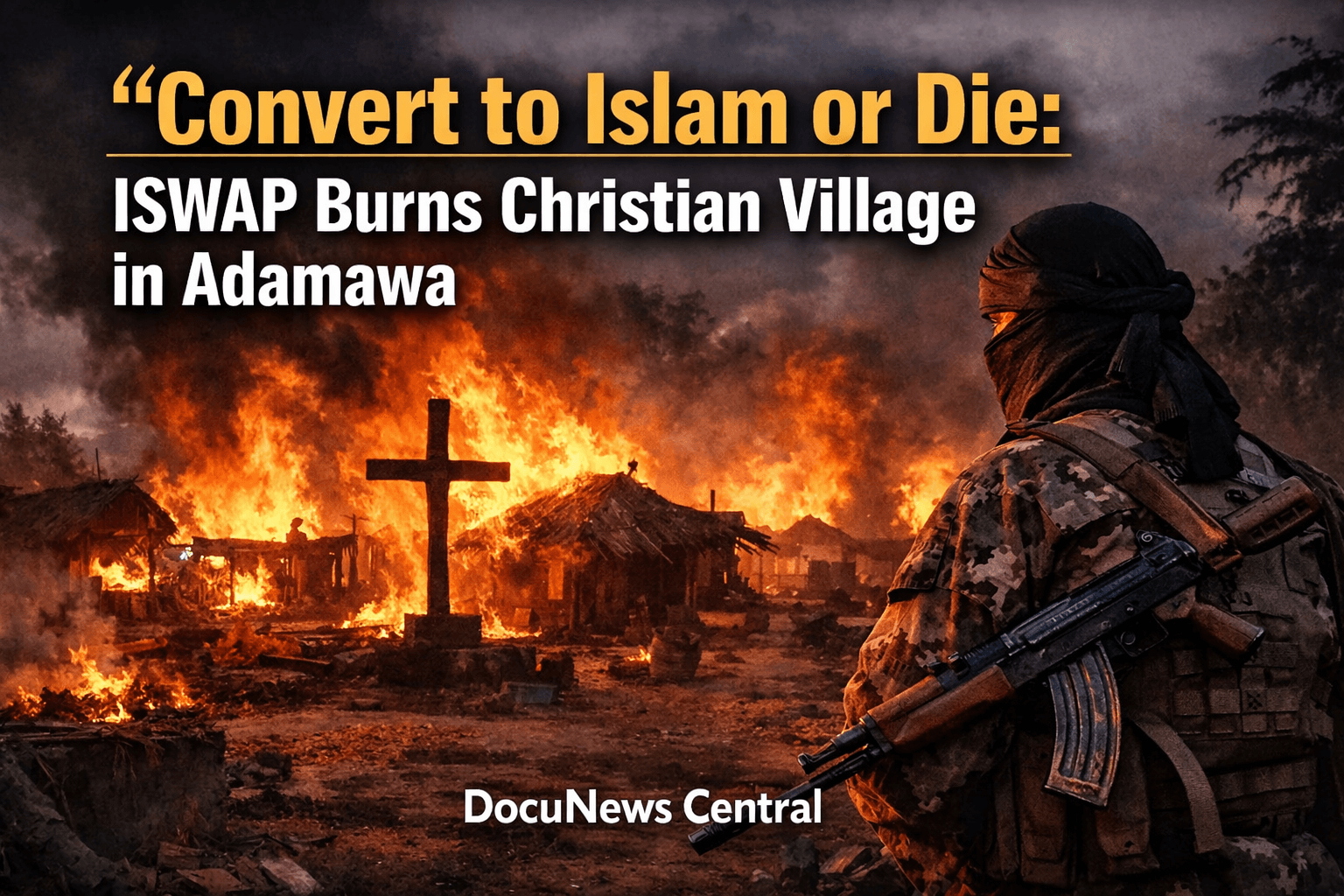
“Convert to Islam or Die”: ISWAP Burns Christian Village in Adamawa
“Convert to Islam or Die”: ISWAP Burns Christian Village in Adamawa has once again pushed Nigeria’s fragile security situation into the global spotlight. Residents of a Christian-dominated settlement in Adamawa State woke up to devastation after armed fighters linked to the Islamic State West Africa Province stormed the community, set homes ablaze, and delivered a message that many observers have described as both chilling and deliberate. According to local accounts and security sources, the attackers warned that Christians across Nigeria had become what they termed “legitimate targets.”
The assault did not happen in isolation. Analysts see it as part of a wider pattern of retaliation following recent joint military operations reportedly involving Nigerian forces and foreign partners in the country’s northwest. While Adamawa lies far from Sokoto, the symbolic value of the attack has drawn national attention. Faith leaders, security experts, and civil society groups now fear that extremist groups may be attempting to inflame religious tensions while testing the resolve of the state.
For many Nigerians, “Convert to Islam or Die”: ISWAP Burns Christian Village in Adamawa represents more than another headline. It reflects a persistent challenge that blends insurgency, ideology, and local grievances. Understanding what happened, why it happened, and what it means requires a careful look at the events on the ground and the broader security environment. Read also Netanyahu Israel PM and Trump Issue Stern Warning: Christian Persecution Will Not Be Tolerated
What Happened in Adamawa
Eyewitnesses described a coordinated night-time raid that began with gunshots and shouts, followed by fires spreading rapidly through homes built close together. Families fled into nearby bushes, carrying little more than the clothes they wore. By morning, large sections of the village stood in ruins. Community leaders later confirmed that the attackers focused on residential buildings, places of worship, and food stores.
Security officials familiar with the incident said the militants arrived in small groups, moving quickly and avoiding prolonged confrontation. This approach, according to analysts, reflects tactics refined over years of conflict in the Lake Chad region. Although Adamawa has experienced insurgent violence before, the explicit religious ultimatum issued during this attack has intensified concern.
Local authorities reported no immediate mass casualties, largely because residents escaped early. However, the destruction of livelihoods has created a humanitarian challenge. Displaced families now depend on relatives and temporary shelters, while aid groups assess urgent needs. People are reacting to this headline Plateau State: New Year Attack Leaves 7 Dead in Bum.
“Convert to Islam or Die”: ISWAP Burns Christian Village in Adamawa and the Ideological Message
“Convert to Islam or Die”: ISWAP Burns Christian Village in Adamawa was not only an act of violence but also a calculated statement. During the raid, militants reportedly told villagers that Christianity would no longer be tolerated in areas they consider under their influence. They offered three options: conversion, payment of a religious tax, or death.
Extremism researchers explain that such messaging serves multiple purposes. It reinforces loyalty among fighters, spreads fear among civilians, and attracts attention far beyond the immediate area. By framing the conflict in religious terms, the group attempts to justify violence while masking political and economic motivations.
Despite these threats, religious leaders across Nigeria have urged calm. Several church organizations released statements condemning the attack while calling for unity and restraint. Muslim leaders in the region also rejected the ultimatum, emphasizing that violence contradicts Islamic teachings. You may have missed this information Israel Supports US Force to Protect Christians, Jewish Allies in Nigeria
Security Context and Reported Retaliation
Many observers link the Adamawa incident to recent military developments elsewhere in the country. Reports of joint air operations in Sokoto State, allegedly targeting terrorist camps, circulated widely in the days preceding the attack. Although official confirmation remains limited, the timing has fueled speculation about retaliation.
Security analysts note that extremist groups often respond to losses by striking softer targets. Villages with limited security presence become vulnerable, especially when attackers seek symbolic impact. Adamawa’s proximity to long-standing insurgent corridors makes it strategically significant.
Government sources have not publicly confirmed a direct connection between the air operations and the Adamawa raid. However, officials acknowledged that insurgent groups remain capable of launching attacks across multiple regions.
“Convert to Islam or Die”: ISWAP Burns Christian Village in Adamawa and Its Impact on Communities
“Convert to Islam or Die”: ISWAP Burns Christian Village in Adamawa has left deep psychological scars. Survivors describe fear, uncertainty, and anger, but also resilience. Many insist they will rebuild, despite limited resources and ongoing insecurity.
Community elders explained that interfaith relations in the area had remained largely peaceful before the attack. Christians and Muslims lived side by side, sharing markets and social events. The raid, therefore, threatens to disrupt long-standing coexistence.
Human rights organizations warn that displacement could increase if similar attacks continue. They urge authorities to strengthen early-warning systems and protect vulnerable settlements.
Government Response and Military Strategy
Federal and state authorities condemned the attack and promised a swift response. Security agencies said they had deployed additional troops to surrounding areas and launched search operations. Officials also reassured residents that the government would not abandon them.
Critics, however, argue that reactive deployments often come too late. They call for sustained presence, intelligence sharing, and community engagement. According to defense analysts, defeating insurgency requires more than force; it demands trust and cooperation.
The military has recorded successes against extremist groups in recent years, particularly in degrading leadership structures. Yet the Adamawa incident highlights gaps that militants continue to exploit.
Regional and International Reactions
International observers expressed concern over the escalation. Advocacy groups monitoring religious freedom described the ultimatum as alarming. Some urged Nigeria’s partners to support efforts aimed at civilian protection rather than purely kinetic operations.
Nigeria remains a key ally in regional counterterrorism efforts. Cooperation with neighboring countries has disrupted cross-border movements, but porous terrain continues to pose challenges. Experts stress that sustained diplomatic and development support remains essential.
Several global media outlets have reported on “Convert to Islam or Die”: ISWAP Burns Christian Village in Adamawa, amplifying calls for accountability and humanitarian assistance.
Faith Leaders Speak Out
Christian leaders across Nigeria organized prayer vigils and relief efforts for the displaced community. They emphasized forgiveness while demanding justice. Statements from church bodies highlighted the need for equal protection of all citizens.
Prominent Muslim clerics also condemned the violence. They stressed that coercion has no place in faith and warned against allowing extremists to define religion. Such responses, analysts say, help counter attempts to polarize society.
Interfaith councils in Adamawa announced plans for dialogue sessions aimed at preventing reprisals and rebuilding trust.
The Broader Pattern of Insurgent Messaging
Extremist groups have increasingly used public threats to assert relevance. By issuing ultimatums, they aim to dominate narratives and overshadow military losses. Analysts caution that amplifying such messages without context can unintentionally serve propaganda goals.
Responsible reporting, therefore, requires balance. While the facts must be known, emphasis on resilience and unity can undermine extremist objectives. Many Nigerian communities have demonstrated this resilience over years of conflict.
“Convert to Islam or Die”: ISWAP Burns Christian Village in Adamawa stands as a reminder of the stakes involved.
What Comes Next for Adamawa
Rebuilding will take time. Homes, schools, and places of worship need reconstruction. Beyond physical structures, restoring confidence remains critical. Local leaders have called for permanent security posts and improved infrastructure.
Aid agencies plan assessments to determine food, shelter, and medical needs. They stress that timely assistance can prevent secondary crises such as disease outbreaks and hunger.
Residents say they want more than promises. They want visible action that ensures safety and dignity.
Internal and External Resources
For more background on Nigeria’s security challenges, read our in-depth analysis on Nigeria Security Updates. You can also explore our report on Religious Freedom in Africa.
External perspectives are available through reputable international outlets such as BBC News and Reuters Africa, which continue to monitor developments in the region.
Conclusion
“Convert to Islam or Die”: ISWAP Burns Christian Village in Adamawa has underscored the complex nature of Nigeria’s security crisis. The attack combined ideology, retaliation, and intimidation, leaving civilians to bear the cost. Yet it has also sparked voices of unity from across faith lines.
As Nigeria confronts ongoing threats, the path forward will depend on effective security, inclusive governance, and community resilience. The story of Adamawa is still unfolding, and its outcome will shape perceptions far beyond the state’s borders.
For now, the ashes of a village serve as both a warning and a call to action.
