
Security updates Nigeria
Air Force Jets Hit Bandit Strongholds, Destroy IED Factories

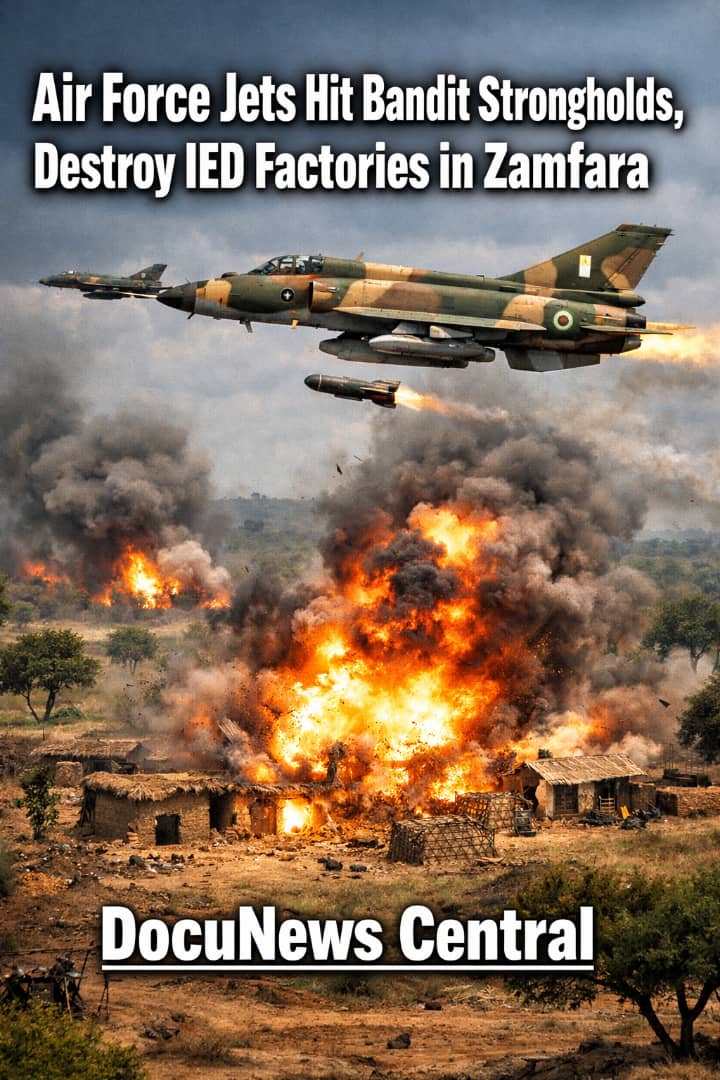
Zamfara Airspace Operation Signals New Phase in Anti-Bandit Campaign
On Tuesday, 6th January 2026, at exactly 6:15 a.m., Nigerian Air Force fighter jets carried out a coordinated air operation against deeply hidden bandit camps across Zurmi and Maru Local Government Areas of Zamfara State, in Nigeria’s North-West region. The early-morning strikes targeted forest enclaves long identified as command centres, logistics shelters, and improvised explosive device production locations used by armed groups operating across rural communities.
The timing of the operation reflected a calculated security decision. At that hour, civilian movement remained limited, while visibility conditions supported precision targeting. Military planners also relied on calm weather patterns recorded overnight, which reduced navigation risks and enhanced strike accuracy. As aircraft entered Zamfara airspace, surveillance assets monitored surrounding settlements to ensure civilian safety throughout the mission.
According to defence sources familiar with the operation, the strikes formed part of an intelligence-driven campaign designed to disrupt explosive manufacturing capabilities rather than respond only after attacks occurred. This approach marked a tactical adjustment in ongoing efforts to reduce roadside bomb incidents affecting both security personnel and local populations.
How Intelligence Shaped the Zamfara Mission
The air operation followed weeks of intelligence collection involving aerial reconnaissance, intercepted communications, and verified human sources. During late December 2025, security agencies recorded a spike in explosive-related incidents along the Gusau–Dansadau and Anka–Gummi road corridors. These incidents damaged patrol vehicles, disrupted commercial transport, and heightened fear among farming communities.
Analysts reviewing drone footage identified repeated night-time activity around forest clearings near Bagega, Mutunji, and surrounding settlements. Heat signatures revealed sustained use of concealed structures, while movement patterns indicated organised logistics rather than random encampments. Further analysis linked these locations to known supply routes feeding armed networks across central Zamfara.
In addition, intercepted communications suggested coordinated distribution of explosive materials to satellite camps. This intelligence prompted planners to prioritise production hubs rather than individual fighters. Disabling manufacturing sites, officials believed, would weaken attack capacity over an extended period and reduce recurring threats along major access routes.
Community-based information also played a role. Local vigilante groups, working under structured verification channels, provided guidance on abandoned areas and seasonal farming boundaries. This collaboration helped eliminate potential civilian exposure and improved confidence in strike decisions. Read also Unexploded Military Device Recovered in Zugurma, Niger State
Air Force Jets Hit Bandit Strongholds, Destroy IED Factories in Zamfara During Dawn Raids
The first wave of strikes began at 6:15 a.m., as aircraft engaged clustered structures hidden beneath dense tree cover. Infrared targeting systems confirmed the presence of volatile materials, while precision-guided munitions neutralised multiple compounds in rapid succession. Observers later reported secondary detonations, indicating the destruction of stored explosives and raw components.
By 6:42 a.m., a second wave focused on escape corridors linking the targeted camps to the Sububu Forest, a route frequently used by bandit commanders to evade ground patrols. Strike patterns disrupted motorcycle paths and narrow tracks carved through vegetation, limiting immediate mobility and complicating regrouping efforts.
Military briefings confirmed that communication equipment embedded within the camps ceased transmitting shortly after impact. Surveillance assets detected no organised counter-response, suggesting command disruption within the affected network. Throughout the operation, pilots avoided agricultural clusters located several kilometres from strike zones.
Following weapons release, aircraft remained on station to conduct real-time assessment. This monitoring allowed commanders to verify target neutralisation and detect secondary risks. No civilian structures were affected, and no distress signals emerged from nearby villages. Many people are reacting to this headline Gunmen Strike Oyo National Park Office, Kill Five
Community Reactions and Immediate Aftermath
Residents in surrounding communities reported hearing aircraft movement shortly after dawn. While the sound initially caused concern, local leaders confirmed that information channels quickly reassured villagers about the nature of the operation. By mid-morning, farming activities resumed in areas previously affected by fear of ambush.
Traders operating along the Anka–Gummi route observed increased patrol visibility later that day. According to transport operators, informal checkpoints that often appear after attacks did not materialise following the air operation. This absence suggested temporary disruption of bandit movement across the corridor.
Displaced residents expressed cautious optimism. Many acknowledged that aerial operations alone cannot guarantee long-term safety. However, they emphasised that destroying explosive workshops directly reduces the likelihood of sudden roadside attacks that have claimed lives in recent months.
Community representatives also stressed the importance of sustained security presence. In previous instances, abandoned camps were reoccupied when pressure eased. Therefore, local leaders urged authorities to maintain surveillance and ground coordination to prevent regrouping.
Strategic Importance of Disrupting Explosive Production
Security analysts consider the Zamfara operation significant because it targeted capability rather than individuals. Improvised explosive devices have become a defining feature of armed violence in North-West Nigeria. Their use extends beyond military targets, affecting commercial vehicles, humanitarian movement, and civilian convoys.
By focusing on production sites, security planners aim to create operational bottlenecks. Without access to explosives, armed groups struggle to maintain control over territory or intimidate communities. This disruption also reduces the need for constant convoy movement by security forces, lowering exposure to ambushes.
Furthermore, the operation reflects lessons drawn from previous counter-insurgency efforts in other regions. Sustained pressure on logistics networks often yields longer-lasting effects than reactive engagements alone.
Coordination, Rules, and Operational Discipline
Sources within Defence Headquarters confirmed that the mission followed strict operational protocols. Target coordinates underwent multiple verification stages, while rules of engagement prioritised civilian protection. Analysts reviewed satellite imagery to confirm the absence of markets, schools, or worship centres within strike radius.
Ground commanders monitored the operation through secure channels, allowing immediate adjustments if conditions changed. After the strikes, reconnaissance flights conducted battle damage assessments to evaluate effectiveness and detect signs of regrouping.
This layered coordination demonstrated increasing integration between air and ground components. Officials described the process as essential for sustaining credibility and maintaining public trust in security operations.
Historical Context of Zamfara’s Security Challenges
Zamfara State has faced persistent armed violence since 2018. Initially linked to cattle rustling and illegal mining disputes, criminal groups gradually evolved into organised networks with access to automatic weapons and explosives. Dense forests and porous borders facilitated expansion and limited early response efforts.
Although previous ground offensives disrupted some camps, terrain challenges constrained long-term success. Air operations now provide reach into areas previously inaccessible by road. However, experts caution that military pressure alone cannot resolve underlying drivers such as poverty, weak governance, and illegal resource extraction.
Consequently, many observers advocate a balanced approach combining security action with economic recovery, community engagement, and judicial reform.
Official Response and Broader Security Outlook
While authorities did not release casualty figures, defence officials confirmed that operational objectives were achieved. Federal authorities reiterated commitment to sustained operations across Zamfara, Katsina, and parts of Niger State, noting that intelligence-led actions would continue where threats persist.
For official updates on national defence activities, readers can visit the Ministry of Defence website:
For additional regional context and related reporting, see:
What the Zamfara Operation Means Going Forward
Security observers stress that sustained success depends on follow-up actions. Consolidating gains requires continued surveillance, ground patrols, and cooperation with local communities. Reduced attack frequency over coming weeks will serve as a key indicator of effectiveness.
For now, the 7 January 2026 Zamfara operation represents a deliberate attempt to weaken one of the most dangerous tools used by armed groups. By focusing on explosive production, authorities aim to restore safer movement and rebuild confidence among affected populations.