
Security updates Nigeria
NAF Intensifies War on Terror with Coordinated Airstrikes in Borno

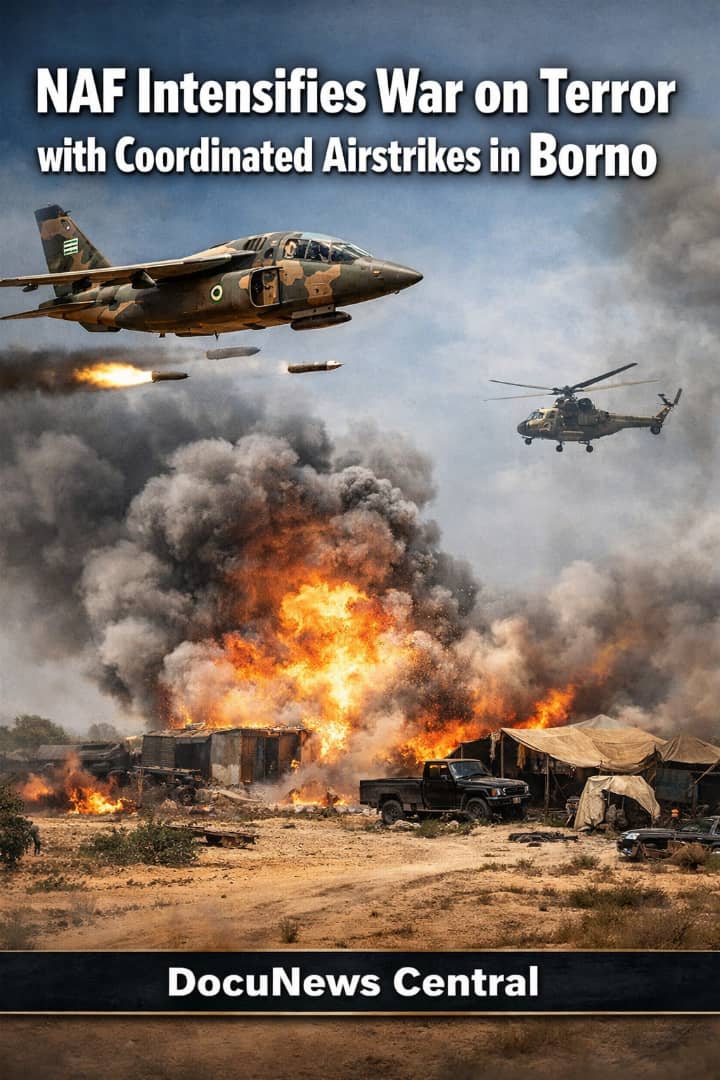
In a renewed push to weaken terrorist networks operating in Nigeria’s North-East, the Nigerian Air Force carried out a fresh wave of aerial operations against identified militant positions on Thursday, January 8, 2026. The operation focused on remote enclaves within the Abbagajiri area of the Timbuktu Triangle, a region long associated with insurgent movement, logistics, and regrouping.
According to military sources familiar with the mission, the air operations commenced during the early hours of the day, a timing deliberately chosen to limit civilian exposure while maximizing tactical advantage. As daylight approached, fighter aircraft executed precision strikes on structures believed to house active fighters, weapons caches, and mobility assets.
The development marks another chapter in the sustained security campaign designed to reclaim territories once exploited by extremist groups. While ground assessments continue, early indications suggest significant disruption of hostile activity across the targeted zone. You can read this also. “Release Him Now” Jewish Leader Tells FG. After Seeing Kanu
Why the Air Campaign Matters in the War on Terror
The renewed focus on air dominance reflects evolving battlefield realities. Terror groups operating in the North-East have increasingly relied on hard-to-reach terrain to evade security forces. However, air power offers a critical edge, particularly in areas where road access remains difficult.
Over the years, the Timbuktu Triangle has served as a convergence point for fighters transiting between forested zones and border communities. Therefore, security planners view sustained aerial surveillance and engagement as essential to breaking supply lines and command structures.
On January 8, intelligence units flagged unusual movement patterns around Abbagajiri. As a result, mission planners activated airborne assets after confirming the absence of civilian gatherings. This layered decision-making process highlights how intelligence-led operations now define modern counterterror efforts.
Moreover, air operations reduce prolonged ground engagements, which often expose troops and civilians to unnecessary risk. By neutralizing threats from above, security forces gain space to stabilize communities afterward.
Coordinated Airstrikes and Tactical Execution
The operation involved multiple aircraft operating in sequence rather than isolation. This structure allowed continuous pressure on selected targets while ensuring airspace control throughout the mission window.
Military analysts note that such coordination prevents escape routes and limits the ability of armed groups to reorganize mid-operation. Consequently, the likelihood of long-term impact increases.
Importantly, mission commanders adhered to strict engagement protocols. Surveillance feeds guided strike decisions in real time, while pre-mission risk assessments shaped weapon selection. This approach aligns with international best practices for conflict environments involving civilian populations.
Although damage assessments remain ongoing, initial reconnaissance suggests several makeshift camps and logistical points were rendered unusable. These outcomes, if confirmed, could reduce the operational reach of militants in surrounding communities.
Community Safety and Civilian Considerations
One of the most sensitive aspects of any security operation involves civilian safety. In the North-East, communities have endured years of instability, displacement, and trauma. As a result, security planners increasingly prioritize civilian protection alongside military objectives.
Prior to the January 8 mission, local monitoring reports indicated limited non-combatant presence in the strike zone. This intelligence influenced both timing and targeting decisions. Additionally, aircraft avoided residential clusters and known farming routes.
Following the operation, humanitarian partners began coordinating with local authorities to monitor potential displacement or secondary effects. This cooperation reflects a broader shift toward integrating security actions with humanitarian response planning.
For residents near Abbagajiri, the strikes brought mixed emotions. While many welcomed the pressure on armed groups, others expressed cautious hope that stability efforts would continue beyond aerial actions.
Military Strategy and Long-Term Security Goals
Security officials emphasize that air operations represent only one component of a wider stabilization framework. Ground forces, intelligence units, and civil authorities play equally vital roles in restoring lasting peace.
After aerial missions weaken hostile positions, ground patrols often follow to prevent reoccupation. These patrols also facilitate engagement with local leaders, allowing security forces to gather fresh intelligence and rebuild trust.
Furthermore, ongoing collaboration between the armed forces and regional partners strengthens border monitoring. Since militant groups frequently exploit porous borders, coordinated surveillance remains essential.
Defense observers argue that sustained pressure, rather than isolated actions, determines success. Therefore, continued vigilance across air and ground domains remains central to current planning.
NAF Intensifies War on Terror with Coordinated Airstrikes in Borno: Regional Impact
The January 8 operation resonates beyond its immediate tactical effects. It sends a signal to both hostile actors and affected communities that security agencies remain actively engaged.
For neighboring towns, reduced militant mobility could translate into safer travel corridors and improved access to markets. Additionally, aid organizations may find it easier to reach vulnerable populations when threats decline.
However, experts caution that long-term peace depends on governance, economic opportunity, and reconciliation efforts. Security actions create space, but other institutions must fill it.
As Nigeria continues to confront complex security challenges, balanced strategies that combine force with development remain crucial.
National Response and Public Communication
Public communication plays a significant role in maintaining confidence during security operations. Transparent updates help counter misinformation while reassuring citizens.
Following the January 8 mission, defense officials released a brief statement confirming the action without disclosing sensitive operational details. This measured approach aligns with security communication standards.
Media organizations, including Vanguard Nigeria and Premium Times, subsequently reported the development, emphasizing its strategic context.
For continued coverage on national security developments, readers can explore related reports on our security news section.
Looking Ahead: What Comes Next
While air operations on January 8 marked a decisive action, security officials stress that vigilance must continue. Intelligence collection remains active, with analysts monitoring movement patterns across forest corridors.
In the coming weeks, additional operations may follow if credible threats emerge. However, authorities reiterate that each action will depend on verified intelligence and civilian safety assessments.
Ultimately, restoring peace in affected regions requires patience, coordination, and sustained commitment. As security forces adapt to evolving threats, communities hope that stability efforts will yield lasting results.
The events of January 8 demonstrate how targeted action, when combined with strategic planning, can disrupt hostile networks while limiting broader harm.
Related Stories
- Fresh Bandit Attack Hits Egbe–Okoloke Road, One Abducted
- Nigerian Air Power Strikes Again as Terrorists Targeted in Borno
- Bandits Run Parallel Government, Tax Farmers ₦50,000 Each