
Security updates Nigeria
Army Confirms Surrender of 80 Militants in Cross River

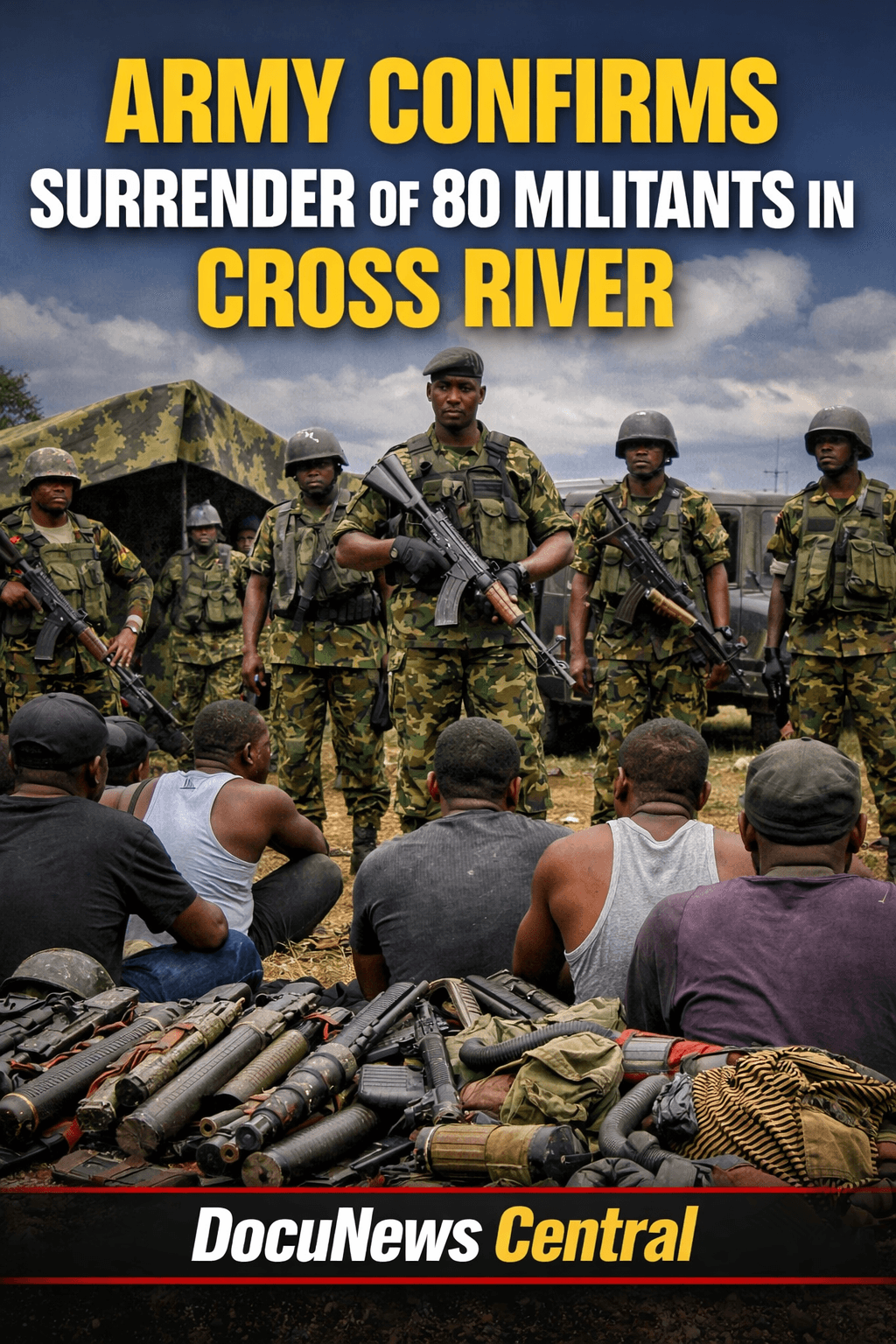
A turning point quietly unfolded in Nigeria’s coastal security landscape when armed groups that once operated beyond state control chose a path of disengagement, signalling a possible shift toward lasting stability.
In the early hours of Friday, 16 January 2026, at the Atimbo Rear Area under Operation OKWOK in Akpabuyo Local Government Area of Cross River State, a group of armed men emerged from the creeks and voluntarily presented themselves to the Nigerian Army as part of an ongoing peace and amnesty process.
Military authorities later confirmed that the exercise involved fighters previously linked to armed activities across riverine communities bordering Calabar and its surrounding waterways. The development followed sustained engagement between security agencies, community intermediaries, and state officials aimed at de-escalating long-standing tensions.
How the Surrender Exercise Took Shape
In the months leading up to the surrender, security forces adopted a strategy that balanced patrol operations with dialogue-driven outreach. Rather than relying solely on force, commanders prioritised intelligence sharing, community trust-building, and behind-the-scenes negotiations.
This approach eventually opened channels of communication with two armed camps operating within the creeks of Akpabuyo. Both groups agreed to participate in the state-supported amnesty framework, citing assurances of fair treatment and reintegration support.
One faction, led by ThankGod Ebikontei, also known locally as Ayibanuagha, accounted for 39 individuals. The second faction, led by John Isaac, popularly called Akpokolo, presented 41 individuals. His group has often been identified in the area as the Akpokolo Marine Forces, sometimes referred to by residents as the Border Boys.
Security personnel secured the area as each participant underwent initial screening. Observers described the process as calm and orderly, with no recorded incidents during the handover.
Weapons and Equipment Handed Over
During the exercise, the individuals surrendered a range of weapons and equipment previously used for operations within the creeks. These included assault rifles, pump-action guns, single-barrel firearms, ammunition, marine engines, speedboats, and explosive materials.
Military sources stated that all recovered items were carefully documented and transferred to appropriate custody in line with operational procedures. The removal of these weapons significantly reduced the immediate capacity for armed disruption in the area.
By eliminating access to mobility tools such as speedboats and engines, security planners believe the exercise has weakened the logistical networks that previously enabled illicit movements across the waterways.
Army Confirms Surrender of 80 Militants in Cross River and Its Local Impact
For residents of Akpabuyo and neighbouring coastal settlements, the development carries practical implications beyond official statements. Fishing routes and transport corridors that were once considered risky have gradually reopened, allowing daily economic activities to resume with reduced anxiety.
Community leaders say the absence of armed patrols along key waterways has improved movement for traders and small-scale business operators. While challenges remain, the immediate atmosphere reflects cautious relief.
Several residents noted that many of the former fighters were young men drawn into armed activity due to limited economic opportunities rather than ideological motivations. This understanding has influenced the design of post-surrender support programmes.
From Disarmament to Reintegration
Following the surrender, authorities transferred the individuals to the Rapid Response Team of the Cross River State Government. From there, the Department of State Services (DSS) began profiling at a designated facility in Calabar.
Profiling involves identity verification, background checks, and risk assessment. Officials say the process helps determine suitable reintegration pathways while ensuring public safety.
Participants are expected to undergo counselling, skills evaluation, and vocational placement. According to state officials, reintegration efforts focus on providing sustainable alternatives that reduce the likelihood of relapse into armed activity.
Why the Development Matters Beyond Akpabuyo
Although the event occurred within a specific local government area, its implications extend beyond Cross River. The state’s waterways connect to broader maritime and commercial routes, making stability in the region strategically important.
Reduced armed presence improves cooperation between neighbouring states and enhances maritime security coordination. Analysts say this contributes to broader efforts aimed at safeguarding trade corridors along Nigeria’s southern coastline.
Stability in the creeks also creates space for investment in fisheries, logistics, and eco-tourism—sectors that rely heavily on predictable security conditions.
The Role of Community Engagement
Traditional rulers, youth leaders, and community elders played a quiet but significant role in facilitating the surrender. Acting as intermediaries, they helped bridge trust gaps between armed groups and state institutions.
Their continued involvement is expected to support monitoring and conflict prevention at the grassroots level. Authorities believe local ownership of peace efforts remains critical to sustaining progress. Read also Major Victory: 11 Insurgents Surrender to Army in Borno State
Media Reporting and Public Confidence
Accurate and responsible reporting plays an important role at this stage. Balanced narratives help reinforce public confidence while discouraging misinformation that could undermine fragile gains.
For broader background on peace efforts in Nigeria’s coastal regions, readers can explore this resource: Conflict in the Niger Delta.
Looking Ahead
Security officials caution that the surrender marks a starting point rather than a conclusion. Sustained engagement, economic inclusion, and consistent policy implementation will determine whether calm endures.
Planned follow-up measures include expanded youth employment initiatives, community infrastructure projects, and continued dialogue between authorities and local stakeholders.
Conclusion
The voluntary disengagement that occurred in Akpabuyo Local Government Area on Friday, 16 January 2026 reflects a growing recognition that cooperation offers a more sustainable path than prolonged confrontation.
If matched with credible reintegration support and community trust, the development could reshape security dynamics not only in Cross River State but across Nigeria’s wider coastal corridor.
For verified national coverage on security developments, visit Punch Nigeria.
Related Stories:
- Major Victory: 11 Insurgents Surrender to Army in Borno State
- Where Do the Poor Go? Rising Attacks Leave Thousands Homeless
- Where Do the Poor Go? Rising Attacks Leave Thousands Homeless
- Twin Attacks: Bandits Kill Seven in Sokoto, IED Hits Zamfara
drover sointeru
January 24, 2026 at 9:40 pm
Thanks a lot for sharing this with all folks you actually understand what you are talking about! Bookmarked. Please additionally seek advice from my web site =). We can have a link change arrangement among us!