
Security updates Nigeria
U.S. Backs Nigeria with Targeted Military Support, Rules Out Permanent Bases

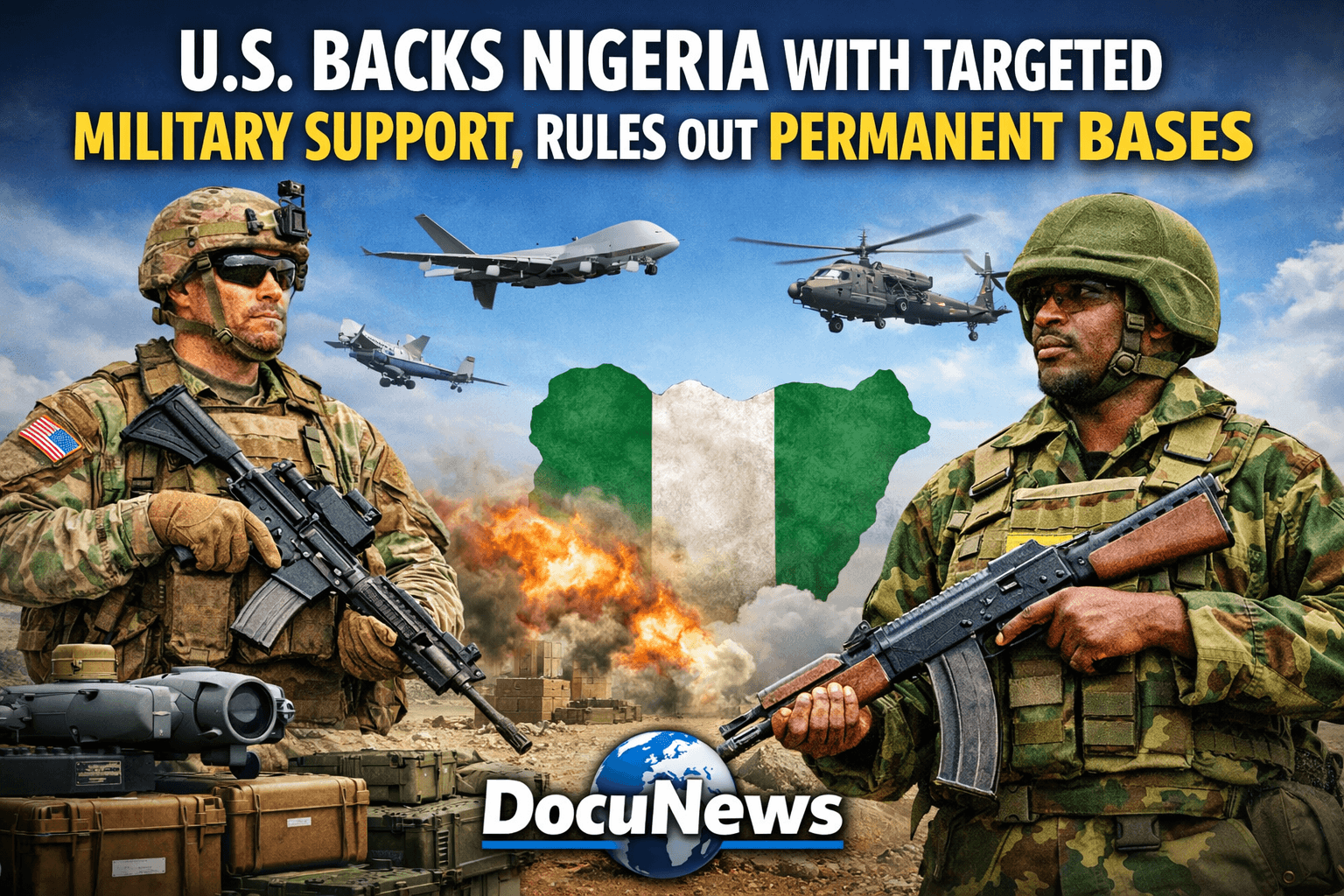
U.S. Backs Nigeria with Targeted Military Support, Rules Out Permanent Bases
The United States has taken a clear and impactful stance in supporting Nigeria’s fight against violent extremism, offering targeted military support, deepening intelligence cooperation, and simultaneously ruling out the establishment of permanent military bases on Nigerian soil. This evolution signals not just a tactical shift in U.S. foreign policy toward West Africa but a strategic blend of military precision, diplomatic restraint, and respect for national sovereignty. For Abuja, this means critical support without compromising its autonomy. For Washington, it means addressing interconnected jihadist threats stretching from West Africa to the Sahel without overextension.
To unpack the significance of this policy shift, understanding the historic timeline, operational decisions, and diplomatic context is essential.
Photo credit Visit Disclaimers: Use Of AI Images In Our Newsletters
Date and Location: December 25, 2025, Sokoto State, Northwest Nigeria.
On that day, U.S. forces carried out precision strikes against militant camps linked to the Islamic State West Africa Province (ISWAP) and associated jihadist groups, in coordination with the Nigerian government, marking a critical moment in the security partnership between the two nations. These targeted strikes did not involve the deployment of U.S. troops as permanent garrison forces. Instead, they reflected a focused strategy designed to disrupt extremist networks while avoiding the political and social complications of long‑term foreign bases on African soil. Wikipedia – 2025 United States strikes in Nigeria, Africanews – U.S. pledges delayed equipment to Nigeria
Why This U.S.–Nigeria Security Partnership Matters
This cooperation comes amid one of Nigeria’s most severe and prolonged security crises. Over the years, various extremist groups—including Boko Haram factions and Islamic State affiliates—have exploited weak governance, porous borders, and socio‑economic instability to expand their reach across northern and central regions. Violent attacks, kidnappings, and ambushes have caused immense suffering and displaced millions.
However, the U.S. policy of targeted support has enabled a calibrated response that aims to strengthen Nigeria’s own military capacity. This format contrasts sharply with bygone eras in which foreign powers maintained sprawling base networks across strategic regions. Instead, the United States has increasingly focused on temporary, capability‑enhancing support that enables partner forces to take the lead. In speeches and briefings, U.S. military officials have repeatedly said that no permanent bases will be established under this approach.
Read also Peace Deal Collapses as Bandits Kill Two, Abduct Over 50 Women in Katsina
Historic Background: Nigeria’s Security Challenges and U.S. Engagement
Nigeria’s struggle against jihadist groups has spanned years. Boko Haram and its splinter, Islamic State West Africa Province (ISWAP), have waged insurgencies since 2009. Over time, they have adapted their tactics, shifting across Nigeria’s northeast and expanding into the northwest and central regions. The New Humanitarian – Boko Haram resurgence
This multifaceted insurgency has brought international attention. Yet, Nigeria has consistently insisted it does not want foreign forces controlling its territory, even as it accepts external support. By the time the Trump administration took up the mantle again in 2025, Abuja had already dealt with decades of insecurity and was cautious about any foreign military footprint that might infringe on its sovereignty.
In 2025, high‑level conversations between Nigeria and U.S. officials intensified. In May 2025, Nigeria’s Minister of State for Defence, Dr. Bello Mohammed Matawalle, called for enhanced U.S. support in intelligence sharing, technical training, and logistics support. He met Major General Garrick Harmon, Director for Strategy, Engagement, and Programs of U.S. Africa Command (AFRICOM) to discuss deeper collaboration. Nigeria Ministry of Defence – Nigeria appeals for U.S. support
These discussions laid the groundwork for later decisions, including precision strikes and expanded equipment deliveries.
People are reacting to this Troops Bust Illegal Arms Factory in Nasarawa, Arrest Suspect
Targeted Military Support vs. Permanent Bases
One of the most pivotal aspects of the U.S. approach has been clarity around its long‑term intentions. Senior U.S. military leaders in 2026 emphasized that their aim was to deliver capacity and capability, not to erect permanent foreign installations in West Africa. In January 2026, U.S. Army Lieutenant General John Brennan, Deputy Commander of AFRICOM, restated that the United States was not seeking to establish drone bases or garrisons in Nigeria or other West African states. Instead, the focus remains on temporary, goal‑oriented missions and long‑term partner empowerment.
This strategy was partly influenced by local sentiment. Many Nigerian leaders—political figures and civic advocates—have stressed that permanent foreign bases would undermine sovereignty and risk political backlash. For example, in November 2025, Nigerian commentator Olufemi Ajadi Oguntoyinbo warned against military bases in Port Harcourt, arguing they could threaten sovereignty and economic stability. AllAfrica – Nigeria warns against militarising Port Harcourt
For Abuja, external support is welcome—but not in the form of entrenched military outposts on its soil.
You may have missed this Zamfara APC Denies Links to Bello Turji
December 2025 Precision Strikes: Details and Coordination
On December 25, 2025, U.S. forces struck militant camps in Sokoto State—an operation widely reported in global media and confirmed by official sources. The strikes targeted Islamic State affiliates, including ISWAP fighters and local jihadist associates. The U.S. action did not occur unilaterally. Nigeria’s federal government publicly confirmed that President Bola Tinubu had authorized the operation and that Nigerian intelligence and operational input had guided the mission. Channels Television – Tinubu authorized joint operation
Foreign Minister Yusuf Tuggar underscored that coordination with U.S. forces was deliberate and structured. He reiterated Nigeria’s stance that the initiative was not intended to single out religious communities but to combat jihadist threats. Wikipedia – 2025 United States airstrikes on the Islamic State in Nigeria
The operation used precision tools such as cruise missiles, reportedly launched from U.S. naval platforms in the Gulf of Guinea, and was designed to hit select targets with minimal collateral damage. Journalistic sources indicate the strikes hit multiple targets and involved a broad security coordination framework between Abuja and Washington. WSWS – U.S. launches Christmas Day missile strikes in Nigeria
Intelligence Sharing and Equipment Deliveries
Beyond kinetic strikes, the United States has ramped up intelligence sharing and equipment deliveries to Nigeria’s armed forces. In January 2026, AFRICOM announced the delivery of critical supplies to Nigeria in Abuja. These included drones, helicopters, tactical platforms, and spare parts—all aimed at strengthening Nigeria’s ability to fight extremist groups independently. BusinessDay NG – U.S. hands over military equipment
This intensifying cooperation reflects both nations’ shared interest in tackling jihadist violence without resorting to permanent foreign military footprints.
Diplomatic Context and Tensions
While cooperation has strengthened, it has not been without diplomatic tension. In late 2025, the U.S. labeled Nigeria a “Country of Particular Concern” over alleged violence against Christians, drawing criticism from Nigerian officials who argued the security crisis affects all Nigerians regardless of faith. This designation complicated relations and highlighted the complexities of framing Nigeria’s multifaceted security challenges. News24 – Nigeria enlists U.S. lobbyists to explain Christian protection efforts
In response, Nigerian leaders stressed collaborative, respectful engagement. At the same time, civil society leaders offered a range of reactions. Some religious figures lauded U.S. strikes as necessary, while others warned against overreliance on foreign intervention. America Magazine – Mixed religious reactions to U.S. strikes
Nigeria’s Own Security Operations
Even as the U.S. assists, Nigeria continues its own military campaigns against terrorism and banditry. In January 2026, Nigerian troops freed scores of hostages and killed militants in separate operations across northwest states—a testament to Nigeria’s ongoing commitment to securing its territory. Reuters – Nigerian troops free 62 hostages
However, security challenges remain acute, as separate ambushes have left military personnel and police officers dead in Zamfara State, underscoring the persistent, complex nature of Nigeria’s crisis. AP News – Ambush in northwest Nigeria kills security personnel
Regional Security and the Sahel Connection
The U.S.–Nigeria cooperation occurs in a broader regional context. Violent extremist groups across the Sahel and West Africa have exploited political instability and governance gaps to expand their networks. According to the Council on Foreign Relations, groups like ISWAP and Jama’at Nusrat al‑Islam wal Muslimeen (JNIM) have increased attacks across borders, creating a security vacuum that demands cross‑border coordination. CFR – Violent Extremism in the Sahel
This context underscores why the United States sees a need to engage but without permanent basing: the threat is fluid, transnational, and best met through flexible, partner‑led cooperation.
Why No Permanent Bases?
Despite increased collaboration, U.S. officials have repeatedly stated they will not build permanent military bases in Nigeria. This stance is rooted in several considerations:
- Respect for Nigerian sovereignty: Permanent bases are often viewed as infringements on autonomy.
- Political sensitivities: Bases can become flashpoints in domestic debates about foreign influence.
- Flexible response: Temporary, targeted missions allow the U.S. to allocate resources where they matter most without long‑term deployments.
This approach resonates with both Nigerian leaders and broader regional preferences for cooperation over occupation.
Looking Forward: What to Expect
As 2026 unfolds, the U.S.–Nigeria partnership will likely deepen, especially if jihadist threats persist or evolve. Intelligence sharing, materiel support, and coordinated operations will remain central. Yet the essential framework—targeted support without permanent military bases—appears stable and mutually accepted.
Security experts emphasize that while external support can help blunt violent extremist threats, long‑term peace in Nigeria will require political reform, economic opportunity, and social cohesion. Militarised responses alone cannot solve deep‑rooted challenges. However, by strengthening Nigeria’s capacity and respecting its sovereignty, the current U.S. approach aims to strike a necessary balance.
Conclusion
The United States’ targeted military support for Nigeria, combined with enhanced intelligence cooperation and a commitment to avoid permanent bases, represents a significant evolution in U.S. foreign policy toward West Africa. This strategy reflects a nuanced understanding of the region’s security dynamics and the need to respect partner nation sovereignty while confronting shared threats. For Nigeria, this cooperation strengthens its ability to defend its citizens. For the United States, it represents a model of focused engagement—one that prioritises capability building over occupation.
For Security Updates In Nigeria Visit Security updates Nigeria