
Breaking news
Nnamdi Kanu Appeals Life Sentence, Seeks Overturn of Conviction

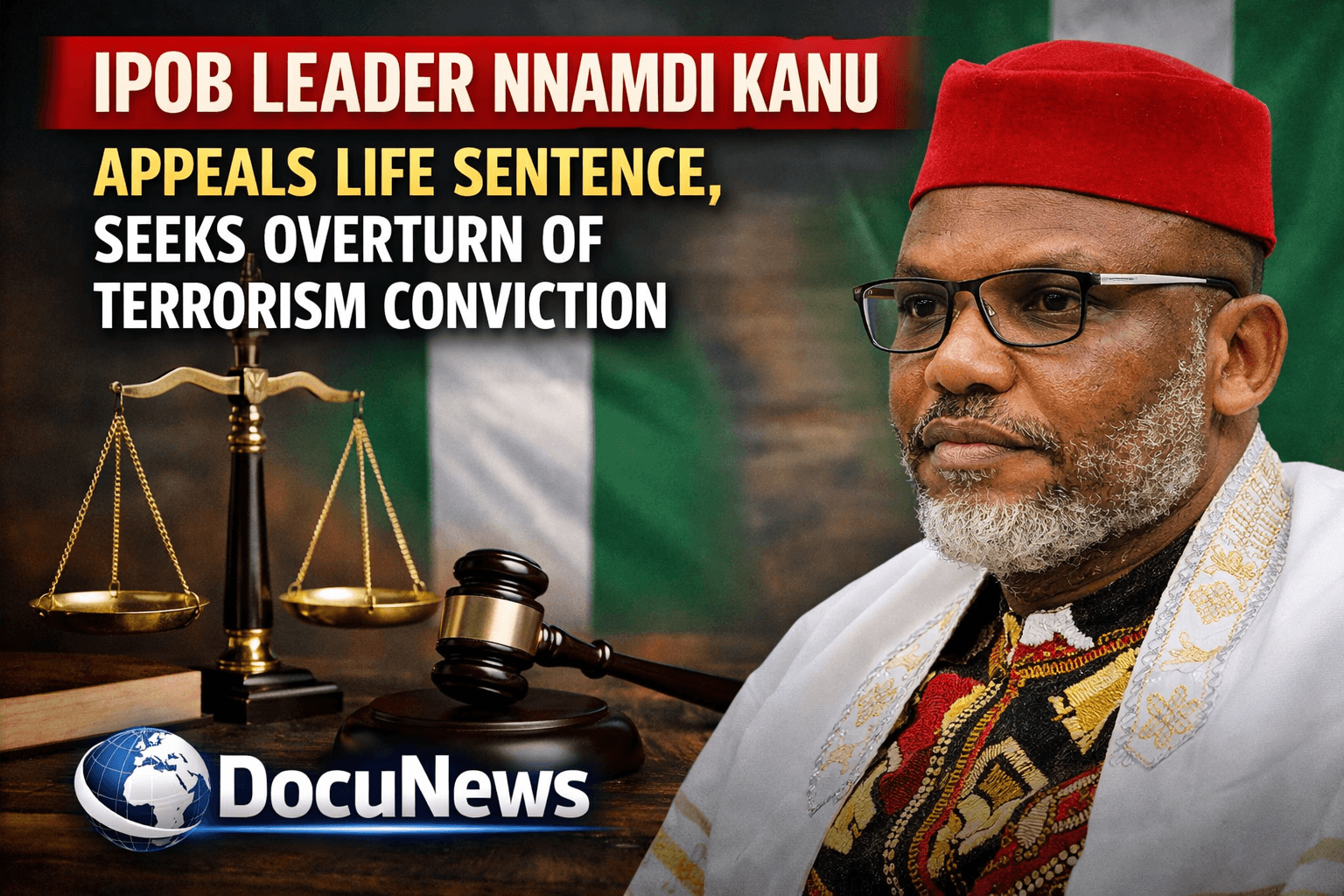
Nnamdi Kanu Appeals Life Sentence, Seeks Overturn of Conviction has emerged as one of Nigeria’s most consequential legal stories in recent years, According to DocuNews Central, this has drawned intense attention from legal experts, political observers, civil society groups, and ordinary citizens alike. This appeal signals a dramatic escalation in Nnamdi Kanu’s long-running confrontation with the Nigerian state and has reopened national conversations about justice, constitutional rights, and the boundaries of political expression.
On February 4, 2026, Nnamdi Kanu formally lodged his appeal at the Court of Appeal, seeking to overturn the life imprisonment imposed by the Federal High Court in November 2025. Through his legal team, Kanu asked the appellate court to nullify both his conviction and sentence, arguing that the trial suffered from serious legal defects and constitutional violations.
The report reaching Us at DocuNews Central suggest that the filing immediately reignited debate across the country. While supporters described the move as a long-awaited opportunity for justice, critics insisted that the conviction reflected the gravity of the allegations. Nevertheless, one fact remains clear: the outcome of this appeal could reshape how terrorism laws are interpreted and applied in Nigeria.
How the Case Reached This Critical Stage
To understand the significance of this appeal, it is essential to revisit the events that led to Kanu’s life sentence. Nnamdi Kanu, leader of the Indigenous People of Biafra (IPOB), has remained a polarizing figure for over a decade. His activism, media broadcasts, and advocacy for self-determination in southeastern Nigeria placed him at the center of political controversy long before his most recent conviction.
After his initial arrest in 2015, Kanu’s case passed through several judicial phases. Court appearances, bail hearings, and adjournments followed. In 2021, he was rearrested abroad and returned to Nigeria, a development that further complicated legal proceedings and attracted international attention.
By November 2025, the Federal High Court in Abuja delivered its long-awaited judgment. Justice James Omotosho convicted Kanu on seven counts connected to terrorism, incitement, and affiliation with a proscribed organization. Prosecutors alleged that his public statements and directives contributed to violent disturbances in parts of the country.
Although federal authorities initially sought the death penalty, the court ultimately imposed life imprisonment. That decision, however, failed to settle the controversy. Instead, it intensified public scrutiny and prompted immediate legal preparations for appeal.
Human rights advocates quickly questioned the process. Several lawyers argued that sections of the Terrorism Prevention Amendment Act cited during trial had already been repealed. Others raised concerns about jurisdiction and fair hearing.
International organizations such as Amnesty International have long emphasized that terrorism prosecutions must comply strictly with due process standards. Their broader position underscores why Kanu’s appeal resonates beyond Nigeria’s borders.
Read more about his case Visit Social Issues & Protests
Inside the Appeal: Core Legal Arguments
Kanu’s appeal rests on more than twenty grounds. His legal team argues that the trial court relied on outdated statutes, failed to properly evaluate evidence, and violated constitutional safeguards. According to court filings, the defense maintains that several procedural errors undermined the integrity of the judgment.
First, the appeal challenges the legal foundation of the conviction. Kanu’s lawyers insist that parts of the legislation applied during trial were no longer in force, rendering the charges defective from the outset. This argument alone, they contend, should compel the appellate court to quash the ruling.
Second, the defense asserts that the court lacked proper jurisdiction due to irregularities in how charges were framed. They also argue that Kanu did not receive a fully impartial hearing, citing limitations placed on cross-examination and evidentiary presentation.
Third, the appeal disputes the prosecution’s narrative linking Kanu directly to acts of violence. His lawyers maintain that speeches and broadcasts were interpreted selectively and that no concrete proof established operational control over alleged attacks.
Consequently, the appeal requests one of three outcomes: a complete dismissal of the case, a reversal of conviction, or alternatively, a retrial under appropriate legal provisions.
For Security Updates In Nigeria Visit Security updates Nigeria
Public Response and National Debate
Following confirmation of the appeal, reactions flooded social media, radio stations, and town halls. In southeastern Nigeria, community leaders urged calm while encouraging supporters to allow the courts to do their work.
Elsewhere, opinions remained sharply divided. Some Nigerians argued that national security concerns justified the original verdict. Others countered that justice must never compromise constitutional protections.
Civil society organizations called for restraint, warning that inflammatory rhetoric could escalate tensions. Political analysts noted that the appeal could influence regional sentiment ahead of future electoral cycles.
Meanwhile, online discussions revealed deep frustrations over governance, accountability, and the rule of law. For many citizens, the case symbolizes broader struggles within Nigeria’s justice system.
For ongoing updates and in-depth reporting on this and similar stories, readers can follow coverage on DocuNews Central, which continues to document major legal and political developments across the country.
Growing International Interest
Beyond Nigeria, Kanu’s appeal has drawn attention from legal scholars and policy observers abroad. Comparisons have emerged with other high-profile cases involving separatist movements and counterterrorism frameworks.
The International Bar Association has consistently highlighted the challenges courts face when balancing free expression with security concerns. Their research provides important context for understanding why cases like Kanu’s attract global scrutiny.
International media outlets, including the BBC’s Africa desk (BBC Africa), continue to track Nigeria’s evolving legal landscape, emphasizing the broader implications of appellate rulings in politically sensitive trials.
These perspectives reinforce one reality: Kanu’s appeal is no longer just a domestic matter. It now forms part of a wider conversation about justice and human rights in complex political environments.
What the Court of Appeal Will Examine
With the appeal officially filed, attention has shifted to the Court of Appeal in Abuja. A panel of judges will review the trial record, examine legal submissions from both sides, and determine whether errors occurred that justify overturning the verdict.
The court will assess whether the Federal High Court applied the correct laws, respected procedural requirements, and evaluated evidence fairly. Judges will also consider constitutional questions raised by the defense.
If the appellate panel finds substantial flaws, it may quash the conviction entirely. Alternatively, it could order a retrial. Should the appeal fail, Kanu still retains the option of approaching Nigeria’s Supreme Court, potentially extending the legal battle into 2027 or beyond.
Security agencies have already increased monitoring in sensitive regions to prevent unrest linked to the proceedings. Authorities continue to emphasize the need for peaceful engagement while the judicial process unfolds.
Political Ramifications of the Appeal
Beyond the courtroom, Kanu’s appeal carries significant political implications. IPOB has long shaped discourse around self-determination in southeastern Nigeria, and developments in this case inevitably influence regional sentiment.
Lawmakers from different parties are watching closely. Some believe the appeal could prompt legislative review of terrorism statutes. Others argue that judicial independence must remain insulated from political pressure.
Political economists also warn that prolonged uncertainty may affect investor confidence, particularly if tensions disrupt commercial activities in key urban centers.
At the same time, grassroots organizations have intensified calls for dialogue, urging government officials to explore peaceful pathways alongside legal remedies.
Human Rights Concerns and Constitutional Questions
Kanu’s appeal has revived discussions about civil liberties in Nigeria. Rights groups argue that terrorism laws should never override constitutional guarantees of fair hearing and proportional punishment.
Many advocates highlight international standards that stress transparency, judicial independence, and humane sentencing. They contend that life imprisonment represents an extreme measure that demands rigorous legal justification.
Conversely, families affected by violence linked to IPOB insist that accountability remains essential. They argue that victims deserve justice and that courts must deter future unrest.
This tension illustrates Nigeria’s broader struggle to reconcile security imperatives with democratic values.
Nigeria’s Wider Security Landscape
The appeal arrives amid persistent security challenges across Nigeria. From insurgency in the northeast to banditry in the northwest, communities continue to grapple with instability.
Against this backdrop, analysts stress the importance of clear communication from authorities to prevent misinformation surrounding Kanu’s case. Experts also emphasize community engagement as a stabilizing force during sensitive legal moments.
Several policy think tanks argue that sustainable peace requires not only enforcement but also inclusive dialogue and economic development.
Economic and Social Dimensions
The uncertainty surrounding Kanu’s legal future also carries social and economic consequences. Markets in parts of the southeast have experienced intermittent slowdowns whenever tensions rise.
Business leaders urge calm, noting that stability remains critical for regional growth. Religious organizations have joined calls for peaceful coexistence, emphasizing unity despite political differences.
Educational institutions, meanwhile, continue to encourage students to focus on academics while civic leaders manage unfolding developments.
Expert Perspectives on the Road Ahead
Legal analysts predict that the appeal process will be meticulous. Appellate courts traditionally review terrorism convictions carefully, especially when constitutional issues are raised.
Some experts believe the case could set precedents affecting future prosecutions involving political movements. Others caution against speculation, noting that outcomes depend entirely on judicial interpretation.
Regardless of the verdict, observers agree that transparency will be crucial in maintaining public trust.
Conclusion
The appeal by IPOB leader Nnamdi Kanu marks a defining chapter in Nigeria’s contemporary legal history. More than a procedural step, it represents a broader reckoning with justice, governance, and national cohesion.
As the Court of Appeal considers arguments over jurisdiction, evidence, and constitutional compliance, millions of Nigerians await clarity. Whether the conviction stands or falls, the ruling will likely influence future interpretations of terrorism laws and political dissent.
For citizens at home and abroad, this case underscores the enduring importance of fairness, accountability, and the rule of law.
Stay informed through trusted platforms such as DocuNews Central as this historic legal battle continues to unfold.
Leonor Bishopp
February 9, 2026 at 12:27 pm
It’s really a great and helpful piece of information. I am glad that you shared this helpful information with us. Please keep us up to date like this. Thank you for sharing.