
Security
Boko Haram Sent A Warning letter to Kwara Community Deadly Massacre

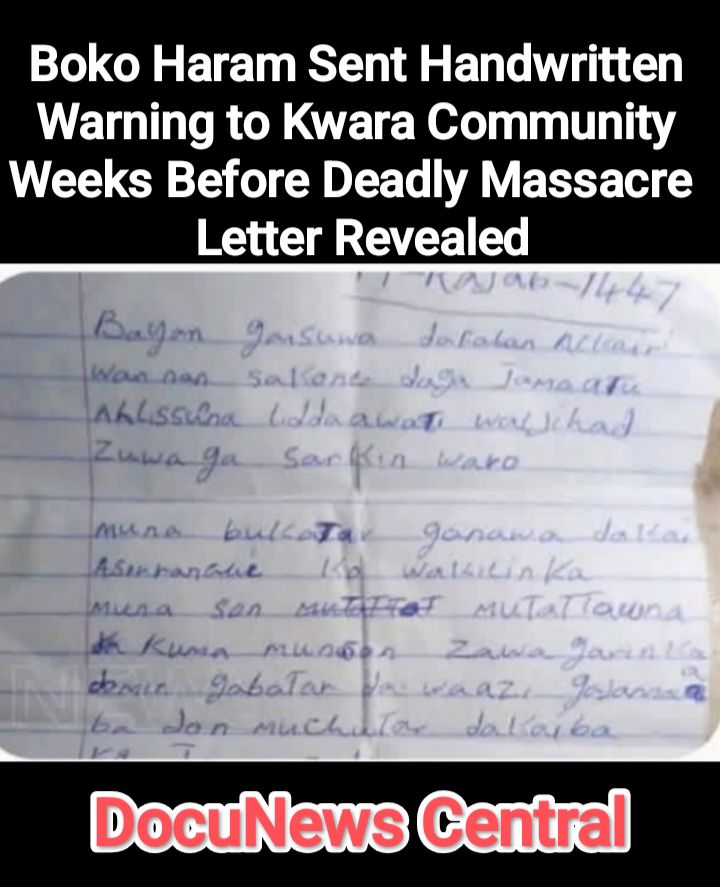
Boko Haram Sent A Warning Letter to Kwara Community Some Weeks Before Deadly Massacre. This has sent shockwaves across Nigeria. The said letter was allegedly delivered by the group representative to residents of Woro community in Kwara State some weeks before a brutal attack that left many dead and majority displaced. What initially appeared to be a calm request for dialogue later became a chilling signal of impending massacre, exposing serious gaps in early-warning response and rural security protection.
The said letter, dated January 8, 2026, and was addressed to the district head of Woro in Kaiama Local Government Area, Kwara State. It was Written in Hausa language and signed in the name of Jama’atu Ahlis Sunna Lidda’awati wal-Jihad, the content of the letter requested a meeting to discuss matters of preaching and guidance. At the beginning, the message did not trigger widespread alarm. But, weeks later, heavily armed bandits stormed the community, leaving families shattered and homes devastated.
Today, the resurfacing of that handwritten note has raised painful questions about missed warning signs, delayed intervention, and the evolving tactics of Boko Haram as it expands beyond its traditional northeastern strongholds.
The Early Contact That Later Turned Deadly, A massacre
According to DocuNews Central, the handwritten letter was quietly delivered through intermediaries familiar with the area. The message claimed the group wanted peaceful engagement and clearly stated there was no intention to declare war. Instead, it proposed dialogue centered on religious guidance and community outreach.
But Sadly it becomes the opposite, yes the assurance proved deceptive.
Several weeks after the letter was received, armed militants arrived in large numbers on motorcycles and pickup trucks. They surrounded Woro and nearby settlements in Kaiama, blocking escape routes and cutting off access roads. Gunfire echoed through the night as residents fled in panic. By morning, dozens of villagers had been killed, while women and children were forcibly taken away.
Survivors and eye witness, later described scenes of chaos and helplessness. Some hid in nearby bushes for hours panicking and trembling. Others escaped barefoot to neighboring towns, leaving behind homes, farms, and relatives.
For More Security Updates In Nigeria Visit Security updates Nigeria
Residents Say Early Warnings Were Ignored
According to DocuNews Central, the reports from Community leaders revealed that concerns had been raised long before the massacre. Suspicious movements were noticed in surrounding forests, and unfamiliar faces were frequently seen passing through remote farmlands. Local representatives said reports were sent to security agencies, while appeals were also made to traditional authorities.
Despite these warnings, no permanent security presence was established in the area, security forces ignored the warnings. Residents now believe decisive action during that period could have changed the outcome.
One elder said villagers felt abandoned after repeated pleas for patrols went unanswered. Another resident explained that people lived in fear for weeks, sensing danger but lacking protection. This perceived neglect has fueled widespread anger across Kwara State, with citizens questioning how such a coordinated attack could occur despite prior alerts.
The Night of Horror
The assault reportedly began in the early evening, just as families were settling indoors. Gunmen entered the community from multiple directions, searching houses and dragging residents outside. Several victims were reportedly tied before being killed at close range. Homes and small shops were set ablaze, livestock was seized, and food supplies were looted.
By dawn, entire households had been wiped out. Bodies were found across residential compounds and farmlands. Human rights groups later confirmed that most victims were civilians, including farmers, traders, and elderly residents.
The psychological impact has been overwhelming. Children who survived now struggle with trauma. Parents mourn sons and daughters. Many survivors say the sound of gunfire still haunts their sleep.
Government Response and Public Outrage
Following the massacre, federal authorities ordered the deployment of additional troops to Kaiama and surrounding communities. Security checkpoints were mounted, while aerial surveillance was reportedly increased. President Bola Tinubu condemned the killings and vowed that the perpetrators would be brought to justice.
However, public confidence remained low. Critics argued that reactive deployments were not enough and stressed that rural communities need permanent protection rather than temporary military visits after tragedies occur.
Security forces later launched coordinated operations across forest routes linking Kwara with Niger State. Temporary forward bases were established, while joint patrols searched suspected hideouts. Several individuals were reportedly questioned as intelligence gathering intensified.
Attention also turned to locating abducted women and children. Families gathered daily seeking updates as hunters and local vigilantes assisted soldiers with search operations. Some escapees later returned, providing information about movement routes and temporary camps used by the attackers.
Authorities confirmed that investigations were opened into how the handwritten warning letter was handled. Law enforcement agencies began reviewing communication records to determine whether standard threat response procedures were followed.
Read Also Terror Attack Rocks Kwara: Community Deserted as Monarch and Survivors Flee for Safety
Boko Haram’s Expanding Reach
For years, Boko Haram operated mainly in northeastern Nigeria, particularly Borno, Yobe, and Adamawa states. Recently, splinter factions have pushed into North-Central regions, including Niger and Kwara, using forest corridors as operational bases.
Security analysts believe this expansion reflects pressure on insurgents in the northeast and their search for new territory. Some experts also warn of growing cooperation between Boko Haram elements and other extremist networks in West Africa.
More background on the group’s history can be found on Wikipedia’s Boko Haram overview: https://en.wikipedia.org/wiki/Boko_Haram
The Deceptive Strategy Behind the Letter
The handwritten warning highlights a disturbing shift in tactics. Instead of launching immediate attacks, militants now test communities through indirect contact. Letters framed as peaceful outreach are used to assess reactions, identify leadership structures, and gather intelligence.
Security experts say such deception makes it harder for villagers to distinguish between genuine dialogue and terror planning, underscoring the need for faster intelligence sharing between communities and national agencies.
Humanitarian Crisis After the Massacre
Thousands of residents were displaced almost overnight. Many families sought refuge in neighboring towns or temporary shelters. Food shortages emerged as farmlands were abandoned, while schools closed indefinitely.
Humanitarian organizations urged the government to provide emergency relief, trauma counseling, and long-term rebuilding support. Amnesty International also called for accountability and protection of vulnerable communities: https://www.amnesty.org/en/location/africa/west-and-central-africa/nigeria/
Community Resilience and Calls for Accountability
Despite the devastation, survivors have begun rebuilding. Volunteers cleared debris, faith leaders organized counseling sessions, and women’s groups supported widows and orphaned children. Youth associations helped restore damaged homes and shared food with displaced families.
At the same time, traditional rulers, legal advocates, and civil society groups demanded accountability. They called for hearings to examine security failures and insisted that justice must extend beyond arresting gunmen to include officials who ignored credible warnings.
The Role of Independent Media
Independent platforms such as DocuNews Central continue to document these events, ensuring victims are not forgotten and authorities remain under public scrutiny. Accurate reporting plays a vital role in highlighting early warning failures and pushing for reforms.
Looking Ahead
The revelation that Boko Haram sent a handwritten warning to the Kwara community weeks before the massacre changes the narrative. This was not a sudden attack. It was planned. It was preceded by contact. And it was allowed to unfold.
As Nigeria mourns, attention must now shift toward prevention. Communities need protection. Intelligence must be acted upon. Rural lives must matter as much as urban ones.
Until these changes occur, fear remains that Woro may not be the last community to receive a quiet letter before loud gunfire.
For broader insights into terrorism trends worldwide, readers can also explore the Global Terrorism Index: https://www.visionofhumanity.org/maps/global-terrorism-index/
Ultimately, the handwritten warning stands as painful evidence of missed opportunities — and a powerful reminder that early action saves lives.

Charlsie Meile
February 9, 2026 at 11:03 am
You are my inspiration , I have few blogs and rarely run out from to post .