

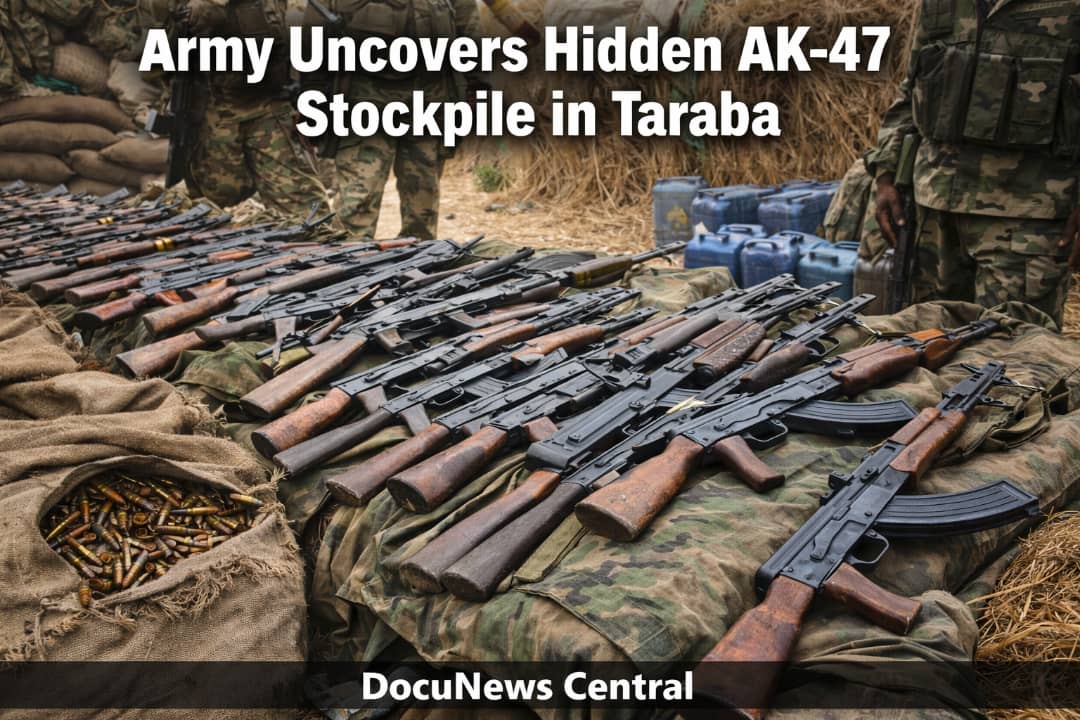
A carefully coordinated military operation in northeastern Nigeria has triggered fresh conversations about arms trafficking, internal security, and the complex networks that sustain criminal dominance in rural communities. Over several weeks, intelligence officers tracked unusual movement patterns across remote settlements, monitored silent supply routes, and gathered testimonies from residents who had grown uneasy with unfamiliar faces appearing after dusk. And a headline was made “Army Uncovers Hidden AK-47 Stockpile in Taraba”
Eventually, these quiet efforts produced a breakthrough. Soldiers moved decisively, cutting off escape paths and sealing key access roads before dawn. What followed was not a random sweep, but a targeted mission shaped by layered intelligence, community insights, and digital surveillance. The operation exposed how deeply organized crime had embedded itself within the region, raising urgent questions about accountability and local complicity.
Security analysts believe the discovery reflects a broader shift in military strategy. Rather than relying solely on reactive patrols, commanders increasingly favor intelligence-led actions that dismantle supply chains before violence erupts. This approach, they argue, reduces civilian risk while weakening criminal influence at its roots.
Residents in affected communities expressed relief after years of silent fear. Many described nights punctuated by distant gunfire and unexplained roadblocks that restricted movement. Although few dared to speak openly before the raid, local leaders now acknowledge that coordinated action restored a measure of confidence.
According to regional security observers, the operation also demonstrates how collaboration between federal forces and grassroots informants can change outcomes. While military hardware and manpower remain vital, trust and information sharing often decide success or failure in volatile zones. Read also Catholic Mission House Burnt as Terrorists Kill 42 in Niger State
Hidden AK-47 Stockpile and the Intelligence Trail
Investigators traced the arms cache through a web of indirect signals rather than a single tip. Analysts noticed repeated short visits by intermediaries to isolated compounds, followed by unexplained absences lasting several days. Satellite imagery later confirmed subtle changes around the area, including newly disturbed soil and reinforced storage spaces.
Once these patterns aligned, field operatives deployed discreet observation teams. They documented supply handoffs, mapped movement schedules, and confirmed identities linked to prior incidents across neighboring states. This patient groundwork allowed troops to act with precision, avoiding unnecessary confrontation.
During the operation, officers recovered multiple assault rifles, explosives, and ammunition packaged for rapid distribution. Specialists safely secured each item before transport to a controlled facility for forensic review. Early assessments suggest the weapons originated from multiple sources, indicating a well-established procurement network rather than a single supplier.
Military spokespeople emphasized that such recoveries rarely occur by chance. Instead, they result from layered intelligence cycles involving analysis, verification, and coordinated field execution. By disrupting storage points, forces reduce the likelihood of sudden attacks while complicating criminal logistics.
Security experts warn that arms trafficking remains adaptive. When one route collapses, alternatives often emerge. However, sustained pressure combined with financial tracking can gradually dismantle these systems, particularly when local cooperation persists. People are reacting to this headline too Fresh Bandit Attacks in Zamfara and Niger Leave Dozens Dead, Travellers Abducted
Taraba and the Expanding Security Challenge
The region has long faced intersecting pressures from banditry, communal tensions, and cross-border crime. Vast terrain, limited infrastructure, and economic hardship create openings for illicit activity. Criminal groups exploit these gaps by offering protection, employment, or intimidation depending on circumstance.
In recent years, authorities intensified patrols along known corridors while expanding intelligence units trained to analyze financial flows and communication patterns. These measures aim to anticipate threats rather than merely respond after damage occurs.
Community leaders argue that security interventions must pair with development initiatives. Without improved access to education, livelihoods, and justice mechanisms, young people remain vulnerable to recruitment by violent networks promising quick rewards.
Government officials insist that progress depends on sustained cooperation across agencies. Military action alone cannot resolve systemic instability. Instead, coordinated policy, economic investment, and judicial enforcement must work together to deliver lasting calm.
Observers also note the psychological impact of decisive operations. Visible enforcement reassures civilians while signaling to criminal actors that concealment no longer guarantees safety.
The interception of close associates linked to the network further illustrates how law enforcement now targets facilitators alongside combatants. By disrupting support structures, authorities aim to prevent regrouping efforts.
Legal experts highlight that successful prosecution will require meticulous evidence handling. Proper documentation ensures that cases withstand judicial scrutiny, reinforcing public trust in the rule of law.
Meanwhile, humanitarian groups call for protection of innocent families affected by enforcement actions. They stress that safeguarding civilian dignity strengthens long-term cooperation with authorities.
For ongoing coverage of national security developments, readers can explore related reports on our security desk.
Additional background on regional arms trafficking trends is available through international crime research bodies.
As investigations continue, analysts expect further disclosures. Each recovered cache provides insight into evolving tactics, financial backers, and regional linkages. While challenges persist, officials maintain that intelligence-driven operations represent a critical step toward restoring stability.
Ultimately, the success of such efforts depends not only on military resolve but also on societal resilience. When communities, institutions, and enforcement agencies align, the space for organized violence narrows significantly.


One thought on “Army Uncovers Hidden AK-47 Stockpile in Taraba”