

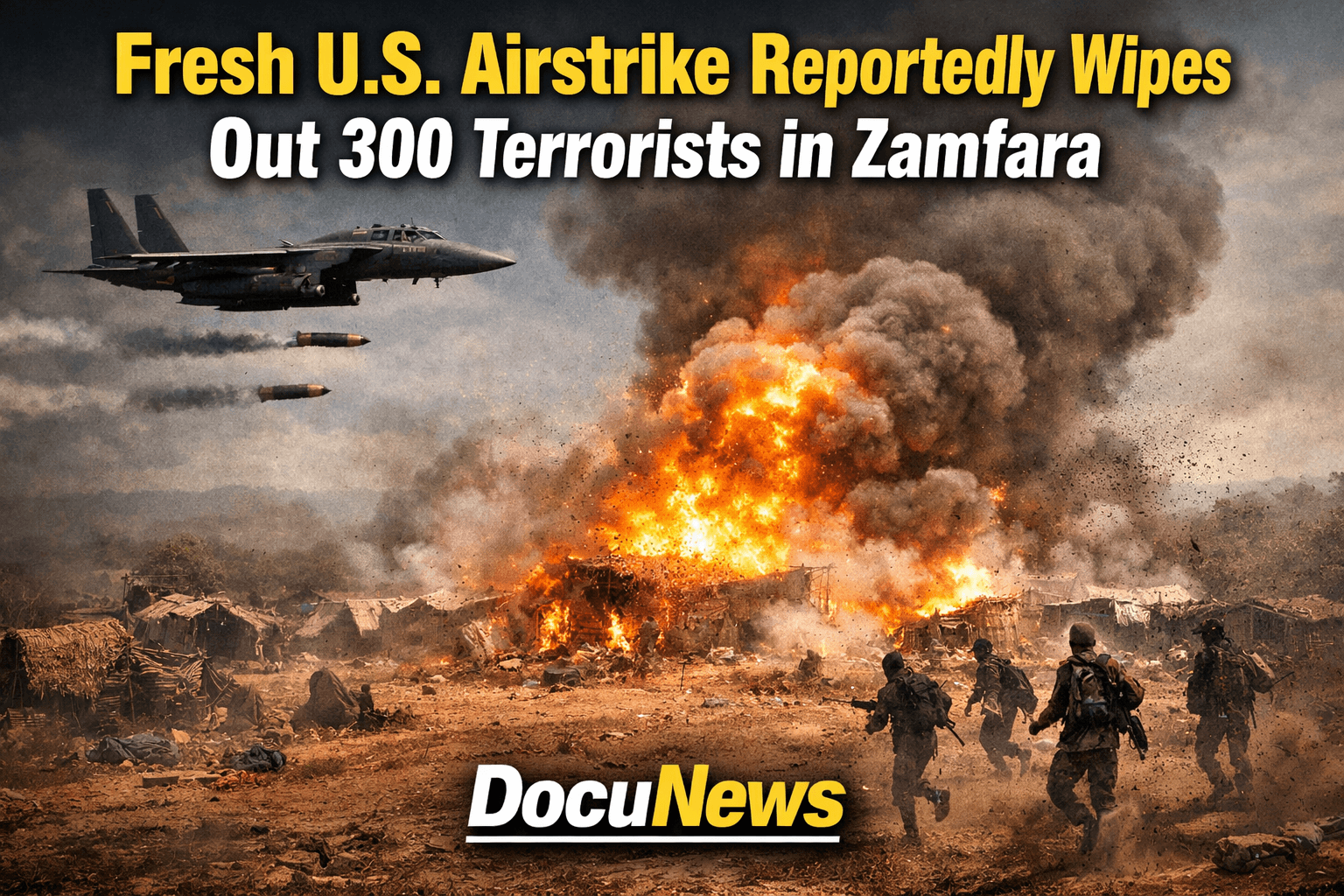
Fresh U.S. Airstrike Reportedly Wipes Out 300 Terrorists in Zamfara has triggered widespread attention across Nigeria’s security landscape, following reports that a coordinated aerial operation struck deep inside the Zamfara bush. According to security sources familiar with the development, the strike occurred earlier this week and targeted a known militant enclave believed to host a large concentration of armed fighters.
Although official confirmation remains unavailable at the time of filing this report, multiple accounts indicate that the operation resulted in devastating losses for the armed group operating within the forest corridor. More than 300 fighters were reportedly neutralized during the bombardment, while several others fled the area shortly after the attack.
The development has once again placed Zamfara State at the center of Nigeria’s long-running battle against violent extremism, banditry, and cross-border insurgent networks. Over the past decade, the state has endured repeated attacks on rural communities, highways, and mining routes, leading to massive displacement and economic disruption. Read also Gunmen Invade Kwara Palace, Abduct Monarch, Son
Security analysts say the latest strike, if confirmed, represents a major shift in operational intensity within the region. Moreover, it suggests deeper international coordination aimed at weakening armed groups that exploit ungoverned forest zones across West and Central Africa.
For background on Nigeria’s broader security challenges, read our in-depth analysis on Nigeria’s Expanding Security Crisis.
Fresh U.S. Airstrike in Zamfara and the Targeted Forest Zone
Fresh U.S. Airstrike Reportedly Wipes Out 300 Terrorists in Zamfara reportedly focused on a remote forest location long suspected to function as a staging ground for armed operations. The area, described by local sources as difficult to access by land, has previously served as a hideout for fighters involved in kidnappings, cattle rustling, and raids on surrounding villages.
Over time, the Zamfara bush has evolved into a strategic corridor linking criminal and extremist elements across state and national boundaries. As a result, security forces have struggled to maintain sustained control due to the terrain, limited infrastructure, and the mobility of armed groups.
According to intelligence-linked sources, surveillance activity intensified in the days leading up to the reported strike. Drones and aerial monitoring allegedly tracked unusual movement patterns, including the arrival of additional fighters and supplies into the enclave.
Shortly afterward, combat aircraft reportedly carried out precision strikes that destroyed multiple structures within the camp. Eyewitnesses in nearby settlements claimed they heard loud explosions followed by prolonged silence, a pattern consistent with high-impact aerial bombardment. Did you know that people are reacting to this news. Gunmen Kill 7, Burn Homes in Plateau on New Year Eve
While the exact nature of the aircraft involved remains unclear, defense observers note that such operations usually rely on real-time intelligence sharing and satellite-based targeting systems. These capabilities often exceed what local forces can deploy independently.
For more insight into aerial warfare tactics used in counterterror operations, visit U.S. Africa Command.
Fresh U.S. Airstrike Reportedly Wipes Out 300 Terrorists in Zamfara: Cross-Border Fallout
Fresh U.S. Airstrike Reportedly Wipes Out 300 Terrorists in Zamfara did not end within Nigerian territory, according to follow-up reports. Several fighters who survived the initial bombardment allegedly fled northward, moving through remote routes toward areas close to the Chad border.
Security briefings suggest that these fleeing elements encountered additional resistance after crossing into border-adjacent zones. Chadian military units, reportedly acting on shared intelligence, engaged the retreating fighters in separate clashes.
Although details remain limited, regional security experts say such coordinated responses reflect growing cooperation among countries affected by transnational armed groups. Chad, Niger, Nigeria, and Cameroon have all suffered from the spillover effects of militant violence over the years.
In recent months, regional forces have increased joint patrols, intelligence exchanges, and rapid-response drills aimed at preventing fighters from exploiting porous borders. Consequently, escape routes once considered safe have become increasingly dangerous for armed groups.
Despite these developments, neither U.S. nor Chadian authorities have released official statements confirming their roles. Observers believe this silence may reflect operational sensitivity rather than denial.
You can explore regional counterterror cooperation through the United Nations Counter-Terrorism Office.
Fresh U.S. Airstrike Reportedly Wipes Out 300 Terrorists in Zamfara and Local Reactions
Fresh U.S. Airstrike Reportedly Wipes Out 300 Terrorists in Zamfara has generated mixed reactions among residents of affected communities. While many welcomed the reported success, others expressed cautious optimism, citing past experiences where major operations failed to deliver lasting peace.
Community leaders in rural Zamfara stressed that sustained security presence remains essential. According to them, air operations alone cannot guarantee safety unless followed by ground stabilization and humanitarian support.
Several displaced families contacted by this platform said they hoped the development would allow them to return to their farms. Agriculture, which serves as the backbone of the local economy, has suffered immensely due to years of insecurity.
At the same time, civil society groups urged transparency and accountability. They called on authorities to clarify the circumstances surrounding the operation, especially given the international implications.
Human rights observers also emphasized the importance of protecting civilians during counterterror campaigns. Although no civilian casualties have been reported in this instance, past operations across the region have raised serious concerns.
For related coverage, see our report on Displacement and Survival in Zamfara Communities.
Strategic Implications for Nigeria’s Security Architecture
The reported strike has broader implications for Nigeria’s overall security framework. Analysts argue that external involvement, whether direct or indirect, signals international recognition of the threat posed by armed groups operating within Nigeria’s northwest.
Moreover, it highlights the growing convergence between bandit networks and extremist factions. What began years ago as criminal activity has increasingly adopted ideological, logistical, and tactical elements associated with insurgency.
If sustained, such coordinated operations could disrupt supply chains, reduce recruitment, and weaken command structures. However, experts caution that military success must align with governance reforms to address root causes.
Poverty, weak institutions, and limited state presence continue to fuel instability across rural zones. Without parallel investments in education, infrastructure, and justice, armed groups may eventually regroup.
Defense strategists also point out that intelligence accuracy remains critical. Faulty data can undermine trust and lead to strategic setbacks. Therefore, transparency and oversight remain essential components of long-term success.
Why Official Silence Persists
The absence of official confirmation has raised questions among the public. However, security experts say silence often accompanies sensitive operations involving multiple nations.
Public acknowledgment can sometimes expose operational methods, compromise informants, or inflame diplomatic tensions. As a result, authorities may delay statements until strategic objectives are fully secured.
In previous cases across the Sahel region, confirmations arrived weeks after operations concluded. Therefore, observers suggest patience while monitoring developments on the ground.
Nevertheless, calls for clarity continue to grow, particularly from lawmakers and civil society organizations seeking accountability.
Conclusion
Fresh U.S. Airstrike Reportedly Wipes Out 300 Terrorists in Zamfara stands as one of the most significant security developments reported in the region in recent times. While confirmation remains pending, the scale of the reported losses underscores the intensity of the ongoing battle against armed groups.
As Nigeria navigates this complex security environment, collaboration, transparency, and sustained reform will determine whether such operations translate into lasting peace. For now, all eyes remain on Zamfara and the broader northwest region as events continue to unfold.