






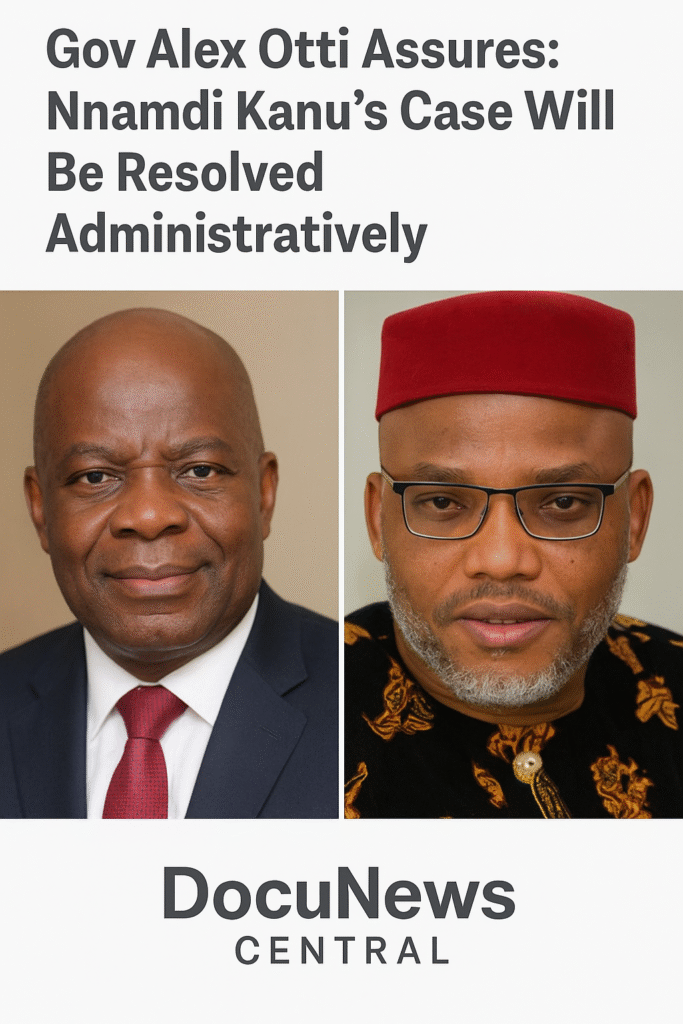
The debate surrounding the legal and political journey of Mazi Nnamdi Kanu has generated intense discussion across Nigeria. Governor Alex Otti of Abia State has provided a new direction by stating that the matter will reach a conclusion through administrative channels. His statement offers renewed confidence, especially within the South-East, where people continue to seek stability, fairness, and progress. As a result, public attention has shifted toward understanding what an administrative approach means and how it may influence peace in the region.
Why Governor Otti’s Statement Matters
Governor Otti speaks boldly on sensitive issues, and his words carry weight because he values transparency and fairness. He consistently engages with national leaders and understands the effects of regional unrest. Since Nnamdi Kanu hails from Abia, Otti views the situation as both moral and constitutional. Consequently, his assurance suggests that conversations are ongoing at high levels.
In previous national matters, swift administrative action produced stability. For example, leadership changes in the First Bank parent company sale highlighted how decisive steps can calm economic tension. In a similar way, a clear administrative direction in Kanu’s matter may ease regional concerns while strengthening trust.
Understanding the Context Surrounding Nnamdi Kanu
Nnamdi Kanu’s journey includes arrests, bail conditions, legal battles, and appeals. Each stage created reactions across the country. His supporters call for freedom, while critics insist on legal responsibility. Therefore, the issue has both judicial and political dimensions. Courts addressed legal questions, but peace requires strategic engagement.
A Brief Timeline
- 2015: Initial arrest on charges including treasonable felony.
- 2017: Bail granted and later disrupted by unrest.
- 2021: Return to Nigeria sparked diplomatic questions.
- 2021–2024: Multiple appeals and rulings from both sides.
Each stage added new considerations. Because of this history, Governor Otti’s latest remark introduces hope for a different solution.
What Administrative Resolution Means
Administrative action occurs outside the courtroom. It includes executive directives, negotiated settlements, intergovernmental consultations, and structured releases. These steps help governments resolve issues that carry legal, political, and social effects.
For example, global governments often use administrative decisions when national security intersects with legal cases. A similar pattern appeared when world powers responded to new nuclear developments, as seen in recent reports on Iran’s laser-based nuclear breakthrough. Leaders acted quickly because diplomatic stability required immediate administrative moves. Kanu’s matter fits a similar mold because peace in the South-East affects national progress.
Why Administrative Action May Be the Best Path
Governor Otti chose his words carefully. He believes that legal processes alone cannot address every part of the issue. Many people desire calm communities, thriving businesses, and open roads. Political tensions disturb daily life, especially in areas affected by fear or uncertainty.
Administrative action may succeed because:
- Negotiation creates room for peaceful agreements.
- Dialogue reduces agitation and mistrust.
- Federal and state partnerships improve stability.
- A structured plan encourages unity across communities.
Each point shows why administrative channels may produce balanced results.
Reactions Across the Region
Governor Otti’s message generated wide responses. Supporters viewed it as a sign of progress. Business owners welcomed it because stability encourages investment and growth. Community leaders urged patience while discussions continue. Legal analysts acknowledged the possibility of administrative action but stressed the need for due process.
Meanwhile, security experts emphasized the need for order during any transition. Their concerns mirror reactions from sensitive regions. A similar pattern appeared when tensions rose after the kidnap of the Ojibara of Bayagan. After the incident, leaders advised calm to prevent escalation. The same approach applies here.
What an Administrative Outcome May Look Like
Several options exist within administrative structures. Each path aims to promote harmony and safety.
Possible Steps
- A presidential directive that resolves the matter.
- A structured release that includes peace agreements.
- A negotiation that involves major stakeholders.
- A transfer to a different form of supervision.
- A complete administrative settlement after high-level consultations.
These options highlight the flexibility available within executive powers.
How This Affects National Unity
A peaceful solution may transform the atmosphere in the South-East. Calm streets encourage businesses to grow. Investors feel confident when they see consistent stability. Transport becomes safer when tension declines. Youths become more willing to engage in development programs. Each of these changes strengthens national unity.
Administrative resolution also builds trust between federal and state governments. When leaders collaborate, citizens gain confidence in the system. As a result, communities may embrace dialogue over confrontation.
Why Governor Otti’s Influence Matters
Governor Otti carries influence because he values truth, justice, and order. He addresses issues directly and seeks long-term solutions. His administration promotes development, which requires peace across the state. By assuring the public of an administrative outcome, he shows determination to protect the interests of his people.
How IPOB May Respond
A calm administrative outcome may encourage IPOB members to shift toward peaceful engagement. Dialogue becomes easier when leaders choose productive paths. It may also reduce fear within communities, since many residents desire normalcy. A peaceful approach may create opportunities for reconciliation and progress.
The Federal Government’s Likely Position
The federal government will consider national security, public interest, and political stability. Administrative solutions allow leaders to address sensitive issues with clarity and strength. Direct engagement often provides faster and more stable results than lengthy disputes.
Why This Moment Appears Strategic
Several factors make this period suitable for administrative action:
- Communities want peace more than before.
- Leaders have matured politically.
- Conversation between key stakeholders continues steadily.
- Economic pressure demands stability for growth.
Because of these conditions, a clear administrative approach may succeed.
Possible Challenges Ahead
A few obstacles may appear along the way. Misinterpretation may cause confusion. Legal engagements may require coordination. Security agencies must prevent unrest. Political opponents may raise questions. Nevertheless, these challenges remain manageable with patience, clarity, and strong communication.
Why Stakeholder Engagement Matters
A successful administrative outcome requires teamwork. Federal authorities, state leaders, traditional institutions, community groups, legal teams, and civil society must work together. Their collaboration can guide the region toward peace.
Governor Otti’s Next Steps
Governor Otti may continue to push for constructive dialogue. He may consult with national leaders to encourage a peaceful resolution. His administration may launch programs that promote unity, especially in communities that experienced tension in recent years.
How the Public Should React
The public should remain calm while leaders handle discussions. Clear information prevents confusion. Peaceful behavior encourages responsible negotiation. Constructive engagement ensures that progress continues.
Conclusion
Governor Alex Otti’s assurance that Nnamdi Kanu’s case will be resolved administratively signals a turning point in a long-standing issue. This path creates room for unity, stability, and progress. It also demonstrates the value of leadership that prioritizes peace over confrontation. A successful administrative outcome may bring healing, reduce fear, and inspire economic transformation across the South-East. With collaboration, transparency, and patience, Nigeria can move forward with greater confidence in its future.
