
Photo credit Visit Disclaimers: Use Of AI Images In Our Newsletters
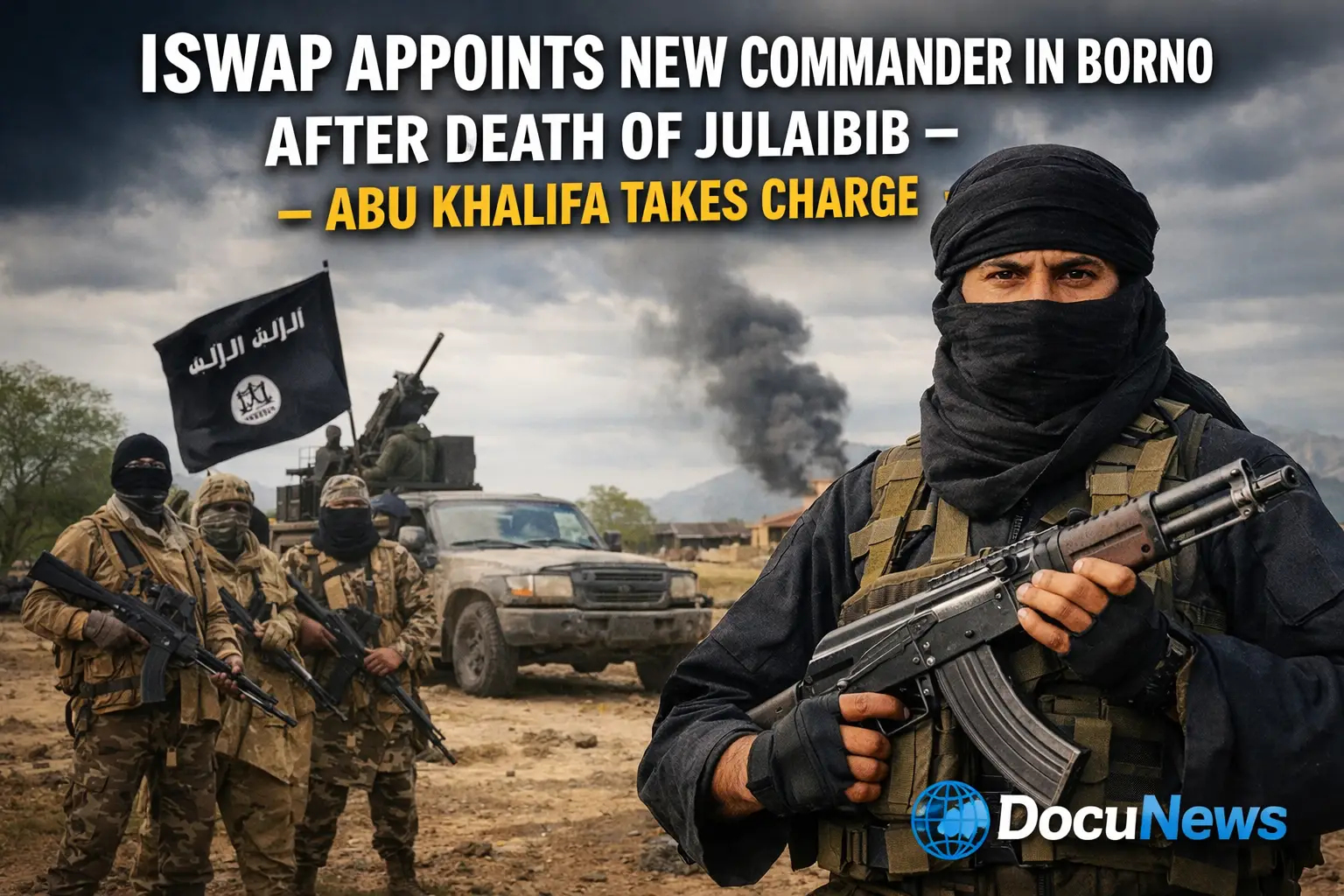
ISWAP appoints a new commander in Borno after the death of Julaibib, with Abu Khalifa officially taking charge of operations, marking a significant leadership shift within the Islamic State West Africa Province as Nigerian troops intensify pressure on insurgent strongholds across the North East. The development underscores the ongoing contest between security forces and extremist groups, while also highlighting the fragile balance of control in one of Nigeria’s most volatile regions.
In January 2026, in Borno State, North East Nigeria, multiple security and intelligence sources confirmed that Julaibib was killed during a coordinated military operation carried out by Nigerian troops in the Timbuktu Triangle. Shortly after his death, ISWAP announced Abu Khalifa as his replacement in an apparent effort to maintain command continuity and prevent internal disarray.
The leadership transition comes at a time when Nigerian security forces are recording incremental gains against insurgent networks. It also reflects how armed groups attempt to adapt rapidly when key figures are eliminated.
How Julaibib Was Killed
Julaibib’s death followed weeks of sustained military pressure across ISWAP-controlled corridors. Nigerian forces expanded reconnaissance missions, restricted insurgent movement, and targeted logistics routes that had sustained extremist activity for years.
As operations intensified, intelligence units tracked Julaibib’s movements through a combination of aerial surveillance and ground-based information. Eventually, troops closed in on his location within the Timbuktu Triangle, an area long regarded as a strategic hub for insurgent operations.
The resulting engagement ended his leadership and disrupted several coordinated plans that were reportedly in advanced stages. Military officials described the operation as precise and intelligence-driven, reflecting a shift away from broad offensives toward targeted strikes.
Read more Security Crackdown in Edo: Police Arrest 13 Suspects, Rescue Three Kidnap Victims
The Strategic Importance of the Timbuktu Triangle
The Timbuktu Triangle occupies a critical position within the Lake Chad Basin. Its difficult terrain, dense vegetation, and proximity to international borders make it attractive to armed groups seeking concealment and mobility.
For years, ISWAP relied on the area to move fighters, store weapons, and coordinate attacks across Borno, Niger, and parts of Chad. As a result, Nigerian troops have consistently prioritized the region in counter-insurgency planning.
By neutralizing Julaibib within this zone, the military struck at the heart of ISWAP’s operational architecture. However, the group’s quick appointment of a successor shows that the battle for dominance remains ongoing.
Format more Security Updates In Nigeria Visit Security updates Nigeria
Who Is Abu Khalifa?
Abu Khalifa is described by intelligence analysts as a long-serving ISWAP operative with deep operational knowledge of the Lake Chad terrain. Unlike some previous leaders who focused heavily on ideology, Abu Khalifa is known primarily for tactical coordination and enforcement.
Before his elevation, he reportedly supervised field units responsible for patrols, intelligence gathering, and discipline within key camps. His familiarity with local routes and command structures likely influenced his selection.
Security experts believe ISWAP chose Abu Khalifa because of his ability to manage fighters under pressure rather than his public profile.
Why ISWAP Moved Quickly
Leadership vacuums often trigger fragmentation within extremist groups. To avoid this risk, ISWAP acted swiftly after Julaibib’s death.
By announcing Abu Khalifa’s appointment almost immediately, the group sought to reassure its fighters and supporters. The move also aimed to prevent rival commanders from challenging authority.
However, analysts note that speed does not guarantee stability. New leaders often face internal resistance, especially when operational losses continue.
Nigerian Military Strategy and Its Effects
Nigerian forces have increasingly relied on intelligence-led operations to weaken insurgent networks. Rather than engaging large formations, troops now focus on leadership decapitation, logistics disruption, and territorial denial.
This approach has yielded results. Several high-ranking insurgent figures have been eliminated in recent months, forcing groups like ISWAP into reactive positions.
According to official updates from the Defence Headquarters of Nigeria, sustained pressure remains central to current strategy.
Regional Security Implications
ISWAP’s leadership change affects not only Nigeria but also the wider Lake Chad Basin. The group maintains cross-border connections that allow fighters to evade national forces.
Regional cooperation through the Multinational Joint Task Force continues to play a role in containing these movements. Intelligence sharing has improved response times and reduced safe havens.
Still, security agencies remain cautious. New commanders often attempt to prove their authority through limited attacks.
Civilian Communities and Local Impact
For communities in Borno, leadership changes within extremist groups bring cautious optimism mixed with fear. While the death of a commander weakens insurgent coordination, it can also trigger reprisals.
Community leaders continue urging residents to cooperate with security agencies. Information from civilians has proven crucial in past operations.
Local reporting platforms, including DocuNews Central, have continued to highlight both security developments and humanitarian challenges affecting displaced populations.
Humanitarian Situation in Borno
Despite military gains, humanitarian needs remain severe. Millions of residents face food insecurity, displacement, and limited access to healthcare.
Aid organizations stress that improved security creates space for relief efforts. However, instability continues to complicate access.
The United Nations Office for the Coordination of Humanitarian Affairs remains actively involved in coordinating assistance.
ISWAP’s Internal Challenges After Julaibib
The loss of a leader disrupts communication and planning. Fighters must adjust to new command styles while operating under constant surveillance.
Defections have increased in recent years as pressure mounts. Government deradicalization programs offer exit pathways