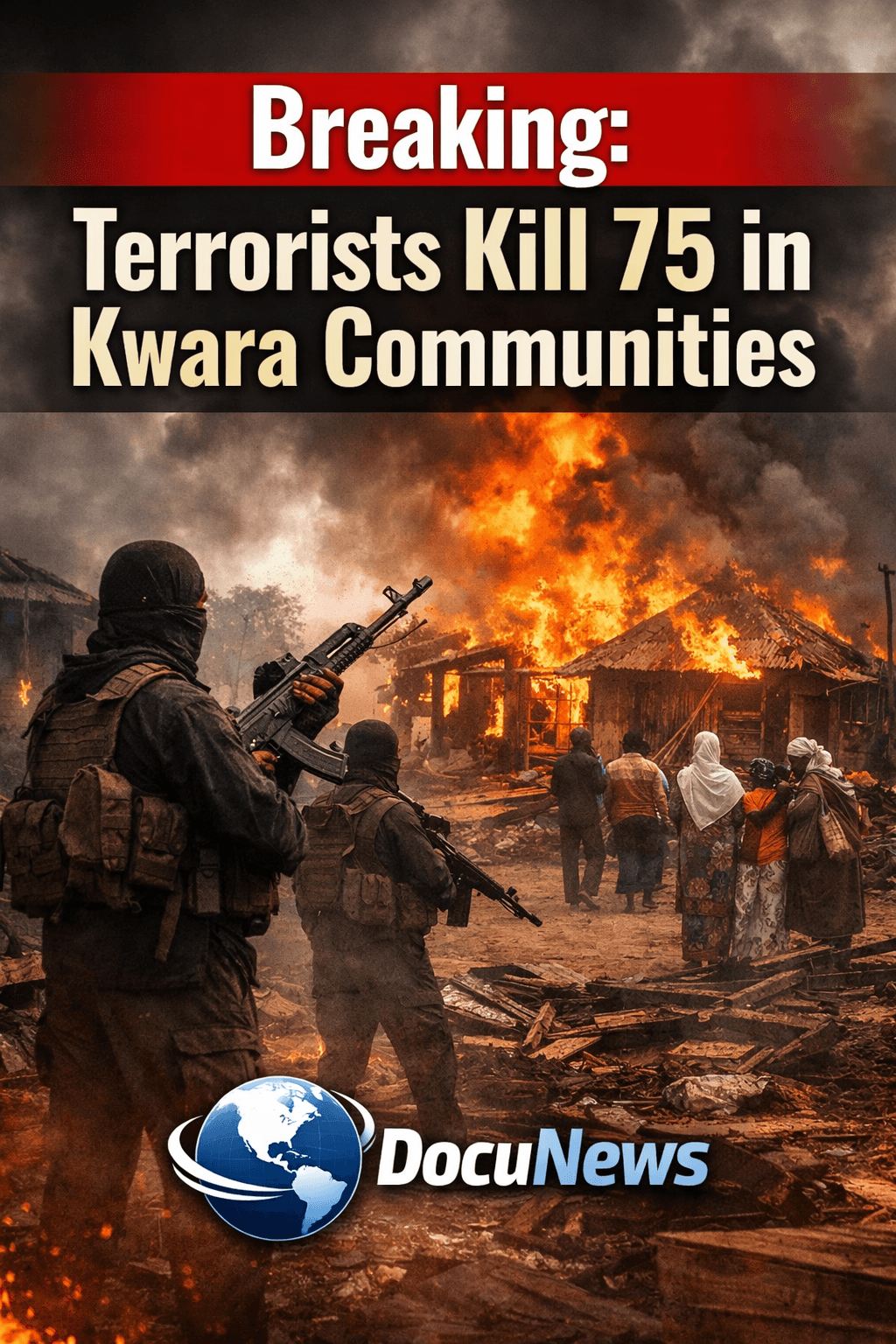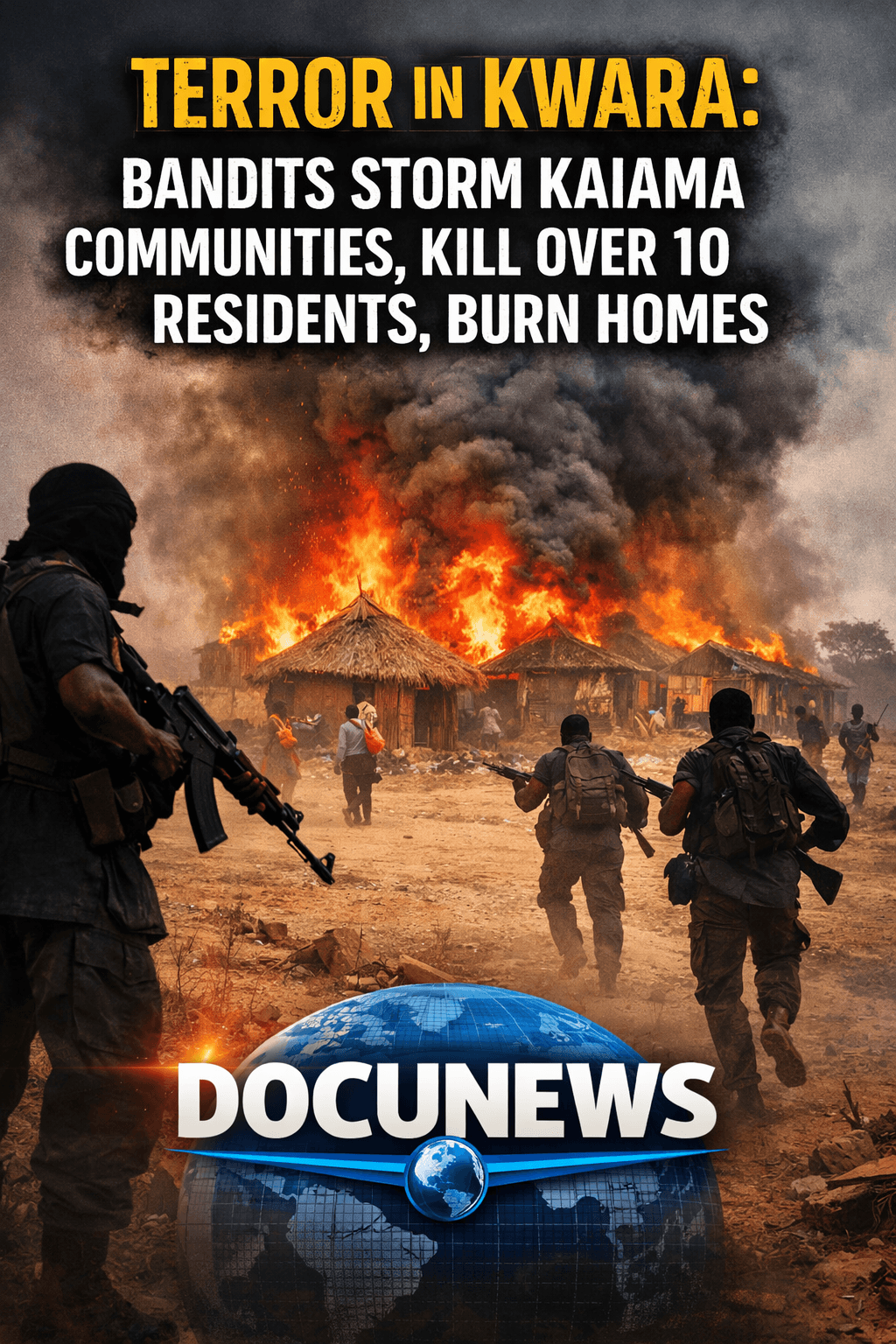
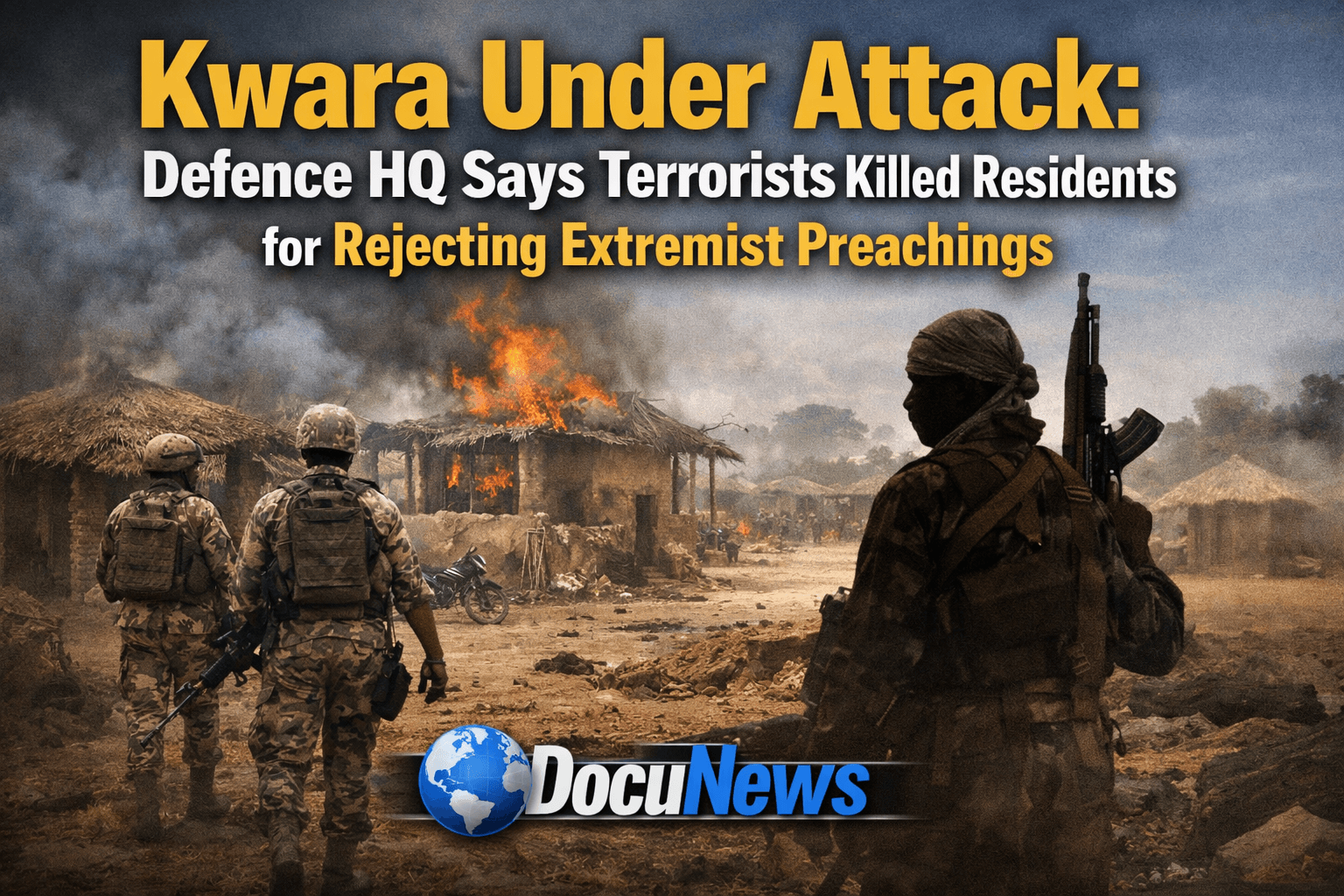
Kwara Under Attack: Defence HQ Says Terrorists Killed Residents for Rejecting Extremist Preachings has shaken Nigeria after Defence Headquarters confirmed that armed terrorists carried out brutal killings in Kwara State because residents refused to submit to extremist indoctrination. The attack, which targeted innocent villagers who stood firm against radical beliefs, has sparked national outrage and renewed concern about the growing reach of violent groups into Nigeria’s Middle Belt.
Photo Credit Visit Disclaimers: Use Of AI Images In Our Newsletters
The killings occurred between February 3 and February 5, 2026, in Woro and Nuku communities of Kaiama Local Government Area, Kwara State, North-Central Nigeria. According to military authorities, the assailants initially approached the communities weeks earlier under the guise of religious preaching. However, after locals rejected their teachings, the group returned with weapons, unleashing terror on peaceful residents.
Community leaders explained that villagers refused to allow unfamiliar doctrines that contradicted their cultural values and constitutional freedoms. Although security operatives increased patrols after the first warning signs, the attackers regrouped and later launched a coordinated assault that left dozens dead, homes destroyed, and families displaced.
How the Terror Attack Began
To understand the tragedy, it is important to examine how events unfolded. According to eyewitness accounts, the terrorists first entered Woro quietly, presenting themselves as preachers seeking an audience with traditional rulers. They requested gatherings and attempted to introduce extremist ideologies, promising protection and material support in return for loyalty.
However, elders and youth leaders rejected the proposal. They insisted on preserving their peaceful coexistence and immediately alerted nearby security units. For several days afterward, soldiers conducted patrols across forest routes and access roads. Although this presence offered temporary reassurance, the militants withdrew only to reorganize.
Days later, they returned in larger numbers. This time, they arrived heavily armed. Residents said gunshots rang out late in the evening, forcing families to flee into nearby bushes. Meanwhile, attackers moved from house to house, killing anyone in their path and setting buildings ablaze.
Several survivors reported that the assailants accused villagers of betraying their cause. Markets were looted, motorcycles were seized, and livestock disappeared. Consequently, fear spread rapidly to neighboring settlements, triggering mass displacement.
Defence Headquarters Confirms Terrorist Motive
Shortly after the incident, Defence Headquarters released a statement confirming that the massacre occurred because residents rejected extremist preachings. Major General Samaila Uba, Director of Defence Information, described the attack as cowardly and unnecessary, stressing that Nigeria will never allow violent ideologies to override democratic freedoms.
He commended the courage of the affected communities for refusing forced indoctrination and reaffirmed the military’s commitment to protecting civilians. According to him, additional troops were deployed immediately, while intelligence units intensified surveillance operations across forest corridors.
You can follow related security developments through Reuters, which continues to provide international coverage of Nigeria’s security challenges.
Furthermore, Defence Headquarters urged citizens to remain vigilant and cooperate with security agencies. Officials emphasized that community intelligence plays a crucial role in preventing future attacks, especially in remote areas.
Format Security Updates In Nigeria Visit Security updates Nigeria
Presidential Action and Emergency Deployment
President Bola Ahmed Tinubu reacted swiftly to the tragedy. He condemned the killings and ordered the immediate deployment of additional army battalions to Kaiama and surrounding communities. According to reports by Africa News, aerial surveillance also increased to track militant movements across Kwara’s forest belts.
In addition, the Presidency directed intelligence agencies to strengthen coordination with local vigilante groups. Roadblocks were established, while joint patrols expanded into hard-to-reach areas. These measures aimed to prevent further infiltration and reassure frightened residents.
The President stressed that Nigeria would not surrender any part of its territory to terrorists masquerading as religious reformers. He also promised that all those responsible would face justice.
Read Also Boko Haram Storms Borno Army Base, Several Nigerian Soldiers Feared Killed in Fresh Attack
Governor AbdulRazaq Visits Affected Villages
Kwara State Governor Abdulrahman AbdulRazaq personally visited Woro and Nuku to assess the level of destruction and console grieving families. He described the incident as heartbreaking and pledged full state support for survivors.
During his visit, relief materials including food items, medical supplies, and temporary shelters were distributed. The governor also announced plans to rebuild damaged homes and assist farmers whose livelihoods were disrupted.
Moreover, he urged residents to remain united and report suspicious movements promptly. According to him, collective vigilance remains essential in preventing similar tragedies.
You may have missed this Bandits Ambush Zamfara Market Returnees, Kill Five Residents, Several Still Missing
Humanitarian Crisis and Displacement
Beyond the immediate loss of life, the attack triggered a humanitarian crisis. Hundreds of residents fled to nearby towns, seeking safety among relatives and host communities. Many arrived with nothing but the clothes they wore while escaping.
Children showed signs of trauma, while elderly residents struggled with exhaustion and grief. Local clinics became overwhelmed, prompting emergency medical outreach by volunteer groups and faith-based organizations.
Humanitarian workers emphasized the urgent need for psychological support, clean water, and stable shelter. International organizations such as Amnesty International continue to advocate for stronger civilian protection across conflict-prone regions.
International Condemnation of the Attack
The massacre attracted widespread international condemnation. The Muslim World League released a statement denouncing terrorism in all forms, stressing that violence contradicts genuine religious teachings.
Similarly, the Organisation of Islamic Cooperation and Türkiye expressed solidarity with Nigeria, urging stronger global cooperation against extremism. News platforms like Al Jazeera also highlighted the incident as part of broader security challenges facing West Africa.
These reactions reinforced the global consensus that extremist violence threatens peace and stability far beyond national borders.
Read more more about DocuNews Central here ABOUT US- DOCUNEWS CENTRAL
Why Kwara Matters in Nigeria’s Security Landscape
Kwara State occupies a strategic position between northern and southern Nigeria. Traditionally known for peaceful coexistence, the region now faces increasing pressure from armed groups seeking territorial expansion.
Security analysts warn that extremists often target rural communities with limited infrastructure, exploiting poverty and isolation. They frequently begin with ideological outreach before resorting to violence when rejected.
This pattern mirrors trends across parts of the Sahel, where militant networks continue to evolve. For deeper regional insights, the International Crisis Group provides detailed conflict analysis.
As a result, experts emphasize the importance of early intervention, community engagement, and sustained development programs.
For ongoing national security reporting and exclusive investigations, readers can also visit DocuNews Central.
Community Strength and Local Resilience
Despite the trauma left behind by the attack, residents of Woro and Nuku have shown remarkable resilience. Community leaders immediately organized meetings to encourage unity, while youth groups assisted security personnel by guiding patrols through forest paths and remote settlements.
Women formed support networks to provide food for displaced families, while religious leaders coordinated prayer sessions and counseling services. These collective efforts have helped restore a sense of belonging, even as many families continue to mourn loved ones.
Traditional rulers also appealed for calm, urging citizens not to resort to revenge. Instead, they encouraged cooperation with authorities and emphasized the importance of peacebuilding initiatives.
Security Experts Call for Long-Term Solutions
Security analysts believe that military deployment alone will not eliminate extremism. While immediate force remains necessary to protect civilians, experts argue that sustainable peace requires addressing underlying social and economic issues.
They point to unemployment, limited education, and rural neglect as major factors that make communities vulnerable to radical influence. Therefore, many specialists recommend expanding vocational training, improving school access, and investing in agriculture to stabilize affected regions.
Additionally, experts stress the importance of early-warning systems that allow residents to report suspicious activities before attacks occur. According to analysts, strengthening trust between civilians and security agencies remains a critical step toward preventing future tragedies.
Federal Government Promises Accountability
Meanwhile, federal authorities have promised to identify and prosecute everyone connected to the Kwara massacre. Investigative teams are currently gathering intelligence, while forensic units continue to document evidence from destroyed homes and abandoned camps.
Officials also announced plans to reinforce security across forest borders linking Kwara to neighboring states. These measures aim to disrupt militant supply routes and restrict movement of armed groups.
Furthermore, the Ministry of Humanitarian Affairs confirmed that additional relief packages will reach displaced families in the coming weeks. The government reiterated its commitment to rebuilding affected villages and restoring livelihoods.
Regional Implications for Nigeria
The Kwara attack has raised serious concerns about the expansion of extremist networks beyond their traditional strongholds. Previously, such violence remained largely concentrated in northeastern Nigeria. However, recent incidents suggest a gradual shift toward central regions.
This development places increased pressure on security agencies already stretched by multiple conflict zones. As a result, policymakers now face urgent calls to reassess national security strategies and strengthen border surveillance.
Regional cooperation also remains vital. Analysts encourage Nigeria to deepen intelligence-sharing agreements with neighboring countries to track cross-border militant movements.
Survivors Share Harrowing Experiences
Several survivors described terrifying moments as gunmen stormed their homes. Many recalled hiding in bushes overnight, clutching their children while listening to distant gunfire. Others spoke of watching neighbors fall while attempting to escape.
One resident explained how attackers accused villagers of rejecting their beliefs before opening fire. Another survivor recounted losing three family members within minutes.
These testimonies highlight the human cost of extremism and underline the urgent need for stronger protection of rural communities.
Faith Leaders Reject Extremist Ideology
Local clerics and religious organizations have strongly condemned the violence, emphasizing that genuine faith promotes peace and compassion. They warned young people against being deceived by groups that exploit religion for violent purposes.
Interfaith forums have also emerged, bringing together Christian and Muslim leaders to promote unity and counter radical narratives. These initiatives aim to educate communities about tolerance and shared values.
Economic Impact on Kwara Communities
Beyond emotional trauma, the attack disrupted local economies. Farmers abandoned fields during harvest season, traders lost goods, and transport services halted temporarily. Many households now struggle to meet basic needs.
State officials are working with agricultural cooperatives to distribute seeds and tools, hoping to revive farming activities. Small business grants have also been proposed to help affected families restart livelihoods.
Economists warn that without sustained intervention, prolonged displacement could deepen poverty in the region.
Calls for Community-Based Policing
Civil society organizations continue to advocate for community-based policing models that empower locals to participate actively in security efforts. They argue that residents understand terrain and social dynamics better than external forces.
Such models, they say, could improve response times and strengthen trust between citizens and law enforcement agencies.
What Lies Ahead for Kwara State
As investigations continue, security forces remain on high alert. Patrols persist across vulnerable corridors, while surveillance operations monitor forest hideouts. Authorities believe these measures will deter further attacks.
Meanwhile, displaced families slowly begin returning home under military escort. Reconstruction efforts are underway, although full recovery will take time.
Community leaders continue to urge patience, resilience, and cooperation with authorities as the healing process unfolds.
Conclusion
The Kwara massacre stands as a painful reminder of Nigeria’s ongoing battle against violent extremism. However, it also reveals the courage of ordinary citizens who refused forced ideology, even at great personal cost.
As the nation mourns, government agencies intensify security operations while humanitarian groups support survivors. International partners offer solidarity, and local communities demonstrate remarkable strength.
Ultimately, lasting peace will depend on unity, accountability, and sustained development. While justice remains the collective demand, Nigerians continue to hope that tragedies like this will give way to stability and renewed trust in national security.