


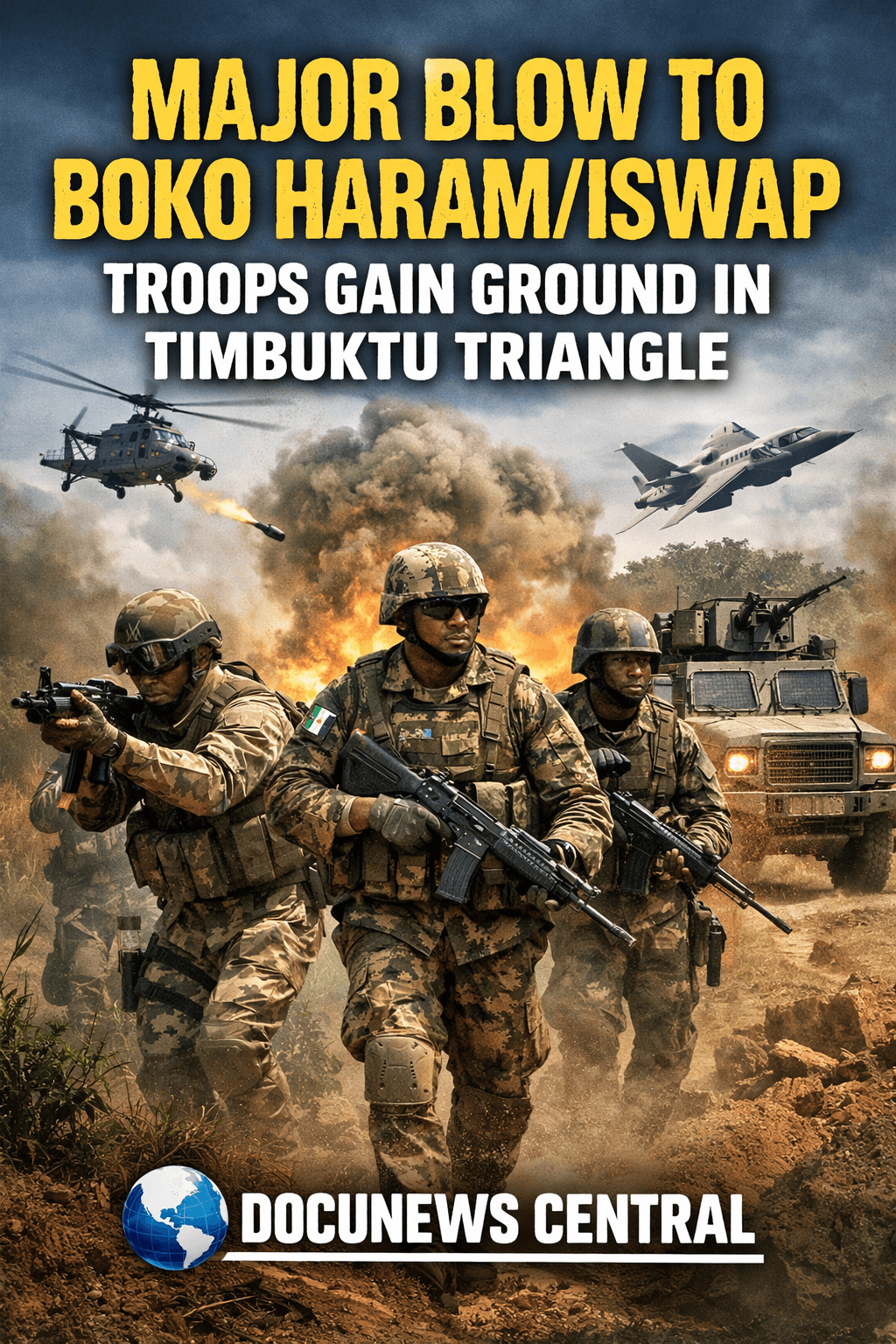
Before dawn, the silence of northeastern Borno was shattered by gunfire, armored movement, and the steady advance of troops. What unfolded was far more than a routine patrol—it marked another decisive phase in Nigeria’s long fight against violent extremism.
Troops of Operation HADIN KAI (OPHK) sustained a determined push into the Timbuktu Triangle, an area long considered a fortified stronghold of Boko Haram and the Islamic State West Africa Province (ISWAP). The operation recorded notable tactical and strategic gains, weakening terrorist networks and reshaping the security landscape of the North-East.
This development represents a major blow to Boko Haram and ISWAP, as Nigerian forces continue to deny insurgents safe havens and freedom of movement.. Read also Bandits Demand ₦28.9m Over ‘Lost’ Bikes Before Ransom Talks in Kaduna
Into the Heart of the Timbuktu Triangle
The Timbuktu Triangle lies deep within Borno State and has, for years, served as a sanctuary for terrorist groups due to its dense vegetation, rugged terrain, and limited access routes.
On Tuesday, January 20, 2026, troops under Operation HADIN KAI launched a renewed offensive into the area. The advance targeted known terrorist enclaves around Tergejeri, Chiralia, and the Ajigin/Abirma axis.
According to operational updates from military authorities, the objective was to dismantle remaining Boko Haram and ISWAP command structures operating within the triangle. Read more here Terror Strikes Kogi as Two Community Leaders Kidnapped
Troops Gain Ground Against Boko Haram and ISWAP
Advancing units recorded steady progress, overrunning several terrorist camps and forcing insurgents to retreat deeper into surrounding bushes.
At Tergejeri, troops dislodged entrenched fighters after intense engagements. They later pushed through Chiralia, securing key routes previously used for terrorist logistics and movement.
By gaining control of these areas, Nigerian forces disrupted supply chains and significantly degraded insurgent operational capacity.
Precision Operations and Tactical Discipline
The offensive followed a deliberate and methodical pattern. Troops cleared each objective before consolidating positions, a strategy that reduced the risk of counterattacks and safeguarded supply lines.
Military sources confirmed that intelligence-led planning guided troop movements throughout the operation, allowing forces to anticipate enemy tactics and respond decisively.
VBIED Threats Neutralized Near Chiralia
While consolidating positions about six kilometers north of Chiralia on January 20, 2026, troops encountered two Vehicle-Borne Improvised Explosive Devices (VBIEDs).
Alert soldiers neutralized one VBIED before it reached its intended target. The second device breached the harbor area and struck logistics equipment.
Despite the explosion, troops maintained full control of the area and prevented further damage.
Losses and Sacrifice on the Battlefield
The success of the operation came at a cost. Some soldiers and members of the Civilian Joint Task Force (CJTF) paid the supreme price during the engagements.
Others sustained injuries and were evacuated by Nigerian Army Aviation helicopters to the 7 Division Medical Services and Hospital.
The Nigerian Air Force provided air cover throughout the evacuation, ensuring the safety of both wounded personnel and ground troops.
Discovery of Terrorist Mass Graves
As troops expanded their presence within the Timbuktu Triangle, they uncovered mass graves containing the remains of about 20 terrorists.
The discovery provided clear evidence of heavy insurgent casualties from previous military operations and exposed the scale of losses suffered by Boko Haram and ISWAP.
Read more on this development via BusinessDay Nigeria .
Ground and Air Coordination Strengthens Offensive
The success of the advance relied heavily on joint operations between ground forces and air assets.
Surveillance platforms and combat aircraft provided real-time intelligence and rapid response to emerging threats, strengthening operational effectiveness.
Additional details on military coordination are available at PRNigeria .
Drone Attacks and Counteroffensives Repelled
During the operation, insurgents attempted to resist using drones and coordinated counterattacks.
Troops successfully repelled these efforts through disciplined firepower, effective positioning, and superior coordination.
The failed counteroffensives further weakened terrorist morale and combat effectiveness.
Role of the Civilian Joint Task Force
Members of the Civilian Joint Task Force played a supporting role during the advance.
Their familiarity with the terrain proved valuable in identifying routes and suspected terrorist hideouts, underscoring community commitment to ending insurgency.
Security Stability Across Borno State
Despite intense fighting within the Timbuktu Triangle, security across much of Borno State remained stable.
Military authorities emphasized their continued focus on civilian protection while sustaining pressure on terrorist elements.
Further reporting on regional stability is available at Nigerian Tribune .
Strategic Implications for Boko Haram and ISWAP
The loss of territory within the Timbuktu Triangle limits the ability of Boko Haram and ISWAP to regroup or plan large-scale attacks.
For Nigerian forces, these gains reinforce confidence in sustained offensive operations and long-term counterterrorism strategy.
Conclusion: A Decisive Moment, Not the End
The advance into the Timbuktu Triangle marks a significant milestone in Nigeria’s counterterrorism campaign.
By gaining ground, dismantling strongholds, and inflicting heavy losses, troops of Operation HADIN KAI delivered a major blow to Boko Haram and ISWAP.
However, the fight continues. Sustained vigilance, strong coordination, and community support remain essential to securing lasting peace in the North-East.
For ongoing coverage, visit Vanguard News .
For More Security updates Visit Security updates Nigeria


One thought on “Major Blow to Boko Haram/ISWAP as Troops Gain Ground in Timbuktu Triangle”