




Maiduguri, Borno State — Tuesday, January 6, 2026, 5:40 a.m.
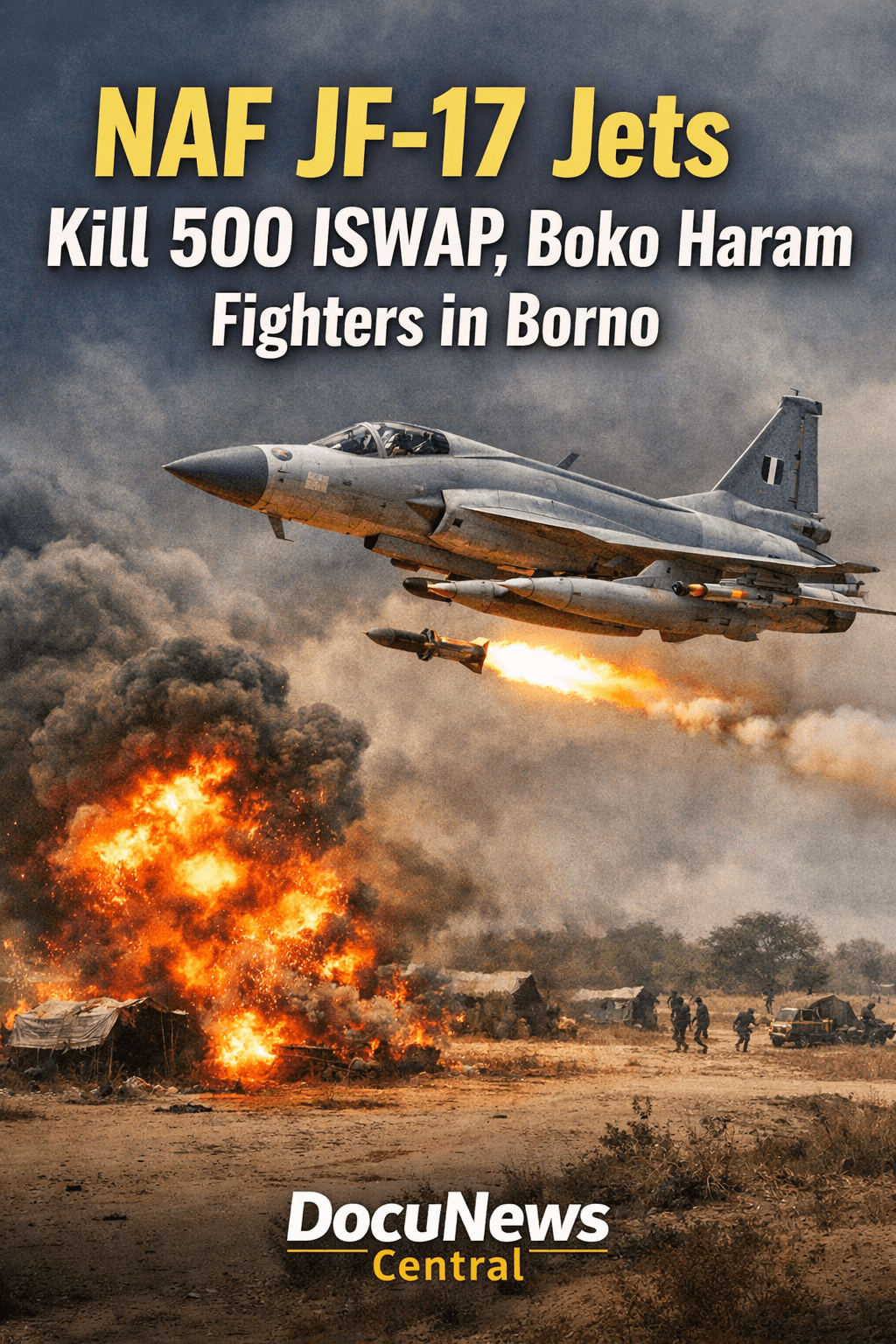
Nigeria recorded one of its most decisive counterterrorism victories in recent years after precision air operations by the Nigerian Air Force dismantled multiple extremist enclaves across northern Borno State. The early-morning strikes targeted fortified hideouts deep within the Lake Chad axis, where violent groups had regrouped following months of intelligence surveillance.
According to military sources, the coordinated offensive followed weeks of aerial reconnaissance and human intelligence fusion. As a result, planners identified exact movement patterns, supply routes, and command locations before authorizing the final operation. Consequently, the mission achieved maximum impact within a short operational window.
Security analysts described the action as a turning point in Nigeria’s long campaign against terrorism in the North-East. Meanwhile, residents of affected communities reported prolonged aerial activity shortly before dawn, followed by heavy explosions that echoed across several kilometers. Read also Nigeria Recovers $9.5m Abacha Loot From Jersey
Operation Overview and Timeline of Events
The operation began shortly after 5:40 a.m. on Tuesday when combat aircraft departed from a forward operating base under strict radio silence. Shortly afterward, air controllers confirmed visual contact with confirmed targets located around the Sambisa–Tumbun corridor, an area long exploited by insurgent commanders due to its difficult terrain.
Once clearance was granted, pilots executed sequential strike runs using guided munitions. Each phase followed a timed pattern designed to prevent escape. As a result, ground movement ceased almost immediately across the targeted locations. Furthermore, follow-up passes neutralized remaining resistance.
Military briefings later confirmed that the mission lasted approximately forty-five minutes from first engagement to final confirmation sweep. Importantly, the strikes avoided civilian settlements, reinforcing the armed forces’ emphasis on precision and rules of engagement.
By mid-morning, surveillance drones confirmed total destruction of weapons depots, logistics trucks, and underground shelters. Consequently, commanders authorized disengagement and recovery procedures.
NAF JF-17 Jets and Strategic Air Power Impact
The deployment of modern combat platforms played a crucial role in the success of the operation. These aircraft provided advanced targeting capability, high maneuverability, and rapid response coordination with intelligence units. Therefore, planners could execute the mission without prolonged exposure.
Defense officials explained that air dominance remains essential in disrupting extremist mobility. Over time, insurgent groups adapted to ground pressure by relocating frequently. However, sustained aerial surveillance now limits those options significantly.
Moreover, the success of the strike demonstrates how air power complements ground forces already deployed across the North-East. Instead of replacing infantry operations, air support weakens enemy structures before contact, thereby reducing risk to soldiers. You may have missed this news. Family Says Teen Girl Was Taken and Forced to Islam in Kano
Confirmed Casualties and Leadership Losses
Preliminary battle damage assessments confirmed that approximately 500 fighters were eliminated during the operation. Analysts emphasized that this figure includes trained combatants, logistics coordinators, and field commanders. Therefore, the loss extends beyond numbers and affects operational capacity.
Additionally, intelligence intercepts suggested the presence of high-value targets at one of the strike locations. While verification continues, officials believe several senior figures responsible for recent attacks may have been neutralized.
As a result, terrorist communication networks reportedly experienced disruption following the strike. Field reports indicated confusion among surviving elements, with scattered movements observed across swamp routes.
Impact on ISWAP and Boko Haram Operational Networks
Security experts noted that the affected camps served as major coordination hubs. These locations stored weapons, fuel, and food supplies for multiple attack cells. Consequently, their destruction limits the groups’ ability to launch coordinated assaults.
Furthermore, analysts highlighted that sustained pressure in this region weakens cross-border movement. Since the Lake Chad basin connects multiple countries, disrupting supply chains inside Nigeria also affects wider regional stability.
Over the past year, joint operations intensified information sharing between agencies. Therefore, strikes now rely less on reactive intelligence and more on predictive modeling. This shift increases operational efficiency.
Community Reactions Across Northern Borno
Residents of several rural communities expressed cautious relief following the operation. Many villagers reported reduced night movement and fewer distant gunfire incidents in the days that followed. Although fear remains, hope for sustained security continues to grow.
Community leaders urged the government to maintain momentum while addressing humanitarian needs. According to them, security gains must align with reconstruction and food support to prevent future radicalization.
Meanwhile, local traders reported gradual reopening of weekly markets previously abandoned due to insecurity. While full recovery will take time, early signs suggest improved confidence.
Military Coordination and Intelligence Planning
Defense officials explained that the operation followed months of coordinated planning between intelligence units, air planners, and regional commands. Each stage involved data verification to prevent misinformation and operational error.
Additionally, the armed forces integrated satellite imagery with on-ground intelligence sources. As a result, planners achieved accurate target confirmation without exposing informants.
This intelligence-driven approach reflects evolving counterterrorism doctrine. Rather than relying solely on force projection, the strategy emphasizes precision, speed, and minimal collateral impact.
Government Response and Security Outlook
Senior government officials praised the armed forces for professionalism and discipline. They reaffirmed commitment to restoring peace across the North-East while supporting affected communities.
According to official statements, security operations will continue alongside stabilization programs. These include rebuilding schools, restoring health centers, and reopening transport corridors.
Furthermore, authorities stressed that military success alone cannot end extremism. Therefore, social investment, education, and employment remain central to long-term peace.
Regional and International Security Implications
Observers noted that the operation sends a strong signal to extremist networks across West Africa. Sustained air capability reduces safe havens and limits expansion.
International partners monitoring regional security welcomed the development. Analysts emphasized that weakening extremist infrastructure contributes to broader Sahel stability.
For Nigeria, the operation reinforces confidence in domestic defense capability while strengthening regional cooperation frameworks.
Looking Ahead After the Borno Airstrikes
While the operation marks a major success, military leaders cautioned against complacency. Extremist groups often attempt regrouping after losses. Therefore, continuous surveillance remains essential.
However, the scale and precision of the strike significantly degrade operational recovery timelines. Analysts estimate that rebuilding similar capacity could take several months.
As security forces consolidate gains, attention now turns to humanitarian access and long-term stabilization. Sustained effort, coordination, and community trust will determine lasting peace.
For continued coverage of security operations, visit our Security updates Nigeria page.
For official information, see updates from the Nigerian Air Force and the Ministry of Defence.
This development reinforces Nigeria’s determination to dismantle terrorism while protecting civilian lives and restoring stability across affected regions.



2 thoughts on “NAF JF-17 Jets Kill 500 ISWAP, Boko Haram Fighters in Borno”