


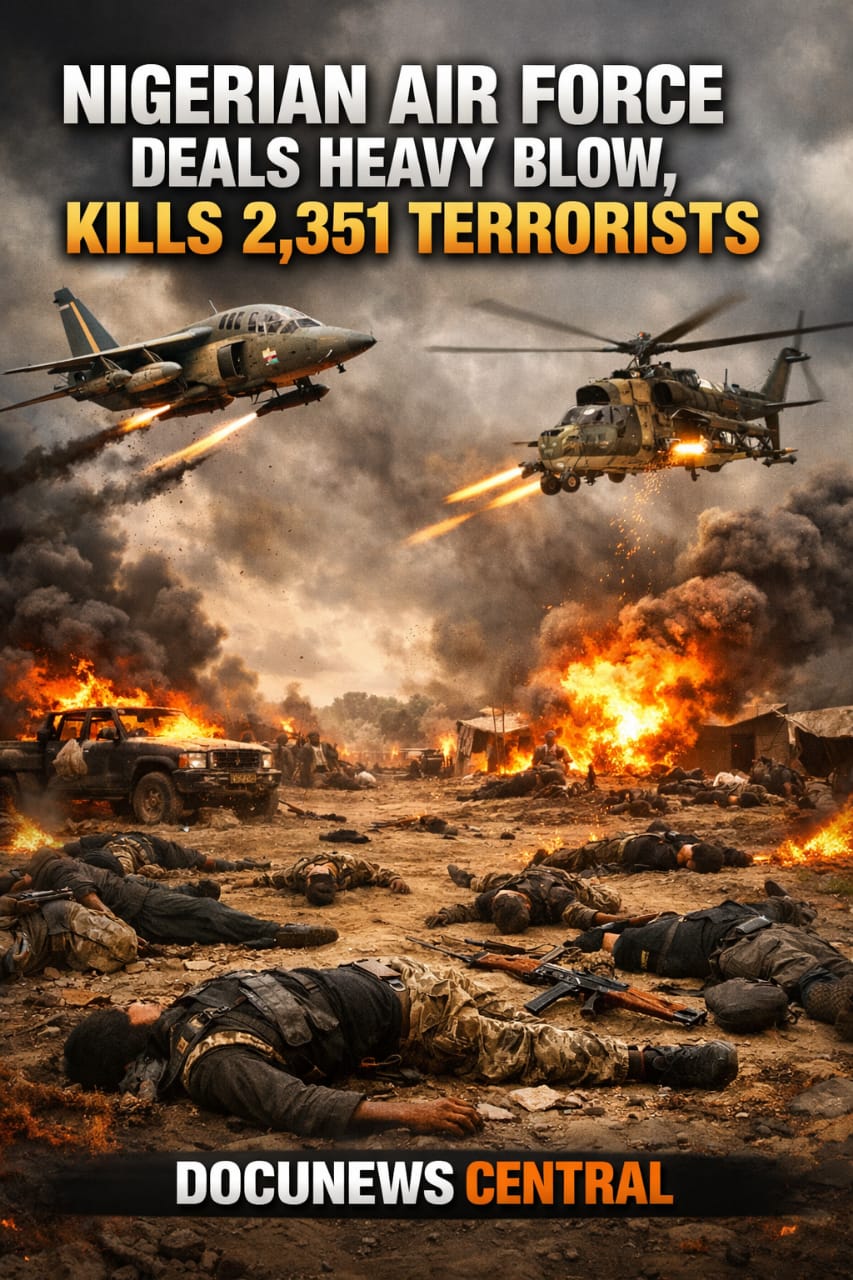
The Nigerian Air Force has recorded a major operational breakthrough after confirming that 2,351 terrorists were killed during sustained air operations carried out throughout 2025. The disclosure highlights one of the most intensive aerial campaigns in recent years, reflecting a deliberate shift toward intelligence-led precision strikes. And this made a headline on DocuNews Central which is Nigerian Air Force Deals Heavy Blow, Kills 2,351 Terrorists. Read full News details below.
According to official briefings, the air raids targeted key terrorist enclaves, disrupted logistics routes, and weakened command structures across multiple regions affected by prolonged insecurity. Rather than relying on sporadic engagements, the Air Force maintained consistent pressure, ensuring that hostile groups struggled to regroup.
This development underscores the expanding role of air power in Nigeria’s counterterrorism strategy. While ground forces continue to secure territory, air operations increasingly shape the tempo and direction of military engagements. Read also Nigerian Military Recovers Boko Haram Spy Drone in Borno
Nigerian Air Force Deals Heavy Blow Through Sustained Air Raids
The scale of the 2025 operations did not emerge by chance. Military planners adopted a long-term approach designed to deny terrorists safe havens. Consequently, air missions focused on areas repeatedly identified through surveillance and field intelligence.
Instead of isolated strikes, the Air Force applied sustained pressure. As a result, armed groups faced constant disruption. Camps that once served as coordination centers lost their operational relevance, while movement corridors came under continuous monitoring.
This strategy reduced the ability of hostile elements to plan complex attacks. Over time, their operational reach diminished, leaving many units fragmented and disorganized. People are reacting to this headline. 8 Dead as Zamfara IED Blast Sparks Security Operation
Intelligence Guides Operations
Intelligence played a decisive role throughout the campaign. Before each mission, analysts combined aerial reconnaissance, signals data, and field reports to verify targets. Because of this layered approach, air crews received accurate information before engagement.
Moreover, real-time monitoring allowed command centers to adapt quickly. When hostile groups attempted relocation, surveillance platforms tracked movement patterns. Consequently, strikes followed swiftly, limiting escape options.
This intelligence-driven posture marked a clear departure from earlier reactive tactics. Instead, the Air Force focused on anticipation, disruption, and denial.
Nigerian Air Force Deals Heavy Blow by Crippling Supply Networks
Beyond direct engagements, the Air Force concentrated on logistics disruption. Terrorist operations depend heavily on steady access to fuel, weapons, food supplies, and communication tools. Once those links weaken, operational capacity declines.
Throughout 2025, air raids targeted storage sites, transport routes, and meeting points. As a result, supply chains fractured. Fighters faced increasing difficulty moving equipment across difficult terrain.
Security analysts noted that this pressure produced cumulative effects. Without consistent resupply, coordinated attacks became harder to execute, forcing many groups into defensive postures. Is you missed this news Nigeria Strengthens Fight Against Terror with 45 Drones
Nigerian Joint Military Coordination
Although the air component remained central, coordination with ground forces shaped overall success. The Nigerian Army and other security agencies shared intelligence regularly, ensuring alignment between aerial strikes and ground movements.
After air operations, ground units secured affected areas. This rapid follow-up prevented hostile elements from reclaiming territory. Consequently, cleared zones remained under government control for longer periods.
This integrated approach improved efficiency while strengthening inter-service trust. Over time, coordination reduced response delays and improved mission outcomes.
Prioritising Civilian Safety
Military leadership repeatedly emphasized civilian protection. Before each mission, planners evaluated population density, environmental factors, and movement patterns. Because of this assessment process, strikes focused on isolated targets away from civilian activity.
Additionally, pilots received strict engagement guidelines. Precision weapons and controlled flight paths reduced unintended exposure. As a result, civilian impact remained limited despite operational intensity.
Humanitarian agencies also benefited. Once areas were secured, relief access improved, allowing displaced residents to receive support.
Nigerian Air Force Deals Heavy Blow Across Multiple Regions
The 2025 air campaign covered several theatres facing persistent security challenges. Each region presented unique operational conditions, including terrain complexity and weather variations.
To address these differences, commanders adjusted flight altitude, timing, and approach angles. Consequently, mission effectiveness remained consistent regardless of location.
These adaptive tactics demonstrated growing operational maturity within the Air Force.
Technology Shapes Outcomes
Modern aviation platforms played a significant role throughout the year. Enhanced aircraft systems improved accuracy, while upgraded communication tools ensured constant coordination between air and ground units.
Training also received attention. Crews participated in regular simulation exercises to sharpen decision-making skills. Therefore, pilots responded effectively under pressure.
Defence observers believe continued investment in technology will further strengthen operational capacity.
Nigerian Air Force Deals Heavy Blow and Alters Terrorist Morale
Beyond physical losses, sustained air pressure affected morale within hostile ranks. Continuous disruption reduced confidence and weakened command authority.
Meanwhile, security personnel reported improved morale following measurable gains. Success reinforced confidence in strategy and execution.
This psychological dimension contributed to declining resistance in several locations.
Nigerian Air Force Deals Heavy Blow With Regional Implications
Nigeria’s security environment influences neighbouring states. As a result, regional partners closely monitored developments.
Improved border surveillance and intelligence sharing accompanied the air campaign. Consequently, cross-border movement faced increased scrutiny.
This cooperation strengthened broader regional security efforts.
Nigerian Air Force Deals Heavy Blow as Public Confidence Grows
Public response reflected cautious optimism. Citizens welcomed regular briefings that clarified operational goals and outcomes.
Transparency helped counter misinformation. Moreover, visible improvements in some affected communities reinforced trust.
Public confidence remains essential for sustaining long-term stability.
Nigerian Air Force Deals Heavy Blow and Extracts Lessons
Every major campaign generates lessons. Commanders highlighted the importance of adaptability, coordination, and intelligence integration.
Continuous evaluation ensures that tactics evolve alongside emerging threats. Therefore, doctrinal refinement remains ongoing.
These insights will inform future operations.
Sustained Commitment
Looking ahead, military authorities reaffirmed commitment to national security. Air operations will continue alongside institutional reforms focused on accountability and professionalism.
Personnel welfare also remains a priority. Well-supported crews perform more effectively under demanding conditions.
This holistic approach underpins operational sustainability.
Marking a Defining Year
The confirmation that 2,351 terrorists were killed during 2025 air raids marks a defining chapter in Nigeria’s counterterrorism efforts. The figures reflect sustained operational intensity rather than isolated engagements.
While challenges persist, momentum offers encouragement. Continued vigilance, supported by intelligence and coordination, will shape future outcomes.
For official updates, readers can follow the Nigerian Air Force. More security reports are available on our Nigeria Security Updates page.