





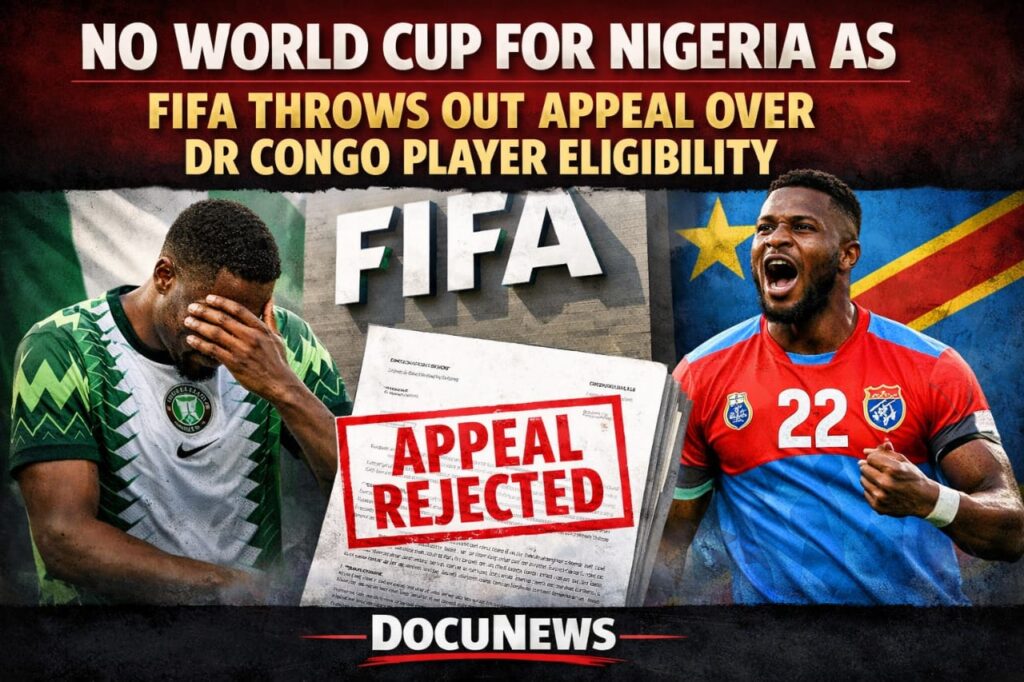
No World Cup for Nigeria as FIFA Throws Out Appeal Over DR Congo Player Eligibility.
No World Cup for Nigeria as FIFA Throws Out Appeal Over DR Congo Player Eligibility
FIFA Rejects Nigeria’s Appeal on Player Eligibility. Nigeria’s quest to qualify for the 2026 FIFA World Cup has suffered a crushing blow after FIFA officially dismissed the country’s appeal over the eligibility of a Democratic Republic of Congo (DR Congo) player. As a result, the world football governing body upheld the original match result, leaving Nigeria without any administrative route back into contention.
This decision has sparked widespread reactions across Nigeria and beyond. Fans, former internationals, analysts, and football administrators have all weighed in. While emotions continue to run high, the ruling delivers a clear message: the Super Eagles’ hopes of qualification will not be revived through off-field decisions.
According to FIFA, the contested match stands as played. Consequently, DR Congo retains its points, while Nigeria gains nothing from the appeal. For many supporters, this outcome confirms the worst fears surrounding an already difficult qualification campaign. Read Also Igbo Community Visits Nnamdi Kanu in Sokoto Prison, Shares Christmas Meals with 1,300 Inmates
How the Appeal Began
Nigeria’s appeal followed a closely watched World Cup qualifying match against DR Congo. Shortly after the fixture, concerns emerged regarding the eligibility of one DR Congo player who featured in the encounter.
Based on these concerns, the Nigeria Football Federation (NFF) submitted a formal complaint to FIFA. The federation argued that the player did not fully meet FIFA’s eligibility requirements at the time of the match.
Initially, optimism spread among Nigerian supporters. Many believed FIFA’s strict regulatory framework could work in Nigeria’s favor. After all, previous qualification cycles have seen teams lose points due to administrative violations.
However, FIFA responded by launching a comprehensive review. That process involved documentation from both football associations, player registration records, and relevant competition regulations.
FIFA’s Final Decision Explained
After completing its review, FIFA dismissed Nigeria’s appeal. The governing body stated clearly that DR Congo followed all required procedures regarding player registration and eligibility.
Furthermore, FIFA emphasized that appeals must rely on verifiable breaches of regulations. In this case, investigators found no evidence strong enough to justify sanctions or point deductions.
As a result, FIFA confirmed that the match result would remain unchanged. The decision also marked the end of the case, as no further internal appeal options exist within FIFA’s framework.
For Nigeria, this ruling represents a final administrative verdict with far-reaching consequences.
What the Ruling Means for Nigeria’s 2026 Campaign
In practical terms, FIFA’s decision severely damages Nigeria’s chances of reaching the 2026 World Cup. Without the points Nigeria hoped to gain from the appeal, the Super Eagles now face an almost impossible path.
From the start of the qualifiers, expectations ran high. Nigeria entered the race with a talented squad and a strong football pedigree. Many analysts predicted early dominance.
Instead, inconsistent performances, missed opportunities, and dropped points defined the campaign. Consequently, Nigeria slipped behind rivals in the group standings. It really hurts as FIFA Rejects Nigeria’s Appeal on Player Eligibility
The appeal against DR Congo emerged as a potential turning point. Now, with FIFA’s dismissal, that final administrative lifeline has disappeared.
Nigeria Football Federation Reacts
Following FIFA’s announcement, the Nigeria Football Federation expressed disappointment but acknowledged the ruling. In a brief statement, NFF officials confirmed receipt of FIFA’s decision. That FIFA Rejects Nigeria’s Appeal on Player Eligibility
According to the federation, the appeal aimed to protect Nigeria’s sporting interests. Officials maintained that they acted within their rights under FIFA regulations.
At the same time, the NFF urged supporters to remain calm. The federation stressed the importance of focusing on rebuilding and long-term development rather than dwelling on setbacks.
Although the ruling hurts, NFF leaders insist that Nigerian football must now look ahead.
DR Congo’s Response to the Verdict
On the opposite side, DR Congo football authorities welcomed FIFA’s decision. Officials described the ruling as confirmation that their federation complied fully with international rules.
According to DR Congo’s football body, the eligibility complaint caused unnecessary distraction. Nevertheless, they expressed relief that the matter has now been resolved.
With the case closed, DR Congo has shifted its focus entirely to on-field performance and qualification objectives.
Voices from Former Super Eagles Players
Several former Nigerian internationals have reacted to the development. While disappointment dominates their reactions, many also pointed to deeper structural problems.
Some former players argued that Nigeria should never depend on administrative rulings to qualify for major tournaments. According to them, matches should be settled on the pitch.
Others emphasized the need for stability in coaching, player selection, and football administration. In their view, frequent changes undermine long-term success.
Fans React Across Nigeria and Abroad
Across Nigeria, the news triggered emotional reactions. On radio programs and social media, fans expressed frustration, sadness, and anger.
Many supporters blamed poor planning and leadership. Others criticized tactical decisions and missed chances earlier in the qualifiers.
Despite differing opinions, one message stands out clearly: missing another World Cup deeply hurts Nigerian football pride.
Broader Implications for Nigerian Football
Missing the 2026 World Cup would mark another painful chapter for Nigeria. As Africa’s most populous nation, expectations remain high.
Consequently, experts now call for meaningful reforms. These include stronger youth development systems, improved domestic league management, and greater administrative transparency.
In the long run, analysts argue that sustainable success requires planning rather than crisis management.
African Football and the CAF Context
Beyond Nigeria, the ruling highlights how unforgiving African World Cup qualifiers can be. Every dropped point carries heavy consequences.
For CAF nations, the decision also reinforces FIFA’s strict approach to eligibility disputes. Compliance leaves little room for error.
Therefore, football associations must prioritize discipline both on and off the field.
Is Qualification Still Possible?
Mathematically, Nigeria still has a chance. However, realistically, the path remains extremely narrow.
Even with perfect results, Nigeria must rely on favorable outcomes elsewhere. As a result, most analysts already view qualification as unlikely.
Nevertheless, football often defies expectations. For now, however, the odds remain firmly against the Super Eagles.
Lessons from the Failed Appeal
This episode offers clear lessons. First, Nigeria must focus on winning matches rather than legal battles.
Second, strong preparation and consistency matter more than last-minute appeals.
Finally, accountability at every level remains essential for future success.
Conclusion: A Harsh Reality Check
FIFA’s dismissal of Nigeria’s appeal closes an important chapter in the Super Eagles’ 2026 World Cup journey. The ruling removes any administrative escape route.
While disappointment dominates today, the future depends on how Nigerian football responds. Reform, reflection, and renewal now matter more than ever.
For the moment, however, the message is clear: no World Cup for Nigeria through administrative means.
Internal Link: Nigeria’s World Cup Qualification History
Outbound Link: FIFA Official Website
DocuNews Central