


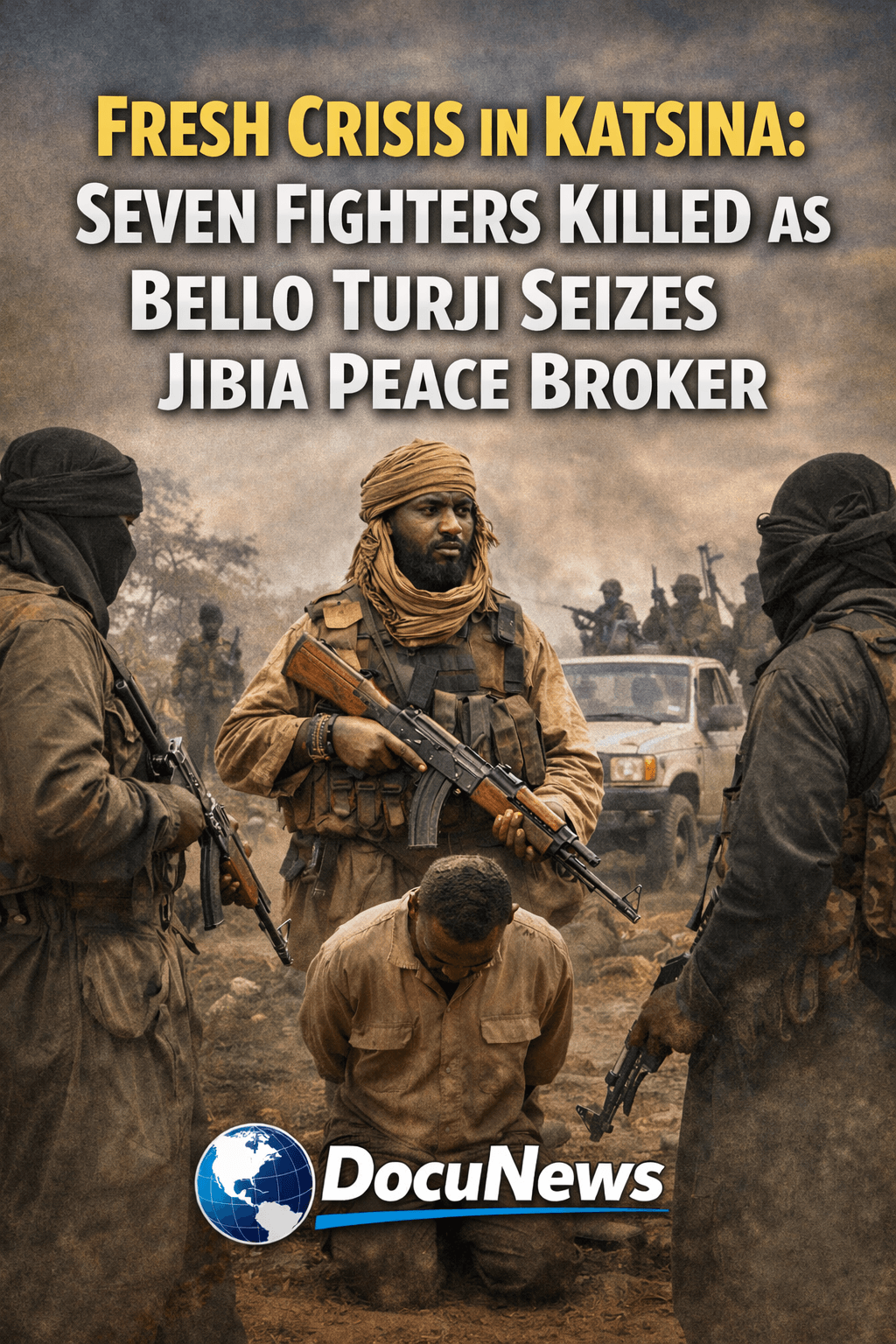
Photo Credit Visit Disclaimers: Use Of AI Images In Our Newsletters
Peace rarely collapses quietly. In northern Nigeria, fragile agreements often unravel amid suspicion, rivalry, and gunfire. What unfolded recently in Katsina State followed this familiar pattern. A peace deal that once calmed nerves in Jibia has now given way to fear, uncertainty, and renewed tension. Communities that had begun to breathe again are once more on edge.
On January 27, 2026, tension escalated sharply in Jibia Local Government Area of Katsina State after notorious bandit leader Bello Turji confirmed the capture of a rival commander who played a central role in negotiating Jibia’s peace agreement. The violent clash that followed reportedly left seven fighters dead, undermined months of calm, and raised fresh concerns about the future of community-led peace efforts in Nigeria’s northwest.
The incident has sent shockwaves across Katsina and neighboring states. It has also reignited debate about the sustainability of peace deals negotiated with armed groups whose alliances remain fluid and whose internal rivalries often turn deadly.
Read also Military Patrol Hit Hard as ISWAP Captures 13 Soldiers in Borno
Why Jibia Became a Symbol of Fragile Peace in Katsina
Jibia is more than a border town. It occupies a strategic position along Nigeria’s northern frontier, linking Katsina State to Zamfara and the Niger Republic. This geography makes it economically important and security-sensitive at the same time. Over the years, bandit groups exploited the terrain, using nearby forests and cross-border routes to evade security forces.
For a long period, residents endured repeated attacks. Armed men raided villages, abducted travelers, rustled cattle, and imposed levies on farmers and traders. Daily life became unpredictable. Fear replaced routine. Many families fled to safer towns.
Against this backdrop, the peace agreement reached in early 2025 offered rare optimism. Community leaders, intermediaries, and selected bandit commanders agreed to halt attacks and reduce hostilities. Roads reopened. Markets resumed operations. Farming activities slowly returned.
According to reports by Freedom Square TV, abducted persons were released and informal checkpoints dismantled. Although cautious, residents welcomed the relative calm. Jibia became a reference point for negotiated peace in Katsina.
You may have missed this Six Killed, Twenty Kidnapped as Bandits Strike Gombe Communities
The Peace Broker Behind the Jibia Agreement
At the center of the agreement stood Abdu Lankai, a bandit leader with significant influence around the Jibia axis. Unlike many commanders, Lankai maintained communication channels with community mediators and local stakeholders.
Residents and security observers said his authority helped enforce ceasefire terms. His fighters reportedly refrained from attacks within agreed zones. Community leaders, in turn, encouraged dialogue and restraint.
However, peace altered internal dynamics among armed groups. Lankai’s role elevated his profile. Rival commanders grew uneasy. Some viewed the peace deal as favoritism. Others feared losing control of lucrative routes and territories.
These tensions remained largely hidden from public view. Yet they continued to simmer beneath the surface, waiting for a trigger.
January 27, 2026: How Seven Fighters Were Killed
The turning point came on January 27. Sources familiar with the incident told Nigerian media that a meeting was arranged to address growing disagreements between rival bandit factions operating around Jibia.
The meeting reportedly involved fighters loyal to Abdu Lankai and commanders aligned with Bello Turji, including figures known as Dogo Rabe and Black. It was presented as a reconciliation effort.
Instead, violence erupted.
Gunfire broke out shortly after the meeting began. Fighters scattered into surrounding bushes. Some attempted to flee. Others were overwhelmed by superior numbers and firepower.
By the time the clash ended, at least seven fighters loyal to Lankai had been killed. Lankai himself was captured alive. Bello Turji later confirmed the capture through channels linked to his network.
The incident was widely reported by Legit.ng, which described it as a major setback for peace efforts in Katsina.
Why Bello Turji’s Role Deepens the Crisis
Bello Turji remains one of the most notorious bandit leaders in Nigeria’s northwest. His influence stretches across parts of Zamfara, Sokoto, and Katsina states. Despite sustained military pressure, his network continues to operate.
Security analysts describe Turji as calculating and ruthless. He understands territory, loyalty, and fear. He also understands the symbolism of power moves.
By seizing the peace broker behind Jibia’s agreement, Turji sent a clear message. Control, rather than compromise, defines his leadership style.
Previous reporting by PRNigeria shows how Turji’s actions have repeatedly disrupted negotiated peace initiatives across the region.
Many people are reacting to this Pregnant Woman Abducted in Ondo as 85-Year-Old Victim Escapes
Why the Death of Seven Fighters Matters
The reported deaths carry significance beyond the immediate clash. Each fatality represents a breakdown of restraint that peace agreements are meant to encourage.
First, the deaths confirm that rival bandit factions remain heavily armed and prepared for confrontation. Second, they show that negotiated peace does not eliminate violence but can redirect it internally.
Third, the killings demonstrate how quickly stability can unravel when agreements lack monitoring and enforcement mechanisms.
For residents, the sound of gunfire carried a familiar warning. Calm, once again, proved temporary.
How the Jibia Peace Deal Collapsed
The breakdown did not occur overnight. Weeks before the clash, reports emerged of growing tension between armed groups operating along the Jibia corridor.
Some fighters accused Lankai of benefiting disproportionately from negotiations. Others suspected him of sharing information with intermediaries.
Meanwhile, rival commanders viewed the peace deal as an obstacle to their influence. Without a neutral enforcement structure, grievances escalated unchecked.
By the time the reconciliation meeting was convened, trust had already eroded beyond repair.
Impact on Jibia Residents and Nearby Communities
For residents of Jibia, the return of violence reopened old wounds. Traders reduced business hours. Farmers hesitated to return to distant fields.
Parents expressed concern over children’s safety. Transporters avoided certain routes. Fear spread faster than official information.
Several residents told local journalists that movement declined sharply after news of the clash circulated. The psychological toll deepened uncertainty.
Communities that had hoped peace would endure now brace for possible retaliation.
Security Implications for Katsina State
The incident exposes gaps in Katsina’s broader security strategy. While negotiated peace deals can reduce immediate violence, they often lack sustainability.
Experts argue that agreements must be backed by continuous monitoring, protection for mediators, and rapid response capacity.
Without these safeguards, deals remain vulnerable to internal power struggles and violent takeovers.
The Jibia experience underscores the limits of dialogue without enforcement.
Expert Analysis on Bandit Peace Deals
Security analysts say the Jibia crisis reflects a broader pattern across northern Nigeria. Armed groups are not unified movements. They are fluid networks driven by profit, territory, and survival.
According to analysis by Vanguard, peace deals often collapse when power balances shift.
The failure of the Jibia agreement fits this pattern, highlighting the challenge of sustaining negotiated calm in volatile environments.
Could the Crisis Spread Beyond Jibia?
Security observers warn that instability rarely remains confined. Jibia’s border location increases the risk of spillover into nearby communities and cross-border routes.
If unchecked, renewed clashes could disrupt trade, farming, and movement across the region. This risk heightens pressure on authorities to respond decisively.
Residents remain watchful, hoping escalation can still be contained.
What Comes Next for Katsina?
The path forward remains uncertain. Some community leaders are calling for renewed dialogue, but with stronger safeguards. Others argue for increased military presence.
Government officials face difficult choices. Any response must balance enforcement with community trust and intelligence-driven operations.
For now, residents of Jibia wait. Their hopes rest on whether lessons from this collapse will shape future security strategies.
Final Reflections
The fresh crisis in Katsina marks a critical turning point. The killing of seven fighters and the seizure of a peace broker expose the fragility of negotiated calm.
It underscores the influence of figures like Bello Turji. It also reminds Nigerians that insecurity in the northwest remains complex and deeply rooted.
For Jibia and Katsina State, the search for lasting peace continues. Whether it succeeds will depend on learning from this painful setback rather than repeating it.
For More Security Updates please visit


One thought on “Seven Fighters Killed In Kastina as Bello Turji Seizes Jibia Peace Broker”