





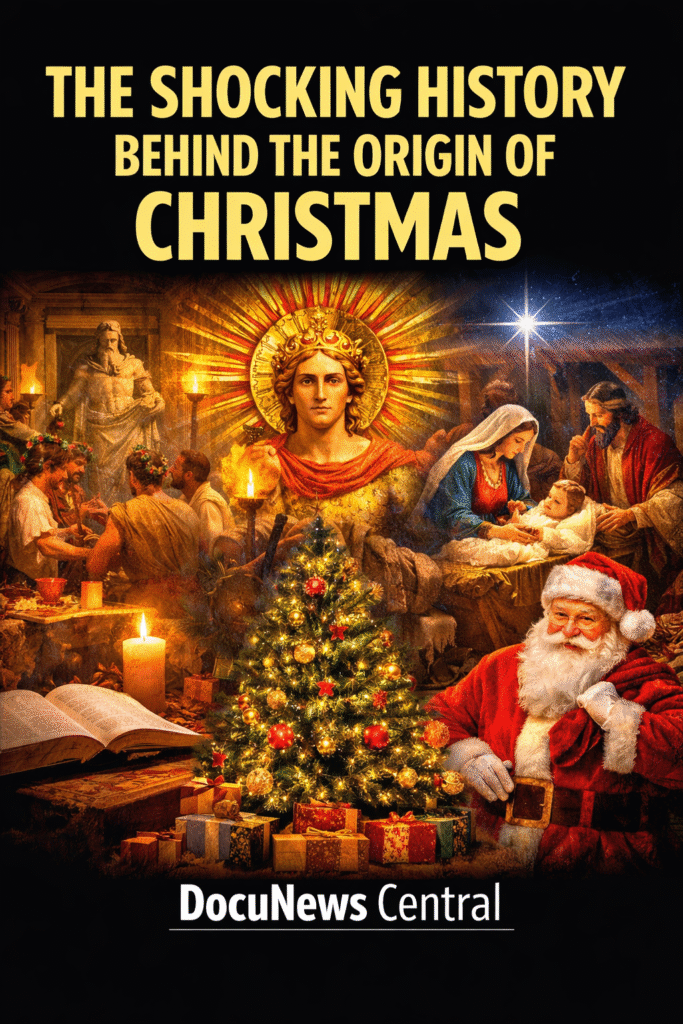
THE SHOCKING HISTORY BEHIND THE ORIGIN OF CHRISTMAS
The holiday known as Christmas — widely celebrated on December 25 — boasts a tangled history, one that blends pagan traditions, lunar-date guesswork, and centuries-old church decisions. However, what many people consider a purely Christian celebration emerged only gradually. Over time, church leaders adapted existing festivals and cultural customs for new purposes. As a result, the true origin of Christmas often surprises those who examine it closely.
This in-depth report, based on DocuNews Central research, explores historical records, early Christian practices, and well-documented scholarly findings. Importantly, the goal is to present facts clearly so readers can make informed conclusions.
The Winter Solstice and Ancient Pagan Festivals
Long before Christianity emerged, civilizations across Europe and the Roman world celebrated the winter solstice. Because it marked the shortest day of the year, people viewed it as a turning point when light slowly returned.
For example, Northern European communities observed Yule, a festival centered on fire, feasting, and evergreen symbols of life. Similarly, ancient Romans celebrated Saturnalia, a mid-December festival marked by gift-giving, public celebrations, and social role reversals.
Later, in AD 274, Roman Emperor Aurelian declared December 25 the birthday of Sol Invictus, meaning the “Unconquered Sun.” According to DocuNews Central research, this date already carried powerful religious meaning centuries before Christmas existed.
For deeper historical context, see History.com’s analysis of Christmas origins.
Why December 25 Became Central
Notably, the Bible does not mention the date of Jesus’ birth. Neither Jesus nor his apostles instructed followers to commemorate it. Instead, early Christians focused on his teachings, death, and resurrection.
Historical records show that December 25 was not associated with Jesus until more than 200 years after his life. Many historians believe church authorities selected the date to align Christianity with popular pagan festivals already familiar to converts.
Although some scholars propose the “calculation theory,” DocuNews Central research indicates that cultural alignment played a far greater role.
Related reading: Early Christian Worship Practices.
Biblical Clues That Challenge a Winter Birth
The Gospel accounts describe shepherds living outdoors and watching their flocks at night. However, historical climate records show that Judean winters were cold and rainy, making such activity unlikely in late December.
Furthermore, early Christians avoided birthday celebrations altogether, viewing them as pagan customs. Consequently, no evidence exists that first-century believers celebrated Jesus’ birth.
See also: Biblical History & Interpretation.
The Church’s Strategy of Adaptation
As Christianity spread throughout the Roman Empire, church leaders faced widespread pagan traditions. Instead of abolishing them, many were rebranded with Christian symbolism.
For instance, sun-related imagery was reinterpreted spiritually, evergreen plants symbolizing life were absorbed into celebrations, and gift-giving continued under a new meaning.
According to DocuNews Central research, this strategy reduced resistance and accelerated conversion.
External reference: Encyclopedia Britannica on Christmas.
Pagan Traditions Within Modern Christmas
Many customs now associated with Christmas existed long before Christianity. Evergreen trees, wreaths, lights, feasting, and gift exchanges were central to ancient solstice celebrations.
Over time, these practices were presented as Christian traditions, despite lacking biblical instruction.
Internal reading: Religious Traditions Explained.
Early Christian Resistance to Christmas
Historical records reveal that some Christian groups strongly opposed Christmas. During the Protestant Reformation, several leaders rejected it as unbiblical.
In 17th-century England and colonial America, Christmas celebrations were even banned. These actions reflected long-standing concerns about its origin.
How Christmas Became a Global Tradition
By the 19th century, Christmas transformed into a family-centered cultural celebration. Literature, folklore, and commerce reshaped the holiday significantly.
Characters such as Santa Claus emerged from non-biblical sources, reinforcing the holiday’s cultural nature.
What the History Really Shows
The origin of Christmas reveals cultural blending rather than scriptural command. Pagan festivals, political influence, and evolving tradition shaped the holiday over centuries.
Understanding this history helps individuals decide how they personally approach Christmas.
Conclusion
The shocking history behind the origin of Christmas rests on documented facts. December 25 was a pagan festival long before it was linked to Jesus’ birth. The Bible neither commands nor records such a celebration.
Christmas, as observed today, developed through tradition layered upon tradition. According to DocuNews Central research, understanding this history empowers people to make informed, conscience-based decisions rather than follow customs blindly.