





Photo Credit Visit Disclaimers: Use Of AI Images In Our Newsletters
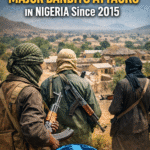
Timeline of major bandits attack in Nigeria since 2015 stands as a sobering record of how armed violence gradually transformed from scattered rural crimes into one of Nigeria’s most persistent security threats. Over the past decade, bandit attacks have reshaped daily life across several states, disrupted agriculture, crippled education, and forced millions to live under constant fear. As incidents multiplied, the pattern of violence evolved, revealing deeper structural weaknesses within governance, border control, and rural security.
Beginning in 2015, with early flashpoints across Zamfara, Katsina, Kaduna, and parts of Niger State, bandit attacks steadily intensified in both scale and brutality. What started as cattle rustling and village raids soon escalated into mass kidnappings, coordinated assaults, and prolonged territorial control by armed groups. This timeline documents the major attacks, defining moments, and shifting strategies that have shaped Nigeria’s banditry crisis.
For Security Updates In Nigeria Visit Security updates Nigeria
Understanding the Roots of Banditry in Nigeria
Banditry in Nigeria did not appear overnight. Instead, it emerged from a complex mix of economic hardship, environmental stress, weak law enforcement, and unregulated arms flow. For years, rural communities struggled with limited security presence. Consequently, criminal groups exploited the vacuum.
Furthermore, competition over land and resources intensified tensions between farming and herding communities. As these disputes grew unresolved, criminal networks inserted themselves as armed power brokers. Over time, violence became normalized in some regions.
Additionally, illegal mining sites, especially in Zamfara State, provided funding streams for armed groups. These sites attracted weapons traffickers and mercenaries. According to analysis by the International Crisis Group, the convergence of economic desperation and weak governance created fertile ground for organized banditry.
Read More Kaduna banditry update: How armed groups attacked villages this week
2015–2016: Early Attacks and Warning Signs
Between 2015 and 2016, bandit attacks largely stayed under the national radar. Incidents mainly involved cattle theft, sporadic village raids, and clashes between armed groups and local vigilantes. However, communities in Zamfara State repeatedly raised alarms.
Villages such as Anka, Shinkafi, and Maru experienced nighttime raids. Armed men stormed homes. Livestock disappeared. Farmers abandoned fields. Despite these warning signs, response mechanisms remained limited.
Meanwhile, porous borders enabled a steady influx of small arms. Forests like Sububu and Rugu gradually became hideouts. This development allowed bandits to operate with relative freedom.
Read About DocuNews ABOUT US- DOCUNEWS CENTRAL
2017: Escalation Into Organized Violence
By 2017, bandit attacks grew more organized and lethal. Armed groups began coordinating assaults across multiple villages. Casualty figures increased sharply. Entire communities fled.
In Zamfara State alone, dozens of civilians were killed within months. Attacks targeted men, women, and children indiscriminately. Fear spread rapidly.
Security forces launched operations. However, difficult terrain and limited intelligence hindered success. As a result, bandits maintained operational advantage.
2018: Expansion Beyond Zamfara
The year 2018 marked a significant turning point. Bandit violence expanded beyond Zamfara into Katsina, Sokoto, Niger, and parts of Kaduna State. This shift transformed banditry into a regional crisis.
Highways became dangerous. Travelers faced ambushes. Commercial transport slowed. Economic activity suffered.
Additionally, kidnapping emerged as a profitable tactic. Armed groups abducted villagers and demanded ransoms. Families sold assets to secure releases. According to Amnesty International, these developments severely violated human rights across affected regions.
2019: Mass Killings Draw National Attention
In 2019, bandit attacks reached unprecedented levels. Mass killings shocked the nation. In several Zamfara communities, entire villages were razed.
Hundreds died within months. Thousands fled. Internally Displaced Persons camps expanded rapidly.
In response, the federal government banned artisanal mining in Zamfara State. The move aimed to cut off funding sources. However, enforcement proved challenging. Bandits retaliated with further violence.
2020: Kidnapping Becomes a Central Strategy
During 2020, kidnapping solidified as the core strategy of bandit groups. Armed men targeted highways, villages, and isolated settlements.
The COVID-19 pandemic worsened conditions. Economic hardship increased vulnerability. Security operations faced logistical strain.
Kidnappings surged in Niger and Kaduna States. Ransom payments fueled weapon acquisition. As noted by the United Nations, criminal networks adapted quickly to changing circumstances.
2021: School Abductions Shock Nigeria
The year 2021 marked one of the darkest chapters. Bandits began targeting schools. In February, students were abducted from Government Girls Science Secondary School in Jangebe, Zamfara State.
Similar incidents followed in Niger and Kaduna. Parents panicked. Schools shut down. Education suffered deeply.
International condemnation followed. UNICEF warned that prolonged school closures could damage an entire generation’s future.
2022: Military Pressure and Tactical Shifts
In 2022, security forces intensified operations. Airstrikes targeted forest camps. Ground assaults followed.
Several notorious bandit leaders were neutralized. Nevertheless, violence persisted. Groups fragmented into smaller cells.
Attacks became less predictable. Bandits adjusted tactics. Civilian suffering continued.
2023: Political Transition and Persistent Violence
Bandit attacks continued through 2023 despite political transitions. Zamfara, Katsina, Niger, and Kebbi remained hotspots.
Elections heightened tension. Security forces faced simultaneous threats nationwide.
According to analysis by the Brookings Institution, long-term solutions require governance reform, economic inclusion, and sustained security coordination.
2024–2025: Recent Trends and Ongoing Threats
Between 2024 and early 2025, banditry persisted with evolving patterns. Some groups aligned with extremist elements. Others focused purely on ransom-driven crime.
Technology improved surveillance. Intelligence sharing increased. Still, terrain challenges remained significant.
Communities demanded accountability. Media platforms like DocuNews Central continued documenting attacks, preserving public awareness and historical records.
Humanitarian and Economic Impact
The humanitarian cost has been enormous. Thousands lost lives. Millions faced displacement.
Agriculture declined. Food insecurity increased. Education disruptions persisted.
According to the World Bank, insecurity directly undermines development, investment, and poverty reduction efforts.
Why This Timeline Matters
This timeline of major bandits attack in Nigeria since 2015 highlights missed opportunities, evolving threats, and urgent lessons.
Security responses alone remain insufficient. Addressing root causes remains essential.
Accurate documentation supports accountability, policy reform, and prevention.
The Road Ahead
Nigeria faces a defining security challenge. Banditry tests national resilience.
However, lessons exist within this timeline. Early intervention matters. Community trust matters.
With sustained commitment, transparent governance, and informed reporting, long-term stability remains achievable.