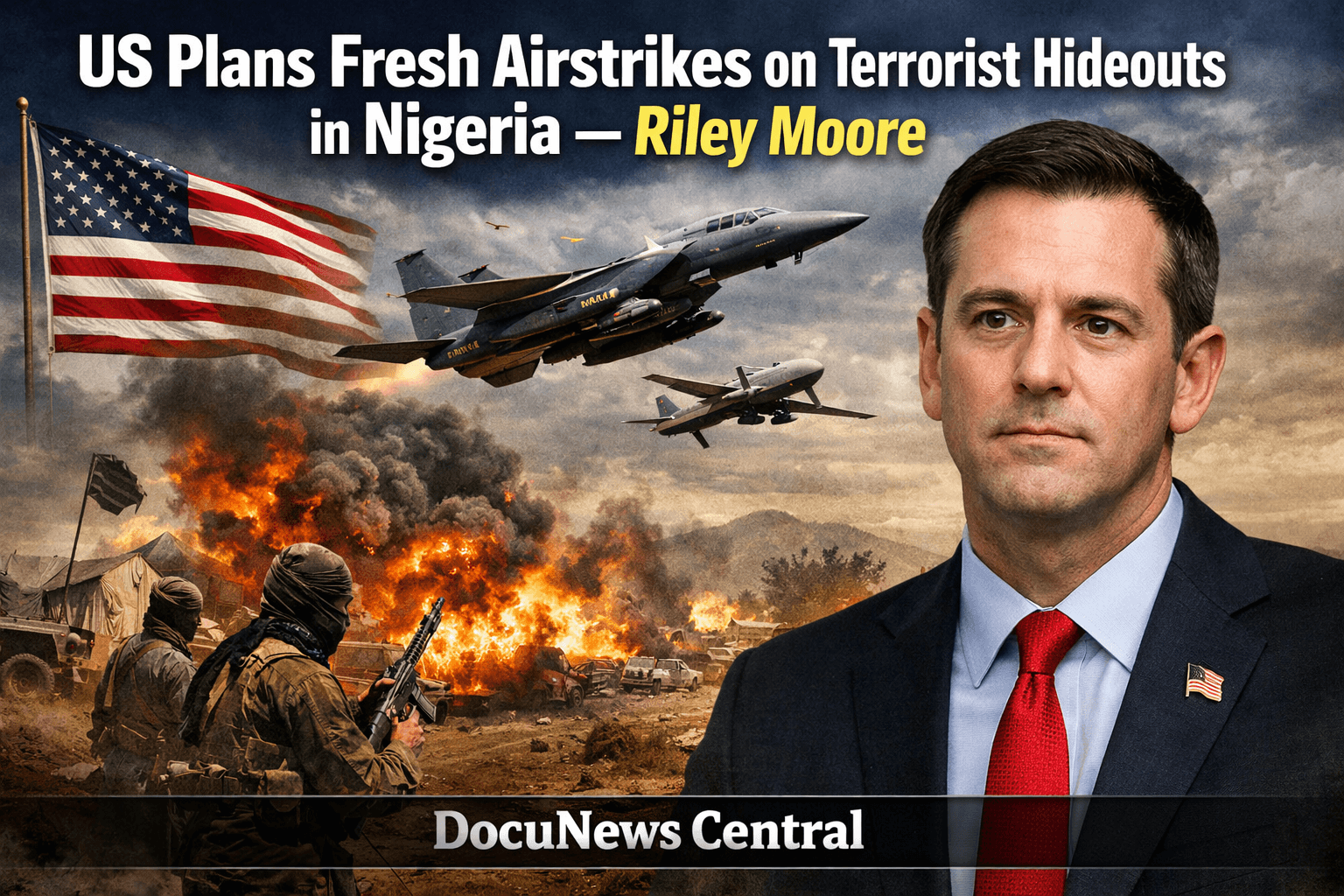
The United States is preparing to intensify its counterterrorism footprint in West Africa as fresh airstrikes on terrorist hideouts in Nigeria are being considered, according to American Congressman Riley Moore. And this made headlines in Nigeria that said US Plans Fresh Airstrikes on Terrorist Hideouts in Nigeria- Riley. The statement, which has sparked diplomatic, military, and public debate, signals a renewed security partnership aimed at dismantling violent extremist networks that continue to destabilize large parts of the country.
Speaking during a recent policy briefing in Washington, Moore emphasized that the evolving threat landscape in Nigeria demands decisive global cooperation. He noted that extremist factions operating across Nigeria’s northern corridor have expanded their influence, making regional stability a shared international concern. Consequently, Washington appears ready to act with precision-based military support.
For Nigeria, the announcement arrives at a time when insecurity remains one of the nation’s most pressing challenges. Communities across Borno, Zamfara, Katsina, Niger, and parts of the North-Central region continue to face attacks, displacement, and economic disruption. Therefore, any foreign military involvement attracts both cautious optimism and intense scrutiny. Also you can Read this too Heavy Airstrikes Rock Zamfara as Nigerian Military Targets Dogo Sule’s Hideout
Background to the US Position
For more than a decade, Nigeria has battled several armed groups, including Boko Haram, Islamic State West Africa Province (ISWAP), and heavily armed bandit syndicates. Although the Nigerian military has recorded strategic successes, evolving tactics by insurgents have prolonged the conflict. As a result, international intelligence sharing and logistical support have become increasingly vital.
The United States has maintained a long-standing security relationship with Nigeria. This partnership includes training programs, intelligence collaboration, equipment transfers, and advisory support. However, direct kinetic involvement, such as airstrikes, remains a sensitive subject due to sovereignty considerations.
According to Moore, the proposed action focuses strictly on identified terrorist hideouts that pose immediate threats to civilian populations and regional security. He stressed that such measures would complement, rather than replace, Nigerian-led operations.
Riley Moore’s Statement and Its Implications
During the briefing, Moore framed the decision within a broader counterterrorism strategy. He explained that extremist groups in Nigeria maintain cross-border links, arms supply routes, and financing channels that extend beyond Africa. Because of this global reach, inaction could produce wider consequences.
He further argued that precision air operations remain one of the most effective tools against entrenched militant camps located in difficult terrain. According to Moore, actionable intelligence has improved significantly, allowing for targeted interventions that minimize civilian harm.
Although Moore did not disclose timelines or operational details, his remarks suggest that planning has reached an advanced stage. Meanwhile, officials within the US defense establishment continue consultations with Nigerian counterparts. Also many people has been reacting to this news Gunmen Storm Odo-Ere Community In Kogi, Kidnap Four Residents
Nigeria’s Security Landscape Today
Nigeria’s security challenges are complex and multifaceted. Insurgency in the northeast persists alongside banditry, kidnapping, and communal violence in other regions. Despite increased defense spending and troop deployments, vast rural territories remain difficult to secure.
Military analysts attribute these challenges to factors such as rugged geography, porous borders, and socio-economic pressures. Consequently, terrorist groups exploit governance gaps to recruit fighters and establish camps.
In recent months, several attacks on civilian targets and military formations have renewed calls for enhanced air support. Therefore, the prospect of American involvement through airstrikes has generated mixed reactions across political and civil society circles. Let me also share this with you… US Launches Surveillance Operations in Sambisa Forest
Government Response and Diplomatic Channels
Officials in Abuja have not issued a formal statement directly addressing Moore’s comments. However, sources within the security sector indicate that discussions with international partners remain ongoing. Nigeria traditionally emphasizes respect for its sovereignty while welcoming technical assistance.
Diplomatic observers note that any direct military action would require clear bilateral understanding. As a result, back-channel negotiations are likely shaping the final approach.
Historically, Nigeria has cooperated with allies through intelligence-driven missions rather than overt foreign combat operations. Therefore, any shift toward airstrike collaboration would represent a notable development.
Public Reaction Across Nigeria
Public opinion remains divided. Some citizens view potential US airstrikes as a necessary intervention that could weaken terrorist networks more rapidly. Others fear unintended consequences, including civilian casualties or escalation.
Human rights organizations have urged transparency and strict adherence to international humanitarian law. They argue that past counterterrorism campaigns, both local and foreign, sometimes produced displacement and long-term trauma.
At the same time, residents in heavily affected regions express fatigue from years of violence. Many believe decisive action could restore economic activity and social stability.
Regional and International Dimensions
Nigeria’s security situation affects the entire West African subregion. Instability often spills across borders into Niger, Chad, and Cameroon. Because of this interconnectedness, regional bodies such as ECOWAS monitor developments closely.
The United States has framed its counterterrorism policy in Africa as partnership-driven. Officials consistently emphasize capacity building rather than occupation. Moore’s comments align with this narrative, highlighting targeted support rather than broad deployment.
International security experts suggest that coordinated pressure on terrorist camps could disrupt supply chains and leadership structures. However, they also caution that military action alone cannot resolve underlying drivers of extremism.
Economic and Humanitarian Considerations
Beyond security, prolonged conflict continues to strain Nigeria’s economy. Agricultural output suffers in insecure regions, trade routes remain disrupted, and humanitarian needs grow. According to aid agencies, millions remain displaced internally.
Therefore, improved security could unlock development opportunities. Investors often cite safety concerns as a major barrier to expansion in northern Nigeria. Consequently, successful counterterrorism efforts may produce long-term economic benefits.
Nonetheless, humanitarian actors stress the importance of post-conflict recovery planning. Airstrikes, while tactical, must align with broader stabilization strategies.
Military Strategy and Precision Operations
Modern airstrike operations rely heavily on intelligence, surveillance, and reconnaissance systems. Advances in satellite imagery and drone technology have transformed targeting accuracy. Moore referenced these improvements while discussing operational planning.
Precision remains central to minimizing collateral damage. Therefore, any strike campaign would likely involve strict rules of engagement and continuous assessment.
Military sources suggest that coordination with Nigerian ground forces would remain essential. Air power alone cannot hold territory or rebuild communities.
Historical Context of US Involvement
The United States has previously supported counterterrorism efforts in Africa through limited air operations, advisory missions, and intelligence support. In Nigeria’s case, assistance has focused more on training and logistics.
Moore’s remarks indicate a potential shift driven by changing threat dynamics. Analysts argue that extremist adaptation necessitates adaptive responses.
Still, history shows that foreign intervention must remain carefully calibrated to avoid backlash or dependency.
Legal and Policy Frameworks
Any US military action abroad operates within a defined legal framework. Congressional oversight, executive authorization, and international law considerations shape decision-making.
Moore emphasized that protecting civilian lives remains paramount. He noted that policy reviews include legal assessments and humanitarian impact evaluations.
Such assurances aim to address concerns raised by advocacy groups and lawmakers alike.
What Comes Next
As discussions continue, attention turns to official confirmation from both governments. Security analysts expect further briefings in the coming weeks.
Nigerians, meanwhile, await clarity on how potential airstrikes could affect daily life. Transparency and communication will play crucial roles in public acceptance.
Ultimately, sustained peace depends on combining military pressure with governance reforms, economic inclusion, and community engagement.
Conclusion
The announcement that the US plans fresh airstrikes on terrorist hideouts in Nigeria, as stated by Riley Moore, marks a significant moment in the country’s ongoing fight against extremism. While the proposal underscores international concern, it also highlights the delicate balance between security cooperation and national sovereignty.
As Nigeria navigates this critical phase, outcomes will depend on strategic coordination, respect for humanitarian principles, and long-term commitment to stability. The coming months will reveal whether this renewed approach can deliver lasting relief to communities affected by years of violence. Please don’t forget to subscribe to DocuNews Central for more Security updates in Nigeria. Here www.docunewscentral.com/#
For continued coverage on Nigeria’s security developments, visit our Security News section. You can also follow international counterterrorism policy updates via the US State Department and regional analysis from ECOWAS.