
 DocuNews Central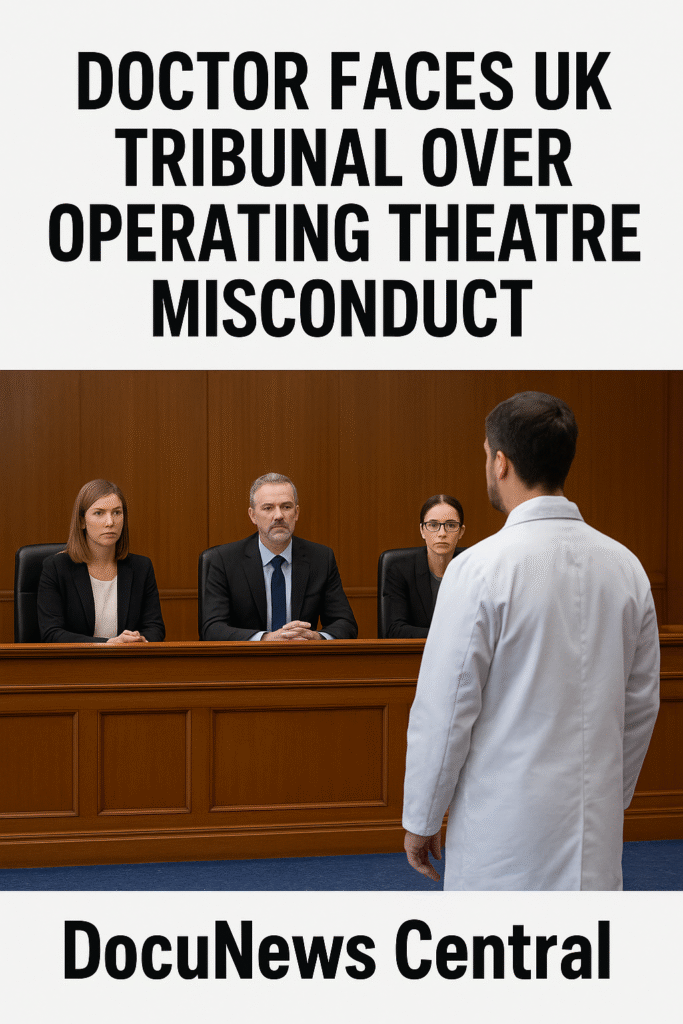
Doctor Faces UK Tribunal Over Operating Theatre Misconduct
Manchester, United Kingdom — A British medical tribunal is examining claims that a hospital doctor acted unprofessionally during surgery.
The case has sparked debate about patient safety and the standards expected of medical staff.
The report first surfaced in The Independent and has drawn wide attention within the United Kingdom’s health sector.
Incident at Tameside Hospital
The allegations concern events at Tameside Hospital in Ashton-under-Lyne on 16 September 2023.
Dr. Suhail Anjum, who worked as an anaesthetist, was assigned to oversee a patient who was under anaesthetic during a surgical procedure.
Tribunal evidence says Dr. Anjum asked a colleague to watch the patient while he stepped out for what he called a short “comfort break.”
He left the theatre for about eight minutes.
According to the testimony, a fellow staff member later found Dr. Anjum in a separate operating theatre in what was described as a compromising situation with a nurse.
The staff member immediately reported what had been seen to hospital management.
The surgical procedure in the original theatre was completed without harm to the patient.
However, the brief absence and the nature of the allegation triggered a formal investigation.
Investigation by the General Medical Council
The matter was referred to the General Medical Council (GMC), the body that regulates doctors in the United Kingdom.
The GMC is legally responsible for making sure doctors maintain high standards of care and conduct.
GMC representatives presented the case to the Medical Practitioners Tribunal Service (MPTS).
This independent tribunal hears cases of alleged professional misconduct.
It has the authority to decide if a doctor’s right to practise medicine should be restricted or removed.
During the hearing, the GMC’s counsel described the eight-minute absence and the discovery made by the nurse who reported the matter.
The tribunal was told that no harm came to the patient during the short time the anaesthetist was away.
Admission and Apology
Dr. Anjum admitted to behaviour that he accepted was unprofessional.
He acknowledged that leaving an anaesthetised patient unattended—except for a colleague covering briefly—put the patient at risk.
In his statement to the tribunal, he called the incident a “one-off error of judgment.”
He said he felt deep shame, adding that he had let down his patient, his colleagues and the hospital trust.
The doctor apologised to all involved and said that he alone was responsible for the lapse.
He also accepted that asking another nurse to watch the patient placed that colleague in an awkward position.
Personal Circumstances
The doctor explained that he had been under personal strain at the time.
He and his wife had recently welcomed a new baby, and he described the period as stressful and overwhelming.
He told the tribunal the situation affected his mental health and his work.
Despite those pressures, he admitted that the stress could not justify his actions.
He said the episode was “shameful” and that he must bear full responsibility.
Resignation and Return to Pakistan
Following the incident, Dr. Anjum resigned from his position at Tameside Hospital in February 2024.
He then returned to his hometown in Pakistan.
The doctor has expressed a wish to resume his medical career in the United Kingdom in the future.
He told the tribunal he hopes to regain the trust of patients and colleagues and to rebuild his professional life.
How the UK Disciplinary System Works
To understand the case, it is important to look at how medical discipline operates in the United Kingdom.
The GMC’s Role
The GMC maintains the medical register—a list of doctors allowed to practise in the UK.
When concerns arise about a doctor’s conduct or competence, the GMC can open an investigation.
This can be triggered by a complaint from a patient, a colleague, or an NHS trust.
Referral to the MPTS
If the GMC finds enough evidence of possible serious misconduct, the case is referred to the Medical Practitioners Tribunal Service.
The MPTS is separate from the GMC to ensure impartiality.
It acts like a court and hears evidence from all sides.
Hearings
Tribunal hearings are usually held in public.
Doctors can be represented by lawyers, and witnesses can be called to give testimony.
The tribunal considers written evidence, witness statements and the doctor’s own explanation.
Possible Outcomes
If the tribunal finds misconduct, it can impose several types of sanctions:
A warning, which stays on the doctor’s record.
Conditions on the doctor’s practice, such as supervision or extra training.
Suspension, which stops the doctor from working for a set time.
Erasure from the medical register, meaning the doctor cannot legally work as a doctor in the UK.
The tribunal must balance patient safety, public confidence in medicine and fairness to the doctor.
Why Professional Conduct Matters
The case highlights the importance of trust in the medical profession.
Doctors are expected to put patients’ interests first at all times.
Even short absences during surgery can create risk.
Actions that undermine trust—whether or not direct harm occurs—are treated seriously.
Experts say that public confidence in healthcare depends on strict standards of behaviour.
Medical staff must follow not only clinical guidelines but also clear ethical rules.
Breaches of those standards can damage the reputation of hospitals and the wider profession.
Impact on Colleagues and Patients
While the patient in this case suffered no harm, the incident placed unnecessary pressure on the theatre team.
Colleagues had to continue the operation while also dealing with the sudden absence of the anaesthetist.
Such incidents can cause stress and reduce team morale.
They can also raise questions for patients and families about the safety culture of the hospital.
The NHS has repeatedly emphasised the need for open reporting of mistakes or misconduct so that problems can be addressed quickly.
Broader Lessons for Healthcare
This case is a reminder that personal stress can affect professional behaviour.
Medical organisations often provide support services for staff facing mental-health or family pressures.
However, professionals are still responsible for maintaining standards.
Training programmes now place greater emphasis on wellbeing and resilience, encouraging staff to seek help before stress leads to poor decisions.
Next Steps in the Hearing
The MPTS will reconvene on Friday to decide what sanction, if any, should be applied to Dr. Anjum.
Possible outcomes range from a formal warning to suspension or even removal from the medical register.
The tribunal will weigh the doctor’s admission of wrongdoing and his personal circumstances against the need to maintain public trust in the profession.
Key Takeaway
The case at Tameside Hospital shows that professional integrity is as critical as clinical skill.
Even when no patient harm occurs, actions that compromise trust can lead to serious consequences.
The coming tribunal decision will determine Dr. Anjum’s professional future and will stand as a signal of how seriously the UK medical system treats breaches of conduct.