
 DocuNews Central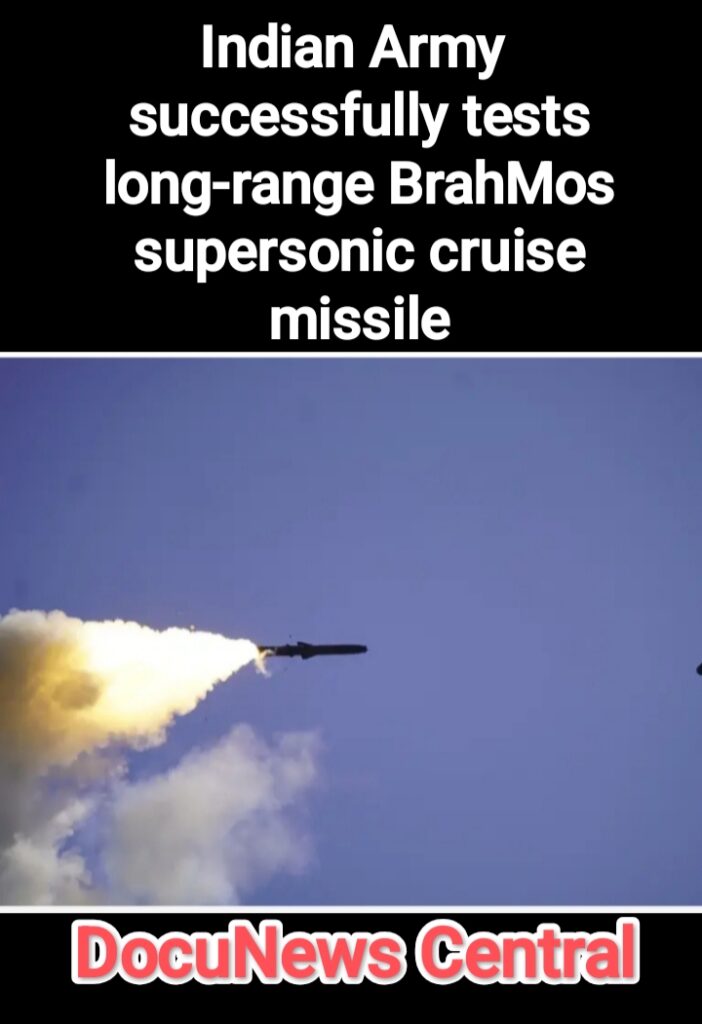
Indian Army successfully tests long-range BrahMos supersonic cruise missile
Author: DocuNews Central
Overview
The Indian Army has achieved a major step in its defence plan. The force tested the long-range BrahMos supersonic cruise missile. The launch worked as expected. As a result, India gained stronger strike reach and better tactical options. Moreover, the trial improved military readiness and boosted confidence in home-grown defence efforts.
For related updates, you may also check these reports: First Bank parent company sale, Iran laser nuclear breakthrough, and Ojibara of Bayagan kidnapping.
Test details
The missile launched from a ground platform. It reached high speed quickly. Then, it held a stable flight path. After that, the seeker locked onto the target. Finally, it hit the point with sharp accuracy. Because of this chain of results, commanders confirmed its smooth performance.
Why the test matters
The success came at a time of rising global tension. Therefore, India needed clear progress in its defence tools. The test offered solid proof of growth. It also showed that India can advance its systems even under pressure. Besides that, the trial supported the push for stronger patrol and quick action capability.
Key strengths of the BrahMos
The BrahMos carries a blend of speed, precision and control. Furthermore, it can travel at supersonic levels through most of its flight. The missile can also adjust direction during travel. Hence, enemy defences struggle to track or intercept it. These traits create a strong advantage in both land and maritime roles.
Range improvement
The long-range variant increases India’s strike envelope. Because of this, ground forces can reach more distant threats. In addition, the new range supports better coverage for coastlines, islands and border areas. This advantage helps India stay ready for modern challenges.
Operational edge
The missile supports fast action. In many cases, speed reduces an opponent’s response time. Also, high accuracy reduces collateral impact. Therefore, commanders gain a reliable tool for critical missions. Moreover, the system adapts well to various terrains and platforms.
Maritime value
The Indian Navy benefits as well. Sea units need strong deterrence. Thus, BrahMos creates a strong shield for ocean zones. Ships equipped with the missile can defend wide routes and key choke points. Since trade depends on secure waters, this improves national stability.
Air deployment benefits
The air-launched version offers even more reach. It helps aircraft strike from safe distances. Additionally, this version boosts mobility in joint missions. Because of that, the Air Force gains strategic flexibility.
Impact on indigenous defence
India continues to expand its own defence industry. The BrahMos project stands as a key example. Many local teams take part in its design, testing and support. As a result, the country reduces outside dependence. Also, technical lessons from this work flow into other programmes.
Economic effects
The system supports jobs in research, assembly and logistics. Besides that, the missile raises export interest. Some nations look for fast, dependable systems. Thus, India may gain both strategic and economic value from this success.
Regional security context
Neighbouring areas face frequent tension. Because of that, strong defence assets remain essential. The BrahMos test sends a message of readiness. It also supports balanced stability across the region. When nations stay ready, conflict risk stays low.
Training and readiness
Trials help crews practise real procedures. They gain sharper control skills. Moreover, teams refine communication and timing. With each test, units grow more confident. Therefore, overall readiness rises.
Safety and control steps
Before launch, engineers check every system. Then, authorities clear the range. During flight, tracking teams oversee the path. After impact, data units gather information. This cycle ensures safe and controlled execution.
Expert comments
Anal