
 DocuNews Central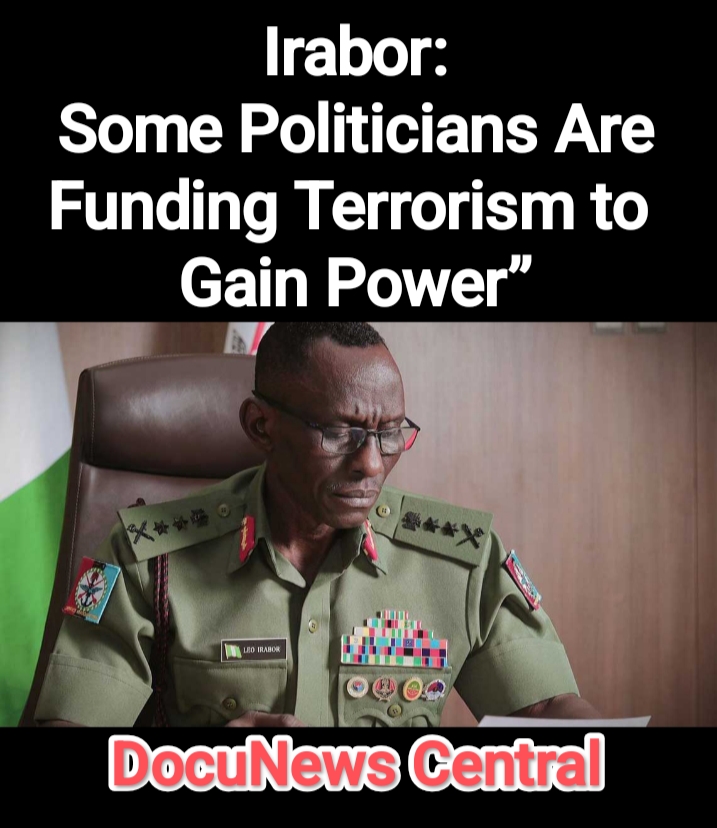
Irabor: Some Politicians Are Funding Terrorism to Gain Power
Former Chief of Defence Staff Gen. Lucky Irabor reveals that some politicians are fuelling terrorism to gain political advantage, stressing the deep complexity of Nigeria’s insecurity landscape.
Nigeria continues to face a growing wave of insecurity across several regions. Although public debates often center on the surface issues driving this crisis, former Chief of Defence Staff (CDS), Gen. Lucky Irabor (retd.), has drawn attention to a deeper and more troubling dimension. He explained that some political actors, driven by personal ambition, are not only exploiting insecurity but are also fuelling it for strategic advantage. His position has revived a national conversation about the roots of terrorism and the forces that sustain it.
The remarks came at a time when several communities across the country remain trapped in fear. While many observers often blame external influences, poor governance, or economic hardship, Irabor insists the problem is multi-layered. According to him, the real story behind the chaos is far more complex than the narratives that dominate airwaves and public forums. In fact, he stresses that political interests, greed, and unhealthy power struggles have created an environment where criminal networks thrive.
As the country looks ahead to upcoming political cycles, his statement has raised new questions about the morality and intentions of certain leaders. Moreover, his perspective forces Nigerians to look beyond sensational headlines and consider the complicated web of motivations that sustain criminal activity. Consequently, this revelation has amplified debates about leadership responsibility, national unity, and the moral health of the political class.
A Nation Under Siege
For years, Nigeria has struggled with insurgency, kidnappings, banditry, and other violent crimes. Although the nation’s armed forces have recorded victories, insecurity persists. Gen. Irabor’s statement suggests that these persistent problems may not be due to lack of military strength. Instead, he points to political sabotage, hidden agendas, and deliberate interference. Because of this, many citizens are now asking how deeply politics has penetrated the criminal landscape.
During his address, Irabor explained that insecurity has evolved beyond simple acts of violence. It has become an industry. It has become a tool. It has become a bargaining chip used by powerful figures who seek influence and dominance. Therefore, he warns that until the country confronts the political side of this crisis, security agencies will continue to fight a difficult and uneven battle.
This observation highlights a painful truth: terrorism does not thrive without support. Funding channels, logistical networks, and safe political alliances often support it from behind the scenes. While many citizens might assume insecurity is driven only by poverty or regional grievances, Irabor reveals that political sponsorship adds fuel to the fire.
Why Political Actors Exploit Violence
Irabor’s remarks suggest a disturbing reality. Some politicians benefit when communities experience fear. Because fear weakens public trust, creates divisions, and distracts the population, political actors can use crises to rebrand themselves as rescuers or strong defenders. In addition, insecurity can influence voter behavior, weaken opponents, and create opportunities for manipulation. Consequently, violence becomes a silent but powerful campaign strategy.
He further explained that insecurity allows certain individuals to control narratives. When violence disrupts daily life, people look for the loudest voices promising safety. As a result, politicians who quietly benefit from the crisis publicly condemn it while still protecting groups that destabilize regions. This double character creates confusion. It also complicates the work of security agencies.
Irabor emphasizes that Nigeria must acknowledge these hidden dynamics. Only then can citizens and security agencies counter the influence of political financiers behind violent networks.
The Complexity of Nigeria’s Security Architecture
Many Nigerians believe insecurity has one dominant cause. However, the former CDS disagrees. He explains that the crisis is multi-dimensional. Because of this, any attempt to blame a single factor oversimplifies the issue. According to him, insecurity involves political ambition, ethnic manipulation, economic desperation, and external infiltration. Therefore, solving the problem requires addressing all these angles at once.
Irabor’s message is clear: the country must invest in intelligence, community engagement, strong justice systems, and political transparency. In addition, he urges citizens to demand accountability from leaders. When people stop accepting shallow explanations, political sponsors will lose influence.
He also highlights the importance of unity. When Nigerians remain divided along ethnic or religious lines, criminal networks use these divisions to strengthen their operations. Consequently, security becomes more difficult to achieve.
Past Incidents That Strengthen His Claims
Although Irabor did not mention names, history reveals several instances where political figures were accused of aiding violent groups. These past cases make his current remarks even more significant. In various states, local leaders have been investigated for providing cover to militants, bandits, or armed gangs. While many of these investigations ended quietly, the patterns remain visible.
Because of these recurring allegations, the public is beginning to ask deeper questions. Why do some criminal groups grow stronger during election periods? Why does violence reduce sharply after certain elections? Why do some politicians maintain close relationships with individuals involved in criminal activities? Such patterns support Irabor’s assertion that politics plays a powerful role in the survival of terrorism in Nigeria.
Moreover, economic evidence points to another disturbing truth. Terrorism exists because someone always gains. Arms dealers gain. Crisis merchants gain. Political lords gain. Some local power brokers gain. Therefore, eliminating terrorism requires eliminating the incentives behind it. Without addressing these incentives, military victories may not offer long-lasting peace.
Public Reaction to Irabor’s Revelation
Irabor’s comments triggered strong reactions nationwide. Many citizens support his honesty. Because Nigerians have long suspected political involvement, his statement validates long-standing fears. Although some citizens express anger, others express relief, hoping that open discussion will encourage reforms.
Meanwhile, some political figures dismissed the claims. They argue that the former CDS is attempting to create controversy. However, the majority of Nigerians believe his reputation makes his remarks too important to ignore. Since Irabor has spent years studying national security from the highest position, his insights command attention.
The reactions demonstrate the emotional weight of insecurity in Nigeria. Families affected by violence hope the country is finally ready to discuss hidden sponsors. Communities longing for peace want stronger laws to punish financiers of terrorism. Civil society groups want better accountability mechanisms. These reactions show that citizens are eager for change.
The Economic Burden of Insecurity
Irabor also highlighted the economic damage caused by terrorism. Because farms have become unsafe, food production has dropped in several regions. As a result, inflation rises. Communities lose markets, roads, and jobs. When businesses close, young people lose income opportunities, creating more frustration and vulnerability. Therefore, insecurity not only affects safety but also destroys financial stability.
Investors are reluctant to expand in areas with growing insecurity. This fear blocks development projects. Meanwhile, social amenities weaken. Hospitals struggle. Schools shut down. Transport suffers. Because of these disruptions, poverty increases. In the end, insecurity becomes a cycle that feeds itself.
Irabor urges Nigerians to understand the full impact. The cost of terrorism is not limited to lives lost. It affects food, jobs, healthcare, education, and community growth. Consequently, understanding the political side of insecurity becomes vital for economic recovery.
The Role of Intelligence and Community Cooperation
The former CDS stressed that Nigeria must strengthen intelligence networks. Because terrorism relies on secrecy, information gathering remains one of the most powerful tools against it. However, intelligence requires trust. Communities must work closely with security agencies. Leaders must build bridges. Youths must remain alert. Traditional rulers must support law enforcement. With improved cooperation, criminals lose hiding places.
He also calls for investment in technology. As criminals adopt modern tools for communication and operations, security agencies must adapt. Better surveillance, improved communication systems, and advanced data analysis can boost safety.
Irabor insists that community involvement will create early warnings. When dangerous patterns appear, citizens can raise alarms. Because of this, threats can be neutralized before they become full-blown crises.
The Moral Responsibility of Leadership
The message delivered by Irabor carries a moral tone. He challenges leaders to place the country above ambition. Politics should not destroy lives. Policies should not encourage violence. Leaders should not benefit from fear. Instead, they should build unity, protect citizens, and strengthen security institutions.
He calls on public office holders to reject alliances with individuals who promote chaos. Nigeria needs leaders with moral courage, strong discipline, and patriotic conviction. Because leadership shapes national destiny, those in power must choose integrity over personal gain.
Internal Links
For related reports, visit:
- First Bank Parent Company Confirms Sale to New Owners
- Global Powers on Alert as Iran Achieves Nuclear Capability
- The Ojibara of Bayagan Has Been Kidnapped
The Way Forward
Irabor’s remarks should serve as a wake-up call. Nigeria must take bold steps. The government must investigate all suspected sponsors of terrorism. Communities must demand truth. Security agencies must pursue criminals without political interference. Moreover, legal reforms must strengthen the fight against terrorism financing.
As long as political actors benefit from insecurity, the crisis will continue. Therefore, the nation must expose hidden sponsors. Only then can peace take root. Nigeria has the strength, intelligence, and capacity to overcome insecurity. What is needed now is honesty, unity, and decisive leadership.
Irabor urges Nigerians to remain hopeful. Although the journey seems long, the country can win this battle. Courage, vigilance, and integrity will shape the future.


