
Security updates Nigeria
“We Hit Them Hard”: Trump Confirms Lethal Military Strike Against Islamic State in Nigeria

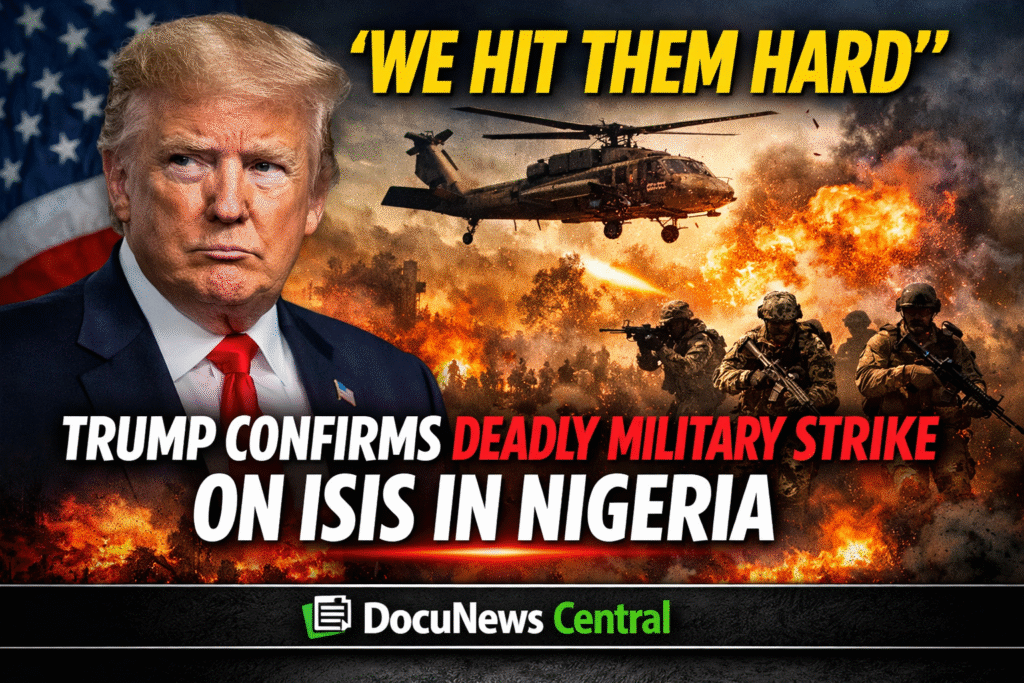
We Hit Them Hard”: Trump Confirms Lethal Military Strike Against Islamic State in Nigeria
.
We Hit Them Hard”: Trump Confirms Lethal Military Strike Against Islamic State in Nigeria
DocuNews Central
United States President Donald Trump has stated that he ordered a deadly military strike against Islamic State terrorists operating in Nigeria. According to Trump, the operation targeted militants accused of persecuting Christians in different parts of the country. His declaration immediately attracted global attention and reopened debates surrounding terrorism, religion, and foreign military intervention in West Africa.
The former president summarized the operation with the blunt statement, “We hit them hard.” Those words quickly circulated across international media platforms. In Nigeria, where insecurity linked to extremist groups remains a serious concern, the claim triggered mixed reactions. While some welcomed decisive action against terrorism, others questioned the broader implications for sovereignty and long-term security.
This article provides a detailed analysis of Trump’s statement, the activities of Islamic State in Nigeria, concerns surrounding religious persecution, and the impact such military actions could have on Nigeria’s security architecture. Reports and analyses from reputable Nigerian media platforms such as Legit.ng, Vanguard, and Sahara Reporters are referenced for balance and context.
The Statement That Sparked Worldwide Attention
Donald Trump did not deliver his announcement through a formal Pentagon briefing. Instead, he made a direct public claim that American forces had carried out a lethal strike against Islamic State militants in Nigeria. He emphasized that the targeted group had engaged in violent acts against Christian communities.
Although Trump did not provide operational details, his statement aligned with previous reports indicating continued U.S. counterterrorism surveillance across parts of Africa. Even after troop reductions, intelligence operations and precision strikes reportedly remained active.
Nigerian newspapers, including Vanguard, have previously reported on security cooperation between Nigeria and the United States. These reports noted intelligence sharing and technical support aimed at degrading insurgent capabilities.
Islamic State’s Presence in Nigeria
The Islamic State’s foothold in Nigeria emerged from internal divisions within Boko Haram. In 2015, a faction pledged allegiance to the Islamic State and became known as Islamic State West Africa Province, commonly referred to as ISWAP.
Since its formation, ISWAP has operated mainly in northeastern Nigeria, especially around the Lake Chad region. The group has targeted military installations, local communities, and humanitarian workers. Despite sustained military pressure, it has continued to adapt and regroup.
According to multiple reports published by Legit.ng, ISWAP has exploited weak governance, poverty, and porous borders. These factors have allowed militants to recruit, rearm, and launch attacks.
Religious Persecution and Civilian Impact
Trump’s claim placed strong emphasis on alleged persecution of Christians. This framing resonates with long-standing concerns raised by faith-based organizations and international watchdogs.
Nigeria remains religiously diverse, with large Christian and Muslim populations. While extremist violence has been most severe in the northeast, its effects have spread to other regions. Civilians of different faiths have suffered displacement, trauma, and economic hardship.
Investigative reports by Sahara Reporters have repeatedly highlighted the humanitarian cost of insurgency, stressing that terrorism affects entire communities regardless of religion.
U.S.–Nigeria Security Cooperation
The United States and Nigeria have maintained a long-standing security partnership. This relationship includes intelligence sharing, counterterrorism training, and logistical assistance.
During Trump’s presidency, U.S. policy emphasized targeted counterterrorism operations. Although troop numbers declined in some African regions, surveillance missions reportedly continued.
Defense analysts quoted in Vanguard have stated that advanced intelligence support has helped Nigerian forces locate insurgent camps and disrupt planned attacks.
Reactions Within Nigeria
Public reaction in Nigeria has been divided. Some citizens expressed relief, viewing the reported strike as a sign of international solidarity. Others expressed concern over transparency and accountability.
Security analysts cautioned that while foreign assistance can weaken terrorist networks, it does not replace the need for local solutions. Economic development, community engagement, and governance reforms remain critical.
Opinion pieces published by Legit.ng reflected this balance, acknowledging the benefits of international cooperation while stressing the importance of Nigerian-led initiatives.
International Reactions and Media Coverage
International media outlets reacted cautiously to Trump’s claim, citing the absence of immediate confirmation from U.S. defense officials. Analysts emphasized the need for verified information before drawing conclusions.
African-focused platforms such as Sahara Reporters placed the statement within Nigeria’s broader insecurity context, urging sustained global engagement rather than isolated military actions.
Security Implications for Nigeria
If confirmed, the strike underscores Nigeria’s reliance on international intelligence support. It also raises questions about balancing sovereignty with strategic partnerships.
While Nigerian forces have recorded successes against insurgents, challenges such as logistics, funding, and morale persist. Experts argue that a comprehensive approach remains essential.
Political Dimensions of Trump’s Statement
Trump’s rhetoric often blends security policy with political messaging. His emphasis on protecting Christians aligns with themes he highlighted during his presidency.
Observers caution that framing complex conflicts through a single lens risks oversimplification. Nigeria’s security challenges stem from multiple social, political, and economic factors. Read also Igbo Community Visits Nnamdi Kanu in Sokoto Prison, Shares Christmas Meals with 1,300 Inmates at www.docunewscentral.com
What Lies Ahead
The long-term impact of the reported strike remains uncertain. History suggests that extremist groups often adapt following military pressure.
Sustained peace will depend on continued regional cooperation, intelligence sharing, and inclusive development strategies.
Conclusion
Donald Trump’s confirmation of a deadly strike against Islamic State militants in Nigeria has drawn renewed global focus to the country’s security challenges. His statement that “we hit them hard” highlights the international dimension of Nigeria’s fight against terrorism.
While military action can disrupt extremist operations, lasting stability will require deeper structural solutions. Nigeria’s journey toward peace remains ongoing and demands both local resilience and responsible international support.
Jonada Oluikpe
December 30, 2025 at 9:46 am
Wonderful