




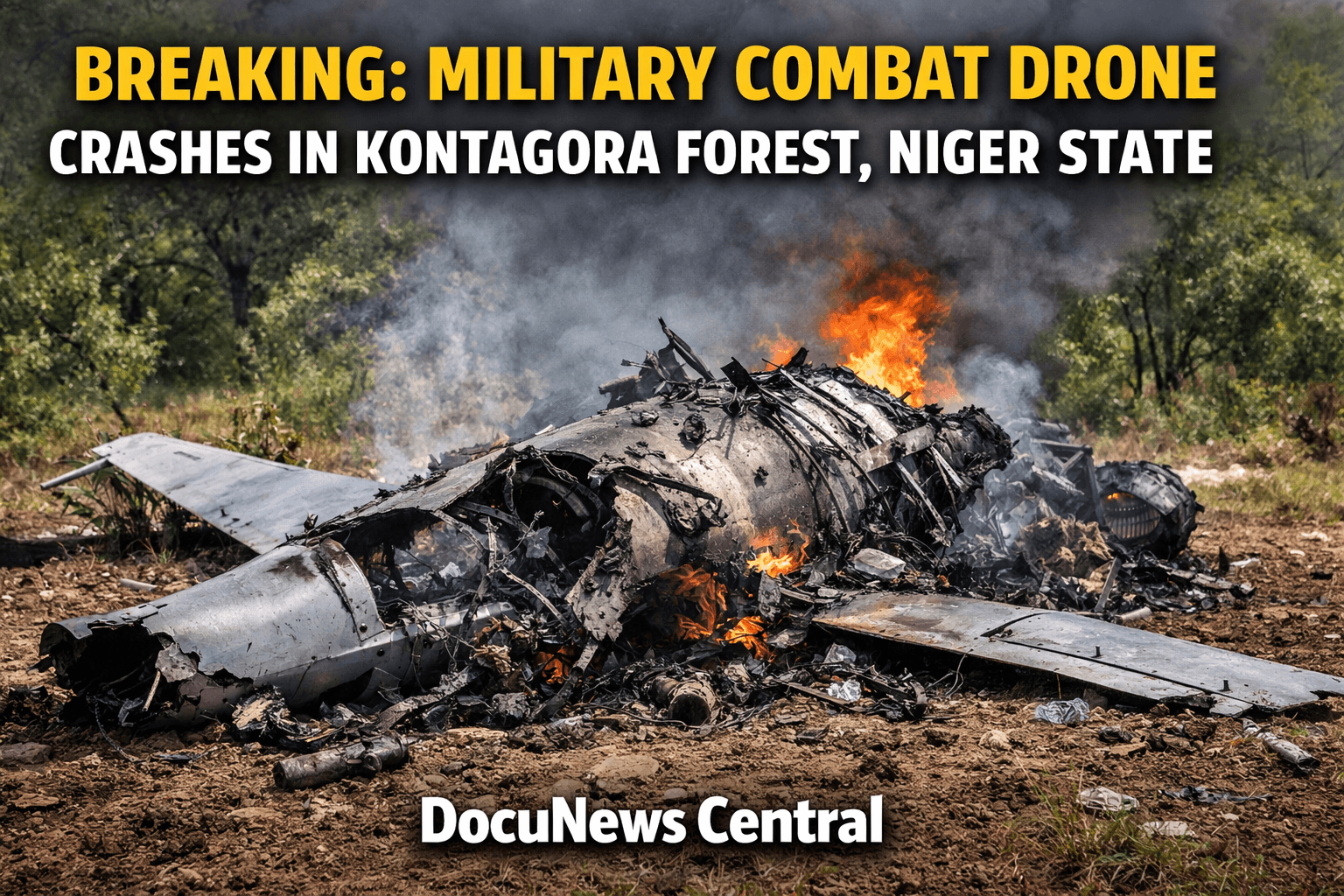
BREAKING: Military Combat Drone Crashes in Kontagora Forest, Niger State has sent shockwaves through Nigeria’s security community, raising urgent questions about aerial operations, intelligence missions, and regional safety. The incident occurred deep within the Kontagora Forest axis of Niger State, an area already known for its strategic importance in counterterrorism and anti-banditry operations.
According to early field reports, the unmanned aerial vehicle went down during an active military operation. Although officials have yet to release a full technical explanation, security sources confirm that recovery teams moved swiftly into the forest terrain to secure the crash site and prevent sensitive equipment from falling into unauthorized hands.
The development has drawn national attention because combat drones play a crucial role in Nigeria’s modern warfare strategy. As a result, analysts, security observers, and citizens alike are watching closely as more verified information emerges. Read also Strategic Victory as Nigerian Army Seizes Sambisa Forest Territory

DocuNews Central
Kontagora Forest lies within a wider corridor that connects several troubled zones in the North-Central and North-West regions. Over the past few years, military forces have relied heavily on aerial surveillance to monitor movements, disrupt criminal networks, and support ground troops. Therefore, any disruption to this system naturally triggers concern.
While no casualties have been reported so far, the implications of the crash extend far beyond the immediate incident. From operational readiness to public confidence, the effects will likely shape discussions in security circles for weeks.
This report examines what is known so far, why Kontagora Forest matters, how combat drones function in Nigeria’s security architecture, and what the next steps may look like.
Why Kontagora Forest Matters in Nigeria’s Security Map
Kontagora Forest occupies a strategic position in Niger State, serving as a natural buffer between multiple regions affected by criminal activity. Over time, the forest’s vast coverage, rough terrain, and limited road access have made it attractive to armed groups seeking concealment.
Security agencies have consistently identified the area as a transit route rather than a permanent base. Nonetheless, its location allows rapid movement across state boundaries. Consequently, military planners often prioritize surveillance operations in this zone.
In recent years, the Nigerian Armed Forces intensified aerial monitoring across forested regions. Drones, in particular, provide real-time intelligence without exposing pilots to danger. Therefore, their deployment has become a cornerstone of modern counterinsurgency tactics.
The crash, however, highlights the risks that accompany advanced technology in challenging environments. Dense vegetation, unpredictable weather patterns, and electronic interference can all affect drone performance.
For local communities, the presence of military assets often brings a sense of reassurance. At the same time, incidents like this can spark anxiety, especially when details remain limited during the early hours.
Authorities have urged residents to remain calm while recovery and assessment operations continue. People are reacting to this headline Nigerian Army Thwarts Deadly Bandit Plot in Plateau, Five Killed
BREAKING: Military Combat Drone Crashes in Kontagora Forest, Niger State — What We Know So Far
Initial information suggests that the drone experienced a sudden loss of control before crashing. Military sources stress that investigations are ongoing and that conclusions should wait until technical teams complete their analysis.
Importantly, officials have not indicated hostile action as the cause at this stage. Mechanical failure, environmental factors, or communication disruption remain under review.
The Nigerian military operates several classes of unmanned aerial vehicles, each designed for specific missions such as reconnaissance, target tracking, and operational support. These systems undergo routine maintenance and monitoring, although no technology is entirely immune to failure.
Following the incident, ground forces reportedly secured the perimeter around the crash location. This step remains critical, as combat drones often carry sensitive components, including sensors and encrypted systems.
Security experts note that rapid response reduces the risk of compromise and ensures that investigators can retrieve intact data modules. Such information often reveals flight conditions, system alerts, and command inputs during the final moments.
Meanwhile, the military has not suspended drone operations nationwide. Instead, commanders have adjusted deployment protocols in nearby zones as a precautionary measure. You may have missed this “Convert to Islam or Die”: ISWAP Burns Christian Village in Adamawa
Readers interested in broader security developments can explore related updates on our security news section.
Understanding the Role of Combat Drones in Nigerian Military Operations
Combat drones represent a significant shift in how modern armies gather intelligence and conduct operations. In Nigeria, their use expanded notably as security challenges evolved across multiple regions.
Unlike manned aircraft, drones can remain airborne for extended periods. This endurance allows continuous observation, which proves essential in tracking movements within forests and remote areas.
Additionally, drones support ground units by providing accurate situational awareness. Commanders can make informed decisions faster, reducing uncertainty during operations.
However, drone systems depend on stable communication links and precise navigation. Forested landscapes can interfere with signals, particularly when weather conditions deteriorate.
Experts emphasize that crashes, while rare, occur in every military that operates unmanned systems. The key measure of effectiveness lies in response speed, transparency, and corrective action.
Globally, armed forces continuously update drone software, hardware, and training programs to reduce incidents. Nigeria follows similar standards, often collaborating with international partners.
For official military information, readers can consult the Defence Headquarters Nigeria for verified statements and policy updates.
BREAKING: Military Combat Drone Crashes in Kontagora Forest, Niger State — Regional Reactions
The news has generated widespread discussion across Niger State and beyond. Community leaders in areas surrounding Kontagora have called for calm, urging residents not to speculate.
Local officials confirmed that no civilian infrastructure suffered damage. Furthermore, they emphasized cooperation with security forces during the recovery phase.
On social media, reactions have ranged from concern to curiosity. While some users raised questions about operational safety, others highlighted the complexity of modern security missions.
Analysts caution against misinformation, particularly during breaking developments. In past incidents, unverified claims often complicated response efforts and fueled unnecessary fear.
Media organizations have therefore urged reliance on official updates and responsible reporting.
Investigations, Accountability, and What Comes Next
Military investigators will likely focus on three primary areas: mechanical integrity, environmental conditions, and operational procedures. Each factor contributes valuable insight.
Once analysis concludes, authorities may release a summary outlining findings and corrective measures. Such transparency helps maintain public trust and institutional credibility.
If technical faults emerge, maintenance protocols may undergo revision. Alternatively, if environmental challenges played a role, flight planning guidelines could see adjustment.
Importantly, lessons learned from incidents often strengthen future operations. Continuous improvement remains a hallmark of professional armed forces worldwide.
As Nigeria continues to address security threats, technology will remain a vital tool. Drones, surveillance systems, and intelligence networks work together to enhance national safety.
Readers can also review background context on Niger State via the Niger State Government portal.
BREAKING: Military Combat Drone Crashes in Kontagora Forest, Niger State — Why This Story Matters
This incident underscores the realities of modern security operations. Advanced tools offer powerful advantages, yet they operate within complex environments.
For citizens, understanding these dynamics promotes informed discussion rather than fear-driven reactions. For policymakers, the event reinforces the importance of sustained investment in training and technology.
Most importantly, the safety of both civilians and security personnel remains paramount. Every operational decision ultimately aims to protect lives and preserve stability.
As official updates emerge, this report will reflect verified developments without speculation.
BREAKING: Military Combat Drone Crashes in Kontagora Forest, Niger State remains a developing story, and its outcome will likely influence operational planning across similar terrains nationwide.
Stay informed through our Breaking News hub for continued coverage.