

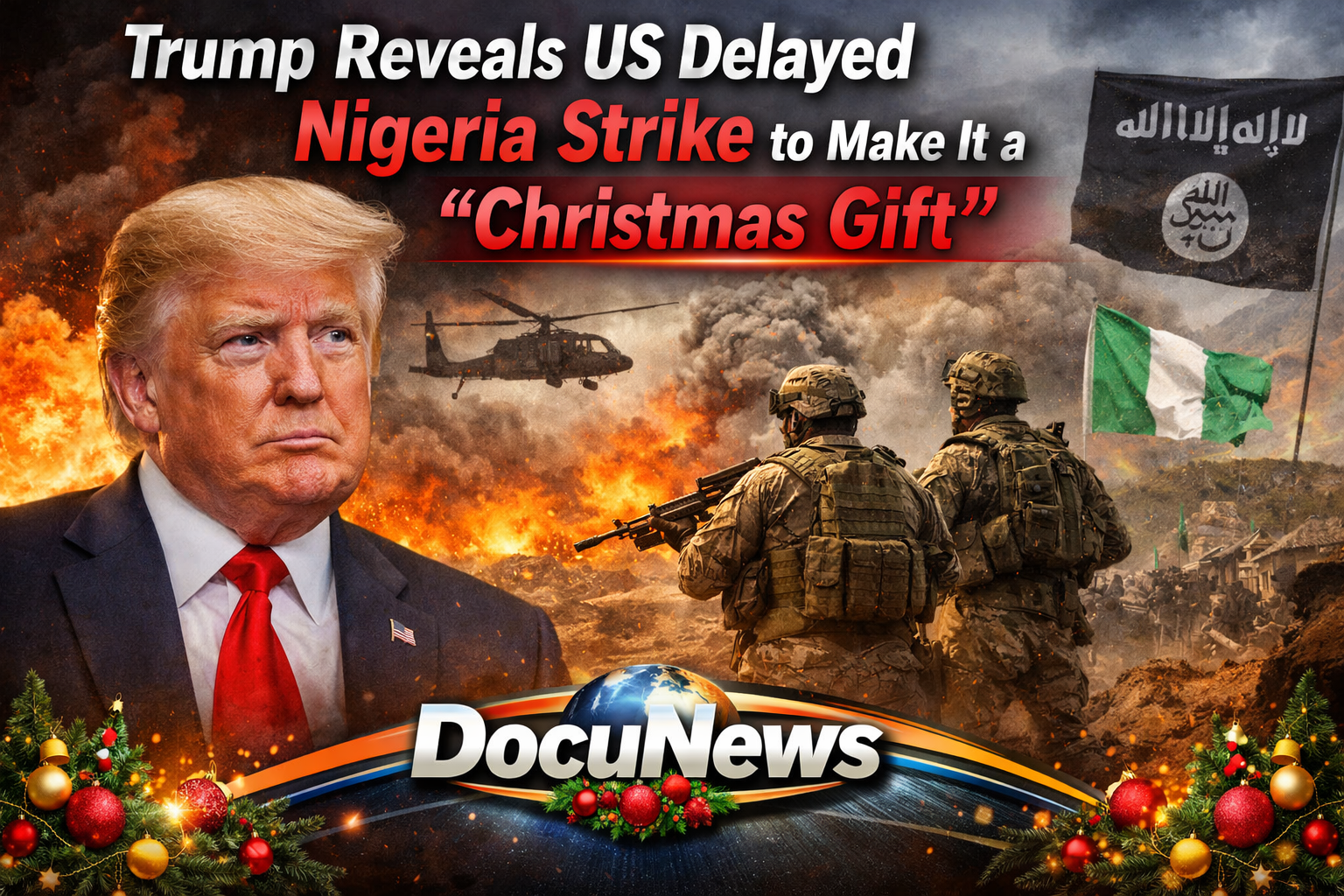
On December 25, 2025, the United States carried out a decisive military operation against Islamic State (ISIS) targets in northwestern Nigeria. In a move that surprised global audiences, US President Donald J. Trump later revealed that the strike had been delayed intentionally so that it could function as a “Christmas gift” to the American public. He underlined it. Trump Reveals US Delayed Nigeria Strike to Make It a “Christmas Gift. In this comprehensive article, we dive into the why, the how, the political implications, and the global reactions surrounding this unexpected development. Have you read about this? Primate Ayodele Claims Lookman’s Goal Was Meant for Osimhen
This blog explains:
- What actually happened in Nigeria
- Why the strike was delayed
- How Trump justified his actions
- What this means for Nigeria
- What the world thinks about the operation
1. What Happened in Northwestern Nigeria?
On December 25, 2025 — Christmas Day — US military forces launched a series of powerful air and ground strikes against ISIS affiliates operating in Nigeria’s remote northwest. According to official statements, these strikes were among the most intense actions taken in the Sahel region this year.
The Nigerian government later confirmed that the strikes hit Islamist insurgent camps, disrupting key logistical bases that ISIS had used to coordinate attacks across West Africa.
For background on the militant threats in Nigeria, see our article on Insurgency Dynamics in West Africa and the Boko Haram & ISIS linkup. Also read this information US Airstrikes in Sokoto Push Terrorists to Flee
2. Trump’s Remarkable Revelation
A day after the operation, Donald Trump stated that the mission had originally been scheduled earlier than Christmas. In his explanation, he said that commanders were ready to act, but he chose to delay the strike so that it would take place on December 25 — positioning it as a gift for the holiday season.
Here’s his direct implication:
“We were going to do it earlier, but I held it so it could be a Christmas present.”
This remark drove viral attention across news networks worldwide. Analysts, commentators, and political strategists have since debated whether this was a shrewd political move, an attempt to reshape public focus, or a calculated morale tactic.
This type of presidential messaging leads us to another topic: the effect of military timing on public perception. You can read more in our piece How Political Leaders Time Major Announcements.
3. Transitional Context: The ISIS Threat in Nigeria
You cannot understand the strike without recognizing the persistent threat posed by ISIS in West Africa.
Despite losing physical territory in Iraq and Syria years ago, ISIS affiliates have continued to grow stronger in the Sahel and Lake Chad basin. In Nigeria, this includes groups linked to the Islamic State West Africa Province (ISWAP), which has conducted high‑profile attacks on villages, military outposts, and civilian transportation routes. Have you subscribe to DocuNews Central? Do it here now for more information www.docunewscentral.com
For deeper context, the Encyclopaedia Britannica outlines how ISIS affiliates have spread in the region: https://www.britannica.com/topic/Islamic-State-group.
4. Why the Strike Was Delayed: Trump’s Justification
According to Trump, the deliberate decision to delay the operation had symbolic and political significance:
- First, he wanted to shift the narrative during the holiday season.
- Second, he believed that timing the strike on Christmas would boost domestic support.
- Third, he saw this as a demonstration of strategic strength — both militarily and rhetorically.
Although some critics called his phrasing tone‑deaf, Trump defended his choice, arguing that:
“Timing matters in warfare, and timing matters in politics.”
Whether this strategy achieves its intended outcomes remains a subject of active debate. For insights into how timing influences public opinion, see our linked analysis Strategic Messaging in Political Warfare.
5. Immediate Impact of the Nigeria Strike
A. Military Outcomes
The operation reportedly:
- Destroyed multiple ISIS camps
- Weakened key insurgent units
- Disrupted supply lines
- Diminished ISIS coordination in the region
Officials emphasized that the mission was precision‑targeted, minimizing civilian harm. U.S. Central Command released brief statements highlighting tactical success. Also check this out Igbo Community Visits Nnamdi Kanu in Sokoto Prison, Shares Christmas Meals with 1,300 Inmates
B. Reactions from Nigeria
Nigeria’s federal government expressed cautious approval, noting that:
- The strike targeted violent extremists
- The Nigerian military remains the primary security provider
- Cooperation with the U.S. will continue
At the same time, voices within Nigeria voiced concern about sovereignty and foreign military action on Nigerian soil. Political leaders stressed that combating insurgency must involve long‑term solutions.
Explore our feature on Nigeria’s Security Challenges and Solutions for deeper understanding.
6. International Reaction
Global reactions ranged widely:
Positive Reactions
- Western allies praised the operation as a step toward destabilizing extremist networks.
- Some African nations saw this as a sign of renewed international cooperation.
Critical Reactions
- Several observers criticized the symbolic framing — saying war should never be marketed as a holiday gift.
- Diplomatic concerns arose about tone and sensitivity, particularly given the holiday context.
For reactions from foreign policy experts, refer to this BBC World article: https://www.bbc.com/news/world.
7. What This Means for US–Africa Relations
The strike signals a possible shift in US military priorities in Africa. Under previous administrations, American involvement in counter‑terrorism in the Sahel remained constant but cautious. This operation, however, is notable for its:
- Timing
- Scale
- Messaging strategy
Scholars are now asking whether this indicates:
- A new posture toward the Sahel
- A transactional approach tied to domestic politics
- An intensified focus on extremist threats
We analyze these possibilities in US Military Strategy in Africa.
8. Political Impact in the U.S.
Within the U.S., Trump’s announcement quickly became a flashpoint:
Supporters argued:
- The president showed strength
- He delivered decisive action
- The timing boosted morale
Critics argued:
- The messaging was inappropriate
- It blurred lines between warfare and political theater
- It could risk trivializing serious military engagement
Numerous opinion pieces followed, and cable news networks debated whether the “Christmas gift” remark was brilliant or blundering.
9. Analysis: Strategic Messaging vs. Military Reality
When leaders frame military action with cultural references, it can have double‑edged effects:
- On one hand, it can strengthen public engagement.
- On the other, it can minimize the gravity of combat operations.
This operation raises questions such as:
- Should military decisions ever be timed for maximum political effect?
- What is the ethical boundary between war and public sentiment?
- How will future leaders learn from this precedent?
For a critical examination of such questions, see our essay Ethics of Strategic Military Messaging.
10. Long‑Term Implications for Regional Security
Experts speculate that this strike could:
- Weaken ISIS’s operational capabilities in West Africa
- Spur collaboration between Nigerian and foreign forces
- Strengthen regional security alliances
However, air strikes alone cannot eliminate extremist ideology. Lasting peace will require:
- Socioeconomic investment
- Local governance reforms
- Community resilience programs
- International coordination
Read about these solutions in Building Lasting Peace in Conflict Zones.
11. How This Fits Into Global Counter‑Terrorism Trends
The strike against ISIS in Nigeria is not an isolated event. Around the world, governments continue to assess how to balance force with diplomacy. This includes:
- US operations in Syria and Iraq
- French engagements in the Sahel
- UN peacekeeping missions in Africa
The global fight against extremist movements remains fluid and complex, as explained by global security experts at RAND Corporation: https://www.rand.org/topics/counterterrorism.html.
12. What Comes Next?
After the December 25 strike, attention now turns to:
- What NATO allies think
- How Nigerian forces will respond
- Whether this will deter future attacks
- Whether the timing will influence voter sentiment
Future developments could redefine how military actions are publicized and politicized.
For up‑to‑date reporting on this ongoing situation:
- Check Reuters
- Follow Al Jazeera News
13. Voices from the Ground: Nigerian Perspectives
Local residents in affected communities reported mixed reactions:
- Some expressed relief that extremist strongholds were targeted.
- Others worried about possible civilian danger and displacement.
Humanitarian groups emphasize that foreign strikes must align with community protection and support.
Learn more in our humanitarian overview: Protection of Civilians in Conflict.
14. Final Thoughts: Was It a “Christmas Gift”?
Calling a military operation a “Christmas gift” might resonate with some supporters, but it also prompts a deeper reflection:
- Are military victories something to celebrate like a holiday?
- How should leaders balance strategy with sensitivity?
- What happens when warfare enters the realm of public spectacle?
This incident will be studied for years in both security and communication circles. It highlights how politics and national messaging intersect with global strategic decisions.
15. Continue Learning
If this topic interests you, here are more recommended reads on our site:
- History of ISIS in West Africa
- US Foreign Policy under Recent Administrations
- Global Security Challenges in 2025