


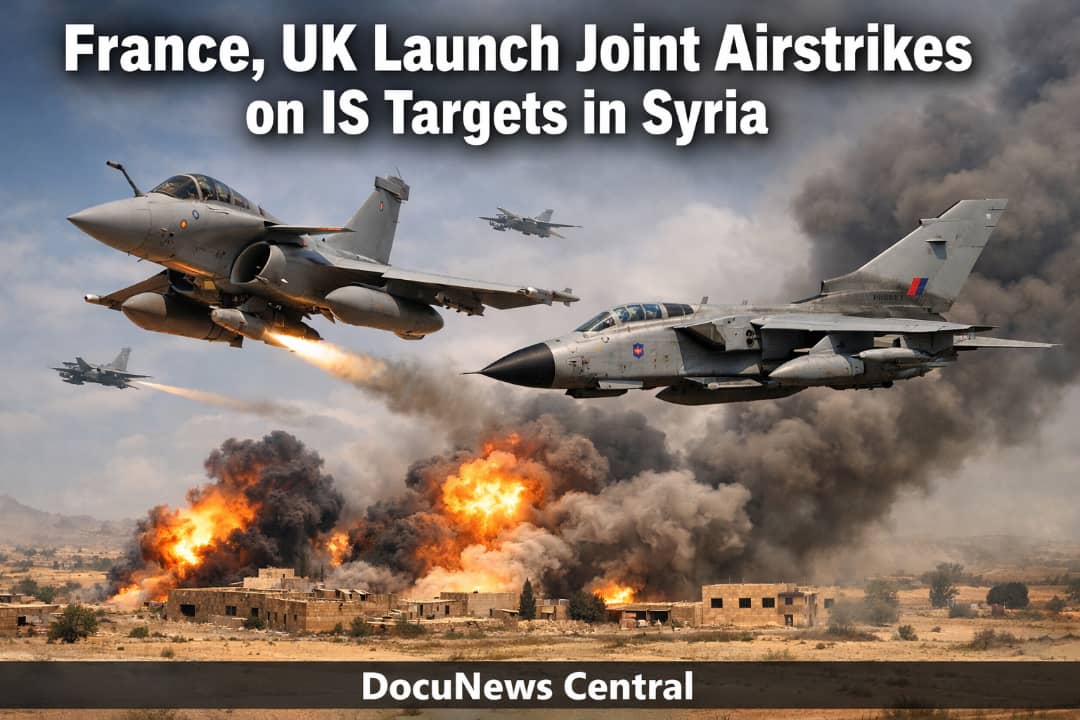
In a decisive show of military coordination, two major European powers carried out a carefully planned aerial operation in the Middle East, targeting an extremist weapons location believed to pose an immediate regional threat. The mission focused on disrupting militant networks that intelligence agencies say have shown renewed activity in recent months. And a headline was made “France, UK Launch Joint Airstrikes on IS Targets in Syria”
According to official briefings, the operation followed weeks of surveillance and strategic assessment. Defense leaders stressed that the objective centered on prevention rather than escalation. By striking at logistical capacity, planners aimed to weaken operational momentum without drawing surrounding states into wider conflict.
This development arrives at a time when security experts continue to warn about fragile stability across parts of the Levant. While large-scale combat has decreased since earlier years, underground cells still attempt to regroup, recruit, and rearm. As a result, Western allies remain alert and ready to act when credible threats emerge.
The latest action reflects a broader pattern of selective engagement rather than prolonged deployment. Officials emphasized that the strike relied on precision intelligence, real-time monitoring, and international coordination. Civilian safety, they added, remained central throughout planning and execution.
For many observers, the event underscores how counterterrorism efforts have shifted. Instead of permanent troop presence, governments now rely on rapid-response capabilities supported by surveillance technology and regional partnerships. This model aims to neutralize threats early while avoiding prolonged ground involvement. Read also Army Uncovers Hidden AK-47 Stockpile in Taraba
Why Joint Airstrikes Matter in Today’s Security Landscape
Modern counterterrorism operations increasingly depend on shared intelligence and synchronized execution. Cooperation between allied nations allows resources, expertise, and strategic insight to merge into a single operational framework. This approach often delivers results faster than unilateral action.
Military analysts note that coordination improves accuracy and accountability. When multiple defense systems operate together, targeting decisions undergo layered review. That process reduces errors and limits unintended consequences, especially in densely populated regions.
Furthermore, such collaboration sends a clear deterrent message. Extremist groups often exploit perceived divisions among international actors. Unified responses remove that advantage, signaling that hostile activity will face collective resistance rather than fragmented reactions.
Beyond deterrence, coordinated action strengthens diplomatic ties. Defense cooperation often reinforces political alignment, intelligence sharing, and crisis management frameworks. Over time, these relationships help prevent threats from escalating into broader instability.
In recent years, European governments have invested heavily in rapid deployment readiness. This investment includes advanced aircraft, enhanced reconnaissance tools, and cross-border command integration. As a result, responses now occur with greater speed and efficiency. Many people are reacting to this headline Catholic Mission House Burnt as Terrorists Kill 42 in Niger State
How the Operation Fits the Wider Fight Against Extremism
Security officials described the targeted site as a critical storage and coordination point. Intelligence sources indicated that equipment housed there supported planned attacks beyond local borders. By removing that capability, planners aimed to disrupt networks before they could mobilize.
Experts explain that extremist organizations rarely rely on single locations. Instead, they use a web of supply points, safe houses, and communication hubs. Precision strikes against key nodes can significantly weaken operational reach.
Importantly, the action aligns with broader international counterterrorism objectives. Rather than pursuing territory, coalition strategies now focus on limiting mobility, funding, and weapon access. This approach reduces the likelihood of large-scale resurgence.
Regional partners also play an essential role. Local intelligence, community reporting, and border monitoring often provide the first signals of renewed militant activity. International forces then support these efforts through surveillance and targeted intervention.
By maintaining pressure on infrastructure rather than populations, officials hope to avoid fueling further radicalization. This balance remains delicate but necessary for long-term security outcomes. You may like this information below Nation Shocked as Terrorists Kill Over 40 in Niger State Market Raid
Regional Stability and Civilian Protection
Civilian safety remains a primary concern whenever military force is applied. Defense representatives stated that extensive measures ensured minimal risk to surrounding communities. These measures included timing selection, target verification, and weapon choice.
Humanitarian organizations continue to monitor developments closely. While acknowledging security concerns, many stress the importance of ongoing aid access and reconstruction support. Stability, they argue, depends not only on security actions but also on economic recovery.
International agencies have repeatedly warned that fragile regions require sustained attention beyond military engagement. Education, employment, and governance reforms all contribute to reducing the appeal of extremist narratives.
As a result, diplomatic channels remain active alongside security measures. Governments involved in the operation reaffirmed commitments to humanitarian law and post-conflict support initiatives.
Political Reactions Across Europe and Beyond
Political leaders across Europe responded with measured statements emphasizing responsibility and restraint. Many highlighted the importance of acting on verified intelligence while maintaining transparency with the public.
Opposition figures called for continued parliamentary oversight, stressing the need for clear legal frameworks governing overseas operations. Such scrutiny, they argued, strengthens democratic accountability without undermining security needs.
Meanwhile, regional governments expressed concern over escalation risks but acknowledged the shared interest in limiting extremist violence. Diplomatic engagement following the operation focused on reassurance and coordination.
Global partners, including security bodies and multinational alliances, monitored the situation closely. Analysts described the response as controlled and proportionate, avoiding broader confrontation.
The Intelligence Dimension
Intelligence gathering formed the backbone of the operation. Surveillance assets tracked movement patterns, supply routes, and communication signals over an extended period. Analysts then cross-referenced data from multiple sources.
This layered approach reduces reliance on single-source information. By confirming details through independent channels, planners increase confidence and accuracy.
Technological advances now allow near real-time assessment. High-resolution imagery, signal analysis, and regional cooperation provide a clearer operational picture than in previous decades.
As threats evolve, intelligence agencies continue adapting methods to detect early warning signs. This adaptability remains crucial in preventing future attacks.
Historical Context and Lessons Learned
Previous campaigns against extremist networks revealed both successes and shortcomings. Large-scale interventions often produced immediate results but created long-term challenges.
In contrast, focused operations guided by intelligence have shown greater sustainability. By avoiding occupation and minimizing footprint, governments reduce unintended consequences.
Lessons from past efforts informed current planning. Military leaders emphasized flexibility, coordination, and exit strategies as essential components.
These lessons continue shaping doctrine across allied forces.
What Comes Next
Officials made clear that the action does not signal broader escalation. Instead, it reflects readiness to respond when credible threats arise.
Monitoring will continue through surveillance and intelligence cooperation. Any further action, leaders stressed, would depend on verified necessity.
At the same time, diplomatic engagement and humanitarian support remain ongoing priorities. Stability requires sustained commitment across multiple fronts.
Observers note that future security efforts will likely follow a similar pattern: targeted, intelligence-driven, and coordinated among partners.
Internal and External References
For related coverage on global security developments, read our analysis on counterterrorism strategies here.
Additional international reporting is available via trusted outlets such as Reuters and BBC News.
As security dynamics continue evolving, informed public discourse remains essential. Understanding the balance between prevention, cooperation, and restraint helps clarify how modern nations respond to emerging threats. To know more about DocuNews Central, Visit here ABOUT US- DOCUNEWS CENTRAL

One thought on “France, UK Launch Joint Airstrikes on IS Targets in Syria”