
Security
At Least 50 Killed as Gunmen Storm Kasuwan Daji Market in Niger

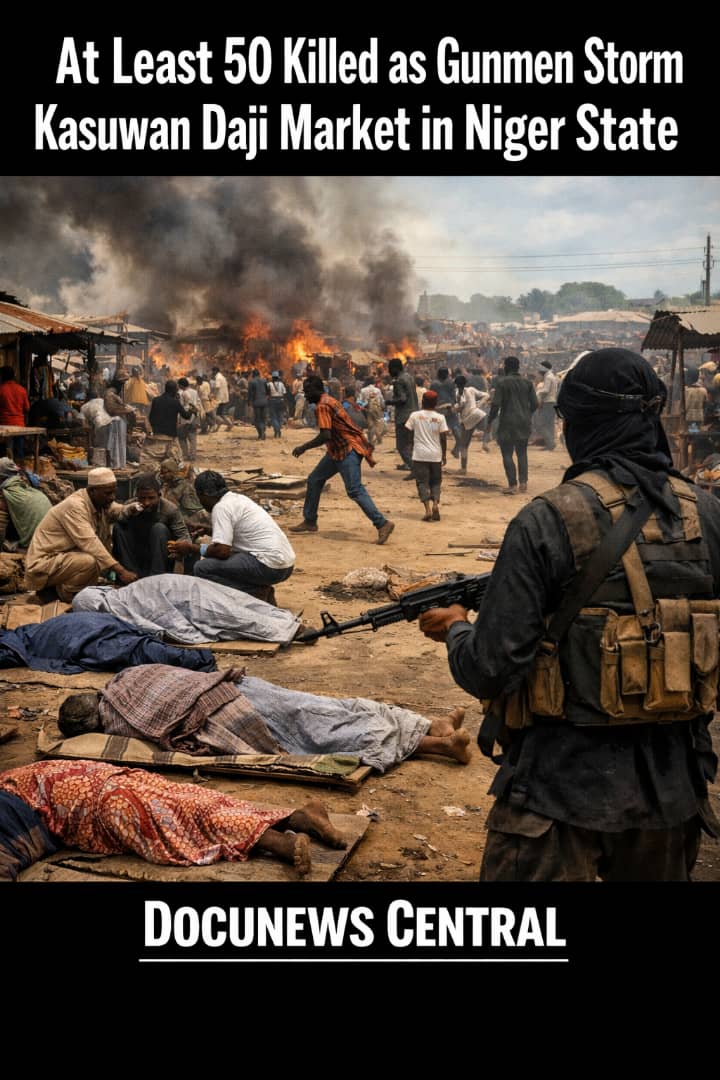
Early trading activities were underway when armed men launched a coordinated assault on a busy rural marketplace in Demo village, a farming settlement in Niger State. Residents described a normal market rhythm at dawn. Traders arranged produce, buyers bargained calmly, and transporters prepared for the day. However, that routine ended abruptly when gunshots echoed across the area and panic spread in every direction. And this made headlines across Nigeria “At Least 50 Killed as Gunmen Storm Kasuwan Daji Market in Niger”
Police sources later confirmed that dozens of people lost their lives during the incident. While initial figures placed casualties lower, more recent reports raised the death toll to at least 50. The scale of the loss has since triggered national concern, especially because the attack struck a civilian economic hub rather than an isolated location.
Eyewitness accounts and security briefings further revealed that the violence extended beyond shootings. Shops were looted, market structures were burned, and several residents were taken away by force. As a result, the community suffered both human tragedy and deep economic disruption. Read also Sheikh Gumi Claims Boko Haram Has Marked Him for Elimination
How gunmen storm Kasuwan Daji Market
Local testimonies indicated that the assailants arrived in groups and moved with speed and coordination. They overwhelmed traders and shoppers before many could escape. Although security operatives later responded, the attackers had already withdrawn into surrounding bush paths that connect several rural settlements.
Police investigators stated that the operation showed signs of planning rather than spontaneity. The attackers struck during peak market hours, ensuring maximum disruption. In addition, the deliberate burning of stalls and shops pointed to an intent to cripple local commerce.
After the attackers left, residents searched for missing relatives, gathered the injured, and assessed the ruins of destroyed livelihoods. Fear lingered across the area, as many worried that the attackers could return. Many people are reacting to this headline too Deadly Attack on Yola Farm Leaves Three Women Dead
Death toll climbs to 50 in Niger State market attack
In the hours following the incident, casualty figures varied. However, later assessments from multiple sources aligned around a death toll approaching 50. This sharp rise reflected the difficulty of rapid verification in remote conflict-affected communities.
Humanitarian observers warned that fatalities often increase after such incidents, since some injured victims lack timely access to medical care. Therefore, concerns remain that the final count may still change.
Abductions linked to the attack also deepened anxiety. Families continue to search for missing loved ones, while community leaders have appealed for stronger security presence across nearby villages.
Market destruction reveals wider objective
The attack did not focus solely on individuals. Instead, shared infrastructure suffered significant damage. Market stalls were destroyed, food supplies were lost, and essential trading tools were taken away. Because the market served several communities, its destruction disrupted food distribution beyond Demo village.
Economic analysts explained that rural markets play a critical role in price stability and food access. When such hubs are damaged, farmers struggle to sell produce, and buyers face shortages. Consequently, inflationary pressure and food insecurity risks increase.
Many traders lost months of savings invested in goods that were reduced to ashes. Without external support, rebuilding efforts may take years.
Community reactions and demands
Community leaders voiced frustration over repeated insecurity in the area. They argued that rural settlements remain exposed despite ongoing security operations. According to them, attacks of this scale highlight gaps in protection.
Residents called for permanent patrols, improved intelligence gathering, and faster emergency response. Youth groups also encouraged cooperation between security agencies and local vigilantes, stressing that shared information could help prevent future incidents.
Religious and traditional leaders urged calm and unity, warning against reprisals that could worsen instability.
Security challenges across Niger State
The incident fits a broader pattern of attacks affecting parts of Niger State and neighboring regions. Armed groups frequently exploit forest corridors, moving across local government boundaries with relative ease.
Security experts noted that dense forests, poor road networks, and limited communication systems complicate surveillance and response efforts. As a result, even when warnings emerge, response times often remain slow.
Economic hardship has also contributed to the challenge. Limited job opportunities have made criminal networks attractive to vulnerable youth, underscoring the need for social interventions alongside security measures.
Government response under scrutiny
Following the attack, government officials condemned the violence and promised investigations. Security agencies announced increased patrols and intelligence-led operations. Nevertheless, residents expressed skepticism, citing previous assurances that failed to prevent similar incidents.
Policy analysts stressed that long-term solutions must replace reactive measures. They recommended permanent rural security posts, improved aerial monitoring, and stronger accountability mechanisms to ensure arrested suspects face justice.
Civil society groups echoed these calls, urging transparency in security spending and improved coordination among agencies.
Humanitarian impact on affected families
Beyond the fatalities, many families fled the area out of fear. Displacement disrupted schooling, farming, and access to healthcare. Women and children faced heightened vulnerability, especially those separated during the chaos.
Aid organizations warned that prolonged displacement could deepen poverty levels. Without timely support, affected households risk losing entire farming seasons.
Local volunteers have organized temporary assistance, although resources remain limited.
Economic effects beyond the community
The market served as a link between farmers and buyers from nearby towns. Its destruction affected transporters, retailers, and service providers who depended on daily trade.
Development experts cautioned that persistent insecurity discourages investment. When traders avoid high-risk zones, communities become economically isolated.
Survivor accounts
Survivors described narrow escapes, hiding behind stalls or fleeing into nearby farms. Many recalled hearing gunshots followed by flames engulfing wooden structures.
Despite trauma, several residents expressed determination to rebuild once safety improves. However, they emphasized that reconstruction without security would remain unsustainable.
Importance of intelligence and early warning
Security analysts highlighted the role of intelligence in preventing large-scale casualties. Community-based reporting systems and early warning mechanisms could help authorities respond faster.
Mobile alert platforms and improved communication networks may also enhance prevention efforts, provided trust exists between residents and security agencies.
Responsible reporting and verified information
Accurate reporting proved essential during the crisis. Initial confusion over casualty figures caused anxiety, while verified updates later clarified the scale of the tragedy.
Readers seeking credible updates can consult reputable outlets such as Reuters and Anadolu Ajansı. In-depth national coverage is also available via Premium Times.
Calls for lasting reform
Experts have urged comprehensive reforms, including forest monitoring, cross-state security coordination, and judicial efficiency. Investment in education and employment remains equally important to reduce recruitment into armed groups.
Dialogue and reintegration programs, alongside enforcement, may also contribute to long-term stability.
Remembering the victims
As mourning continues, families gather for prayers and memorials. Each name represents a life lost during ordinary economic activity.
Community leaders stressed that remembrance should inspire action aimed at preventing similar tragedies.
Conclusion
The deadly assault on a rural marketplace highlights ongoing security challenges facing many Nigerian communities. With lives lost, infrastructure destroyed, and families displaced, the incident demands sustained and preventive action.
Protecting civilian spaces such as markets remains essential. Ensuring safety honors the victims and safeguards the future of vulnerable communities.
For related security analysis, readers can explore updates on DocuNews Central and data-driven insights from the Nigeria Security Tracker.
