
National
Nigeria Once Lent the World Bank $240 Million: What Changed Today

Published Date: July 26, 2026.
Publisher: DocuNews Central
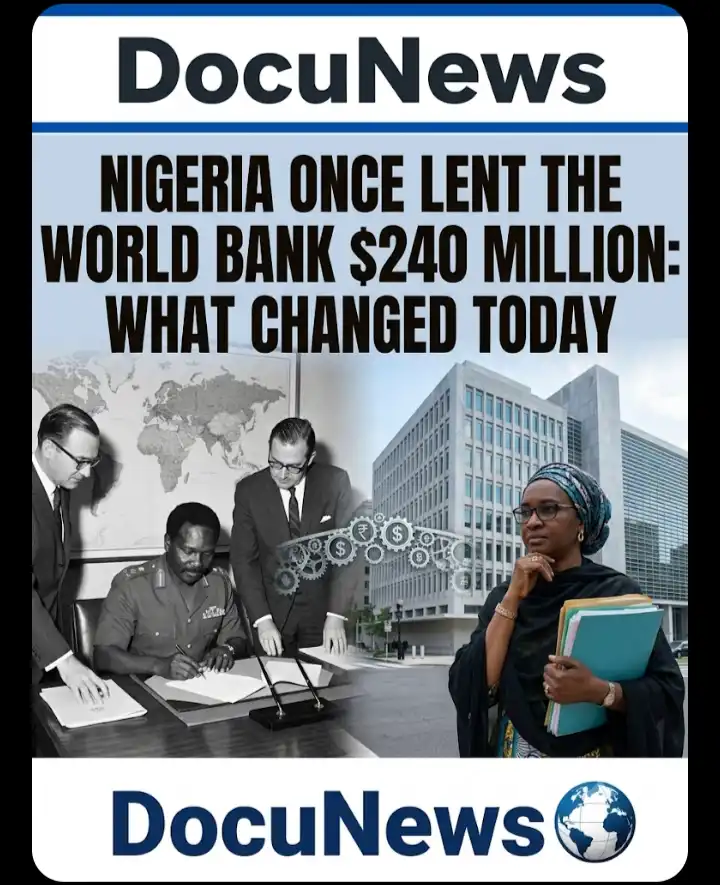
In an era dominated by discussions over public debt servicing, budget deficits, and multilateral credit facilities, a compelling piece of financial history has resurfaced to challenge contemporary economic perspectives. Exactly five decades ago, on December 23, 1974, the Federal Republic of Nigeria signed a landmark agreement to lend $240 million directly to the International Bank for Reconstruction and Development, commonly known as the World Bank.
The transaction, formally recorded under World Bank News Release No. 1974-678, was a historic milestone. It marked the first long-term borrowing operation by the World Bank within Nigeria and established Africa’s most populous country as a sovereign creditor providing vital capital to fuel global development initiatives across weaker developing economies.
Shortly after the World Bank loan facility was executed, Nigeria expanded its global financial footprint in 1975 by contributing an additional $120 million to the International Monetary Fund (IMF) Oil Facility. This facility was created to cushion oil-importing nations against severe balance-of-payments crises triggered by the global energy shocks of the early 1970s.
The historical revelation recently surged back into national consciousness following a poignant, live television segment presented by broadcast journalist Rufai Oseni during the Arise Morning Show on Arise Television. During the broadcast, Oseni presented physical archival documents dating back to December 1974, detailing the official terms under which Nigeria financed the international multilateral institution.
Visibly moved while presenting the historical records on air, Oseni expressed profound grief over the drastic shift in Nigeria’s financial status over the intervening decades. “I cried for Nigeria this morning. Let me read something to you and show why I sometimes raise my voice about this country,” Oseni stated as he displayed the documents to millions of viewers. “We were lending money to the World Bank to support development in other countries… What changed today?”
The broadcast clip triggered extensive debate across policy circles, academic institutions, and digital media, forcing a collective re-examination of the structural, fiscal, and governance shifts that altered Nigeria’s economic trajectory over the last half-century.
To understand what changed today, economists point back to the macroeconomic landscape of the mid-1970s. Under the military government headed by General Yakubu Gowon, Nigeria benefited from a massive windfall produced by the 1973–1974 global crude oil boom. The rapid multiplication of oil export revenues generated substantial fiscal surpluses, propelling foreign reserves to unprecedented heights.
During this period, Nigeria possessed the liquidity needed not only to finance major domestic infrastructure projects but also to deploy capital internationally. The country actively funded regional development initiatives, supported African liberation struggles, and established itself as a financial pillar within the Sub-Saharan region.
However, analysts observe that this era of fiscal surplus sowed the seeds of a classic economic phenomenon known as “Dutch disease.” Flush with abundant petrodollars, successive administrations gradually neglected non-oil productive sectors, particularly commercial agriculture, industrial manufacturing, and mining, which had previously sustained the national economy.
Rather than institutionalizing disciplined sovereign wealth funds or directing capital reserves into enduring wealth-generating assets, national expenditure increasingly leaned toward public sector consumption, heavy import dependency, and administrative overheads. Domestic demand for imported food, luxury goods, and refined petroleum products surged, steadily draining national liquidity.
The vulnerability of this monoculture economy became painfully evident during the global oil glut of the early 1980s. When international crude prices crashed, Nigeria’s primary revenue source collapsed overnight. Faced with mounting fiscal deficits and dwindling foreign exchange reserves, the government turned to commercial bank loans and multilateral credit facilities to sustain public expenditure, initiating a long cycle of external debt accumulation.
Data from the Debt Management Office (DMO) highlights how dramatically the national balance sheet has evolved since 1974. Over the past several decades, total public debt has grown significantly as federal and state governments funded budget deficits through domestic bond issuances, Eurobonds, and concessionary loans from bilateral and multilateral partners.
Today, debt service obligations account for a substantial percentage of total federal retained revenue. This reality stands in stark contrast to 1974, when surplus capital was earning interest on international balance sheets rather than consuming domestic budgetary resources.
Financial experts stress that borrowing in itself is not inherently detrimental to a nation’s economy; rather, the critical variable lies in how capital is utilized. Sovereign borrowing that finances transformative power grids, rail networks, agricultural processing hubs, and educational infrastructure creates long-term productivity that easily offsets interest payments.
In contrast, borrowing to finance recurrent consumption, non-productive subsidies, or administrative overhead creates long-term structural strain. Rufai Oseni’s viral commentary resonated so deeply because it highlighted this exact contrast: the difference between a nation deploying surplus capital for strategic influence and a nation managing recurring debt obligations to cover fiscal shortfalls.
Addressing these structural challenges requires a committed shift toward revenue diversification, rigorous public expenditure management, and institutional transparency. Modern economic reforms aim to revitalize domestic industrial capacity, boost non-oil export earnings, and create an enabling environment for private sector investment.
Key economic management priorities currently focus on expanding domestic tax revenue through efficient digitisation, curbing crude oil theft in the Niger Delta, eliminating wasteful expenditure lines, and bolstering foreign exchange reserves through diversified export channels.
Citizens and policy stakeholders seeking comprehensive, official information regarding current fiscal policies, debt management strategies, and macro-economic frameworks can consult public records available on the Federal Republic of Nigeria Official Portal.
Detailed updates on government programs, ministerial briefings, and national economic policy announcements are regularly published on the Federal Ministry of Information Portal.
The story of Nigeria lending $240 million to the World Bank in 1974 remains far more than a nostalgic footnote. It serves as an enduring reminder of the country’s immense intrinsic wealth and a clear blueprint of what can be achieved when national resources are managed with long-term strategic vision.
Also Read US Lawmaker Urges Due Process or Release for Nnamdi Kanu.
DocuNews Central will continue to follow economic policy developments, providing accurate, in-depth, and fact-checked coverage to keep the public informed on critical issues shaping the nation’s future.
DNC
Written by The Editorial Team | DocuNews Central
The DocuNews Central Desk delivers investigative reporting, grassroots policy updates, and fact-checked news to keep citizens informed with accurate, actionable truth across the nation.
