National
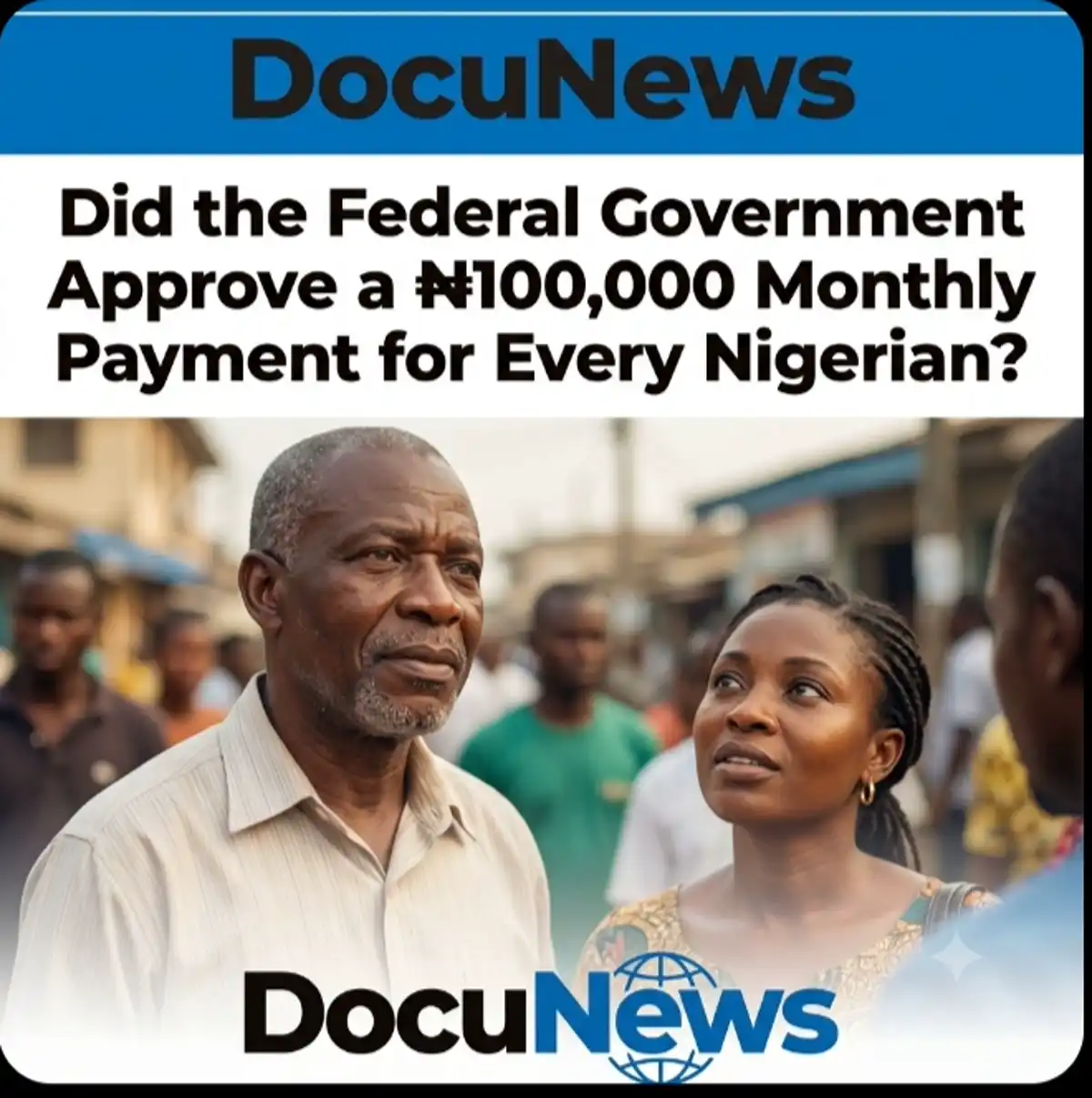
Did the Federal Government Approve a ₦100,000 Monthly Payment for Every Nigerian?

Published Date: July 21, 2026 | Category: Fact-Check / National News | Publisher: DocuNews Central
In recent days, mobile phones across the country have been buzzing with a sensational headline that generated wild excitement and anxiety in equal measure. Millions of citizens woke up to viral WhatsApp messages and Facebook posts asking a major question on everyone’s lips: Did the Federal Government Approve a ₦100,000 Monthly Payment for Every Nigerian? While thousands of eager citizens immediately rushed online to click registration links and input their sensitive financial details, official authorities are now blowing the whistle on what has quickly turned into one of the largest online financial scams targeting unsuspecting families this year.
ABUJA, Nigeria — Independent investigations conducted directly in the nation’s capital confirm that the viral rumor claiming that President Bola Ahmed Tinubu’s administration has approved a direct monthly payment of ₦100,000 for every single citizen is completely false . According to DocuNews Central, no such sweeping cash transfer program exists, and government officials have issued urgent warnings advising the public to avoid sharing suspicious links or disclosing bank verification numbers to unknown websites .
Understanding the Rumor: How the Fake ₦100k Claim Spread
To truly understand how this falsehood took off like wildfire, you must look at the heavy economic burden currently weighing down ordinary households across the country. Because market prices for staple foods like rice, garri, and cooking oil have surged over the past year, many families are actively searching for genuine relief packages or government palliatives to survive the month.
Consequently, online scammers took advantage of this widespread hardship by crafting clever fake websites . These fraudsters designed fraudulent registration forms that mimic official government portals. They added fake countdown timers, forged emblems of the Central Bank of Nigeria (CBN), and included glowing fake testimonies from nonexistent beneficiaries who claimed they had already received their initial payments .
Furthermore, these phishing websites use a sneaky technique to spread rapidly across social media platforms. Before a user can allegedly submit their application, the fraudulent portal forces them to share the link to at least 10 or 15 different WhatsApp groups or friends. Because the message comes directly from a trusted friend or family member, recipients naturally assume the offer is legitimate and continue passing the trap along to others.
For more verified news on national policy updates and official government statements, check out our latest DocuNews Central National Coverage.
Where the Confusion Came From: Minimum Wage vs. Universal Stipends
Although the claim of a direct ₦100,000 stipend for every Nigerian citizen is entirely fake, the specific figure of ₦100,000 did not appear out of thin air . In fact, it stems from recent high-level policy discussions regarding the national minimum wage for civil servants .
During ongoing fiscal consultations, several state leaders under the Nigeria Governors’ Forum (NGF) proposed ₦100,000 as a potential benchmark for monthly public sector salaries . Because news outlets heavily reported on these minimum wage deliberations, cybercriminals distorted the story. They cleverly reframed a proposed salary scale for employed government workers into a fake “free monthly payout for all citizens” .
For an in-depth breakdown of government budget allocations and official labor policies, read our detailed analysis on Official Fiscal Reforms at the Central Bank of Nigeria.
Let us break down the plain truth in everyday language so that every trader in the market, every artisan in the workshop, and every student on campus understands what is happening:
- Is the government giving every Nigerian ₦100,000 every month? No! The Federal Government is not distributing ₦100,000 monthly cash payouts to all 200 million citizens .
- Why do these online links ask for my BVN or account details? They are phishing scams . Fraudsters build these forms to steal your personal data, hijack your banking details, or sell your phone number to spammers .
- Why does my friend keep forwarding the link? Because the scam website tricks them into sharing it before granting access to a non-existent payment page .
- What genuine social intervention programs actually exist? The government operates targeted, conditional cash transfer schemes for verified low-income households enrolled in the National Social Register, as well as formal MSME grants administered through the Federal Ministry of Industry, Trade, and Investment. None of these programs require sharing links on WhatsApp to qualify.
If you want to read more about protecting your financial information from online fraud, visit our complete safety guide on DocuNews Central Fraud Protection Tips.
As digital scams become increasingly sophisticated, every citizen must learn how to spot red flags before clicking unknown links on social media. Here are four golden rules to keep your money and personal details safe:
- Check the Web Address (URL): Official Federal Government portals always end in official domain names like
.gov.ngor.org.ng. If a website link ends in.xyz,.blogspot.com, or weird shortened links likebit.ly, it is almost certainly a scam . - Beware of Forced WhatsApp Sharing: Real government programs will never force you to broadcast messages to 10 WhatsApp groups before processing your application .
- Verify via Mainstream Media: If the government were truly distributing billions of Naira directly to every citizen, major television networks, national newspapers, and verified official portals would broadcast it heavily.
- Never Disclose Sensitive Banking Pins: No legitimate government palliative program will ever demand your ATM PIN, transaction passwords, or full Bank Verification Number (BVN) on a casual online form.
For official updates regarding official federal programs, always refer to verified government resources such as the Official Federal Government of Nigeria Portal.
Navigating tough economic times requires vigilance, especially when deceptive messages promise quick relief. While the desire for direct financial support is completely understandable, believing fake viral claims can leave hardworking people vulnerable to financial loss and identity theft . Always verify claims before sharing them with your loved ones, and rely on credible news organizations to keep you informed with verified, actionable truth.