
National
15 Police and 4 Civilians Killed in Violent Pakistan Attack

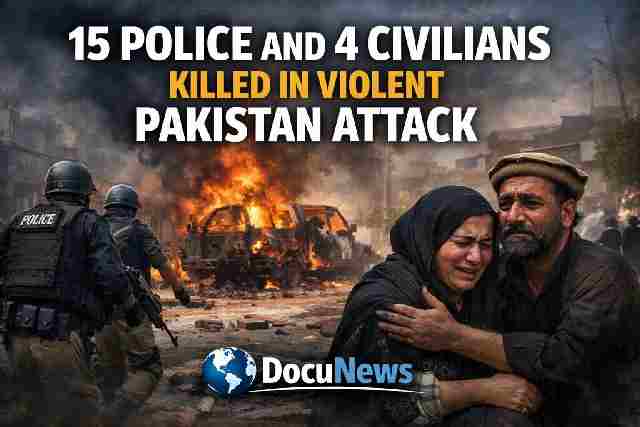
In this article, we delivers a complete and professionally structured report on the tragic incident titled 15 Police and 4 Civilians Killed in Violent Pakistan Attack. This headline 15 Police and 4 Civilians Killed in Violent Pakistan Attack represents a devastating militant assault that claimed the lives of fifteen police officers and four civilians, raising urgent concerns about national security, intelligence coordination, and counterterrorism strategy.
According to DocuNews Central, the incident occurred on February 26, 2026, in northwest Pakistan, including areas within the Khyber Pakhtunkhwa province. Authorities confirmed that emergency teams responded immediately after reports of coordinated militant activity. Security forces secured the affected zones, assisted victims, and launched a comprehensive investigation to determine the full circumstances surrounding the attack.
Officials stated that evidence collection began shortly after the incident. Investigators reviewed surveillance footage, analyzed communication data, and interviewed eyewitnesses. Meanwhile, government leaders promised transparency and reinforced security deployments across vulnerable districts.
Read also Terrorists Attack Mosque in Kebbi State, Four Worshippers Killed
Detailed Account of the Attack
According to security briefings, militants carried out a coordinated operation targeting police personnel and nearby civilians. Consequently, fifteen officers lost their lives while four civilians were killed during the violent confrontation. The attackers used tactical positioning and rapid movement, which increased the severity of the casualties.
Security units responded quickly to contain the situation. Reinforcement teams arrived to stabilize the area and prevent further escalation. Emergency responders transported injured individuals to medical facilities for urgent treatment. Because rapid deployment plays a critical role in crisis situations, authorities praised first responders for their swift action.
Furthermore, leadership officials acknowledged the need to evaluate operational procedures. Therefore, agencies began reviewing communication systems, patrol coverage, and response timing to strengthen preparedness for future incidents.
Government Response and Security Reinforcement
After the attack, national leaders convened an emergency meeting to assess the threat level. As a result, additional forces were deployed across sensitive regions in northwest Pakistan. Surveillance operations expanded to monitor potential militant movements more effectively.
Government representatives strongly condemned the violence and expressed condolences to the families of the victims. In addition, officials reaffirmed their commitment to protecting both civilians and law enforcement officers. Because coordinated intelligence improves prevention efforts, authorities emphasized stronger collaboration between agencies.
Leaders also announced updated counterterrorism strategies. These measures include enhanced training programs, improved technology integration, and expanded intelligence-sharing networks. Consequently, policymakers aim to reduce vulnerabilities and increase national resilience.
Impact on Law Enforcement Institutions
The deaths of fifteen police officers deeply affected security institutions across the country. Departments organized memorial services and provided support to the families of the fallen officers. Senior officials extended formal condolences and pledged continued assistance.
Authorities introduced strengthened protective measures for officers operating in high-risk environments. Training programs now include advanced tactical response modules and updated crisis management strategies. Moreover, equipment standards underwent review to improve safety during field operations.
Internal resilience programs also received attention. Counseling services became available to support personnel emotionally and professionally. Therefore, leadership continues prioritizing morale and institutional stability.
Civilian Casualties and Community Reaction
The loss of four civilians added further tragedy to the event. Local communities expressed grief and demanded enhanced protection measures. Community organizations offered financial and emotional assistance to affected families.
Residents encouraged stronger cooperation with security forces. Consequently, authorities promoted reporting systems to identify suspicious activity early. This partnership strengthens prevention strategies and improves public safety.
Humanitarian groups contributed additional support, focusing on recovery and stability. Because rebuilding trust requires collective effort, both government and civil society continue working together.
Broader Security Context in Pakistan
The incident highlights ongoing security challenges within Pakistan, particularly in the northwest region. Analysts continue studying militant patterns and regional dynamics to understand emerging threats. Because extremist groups adapt strategies frequently, authorities must maintain vigilance.
International cooperation remains essential. Organizations such as the United Nations promote global peacebuilding initiatives and counterterrorism collaboration. Furthermore, cross-border intelligence exchange enhances preventive capabilities.
Experts also recommend combining enforcement measures with economic development initiatives. Education programs, employment opportunities, and community engagement reduce vulnerabilities and discourage extremist influence.
For global police cooperation information, visit INTERPOL.
Economic and Social Impact
Violent incidents often disrupt daily life and local business operations. Consequently, authorities prioritize restoring normal conditions quickly. Transportation systems and public gatherings may experience temporary adjustments during investigations.
However, coordinated recovery efforts help stabilize communities. Development initiatives and public engagement programs contribute to long-term resilience. Because stability encourages economic growth, sustained peace remains a national priority.
Role of Responsible Journalism
Accurate reporting ensures that citizens receive verified information during emergencies. Responsible journalism reduces misinformation and promotes transparency.
DocuNews Central continues to provide reliable and professional coverage of national security developments while maintaining editorial integrity.
DocuNews Central Opinion
DocuNews Central believes this tragic event demands stronger intelligence coordination, improved emergency response systems, and sustained community engagement. Authorities must prioritize advanced monitoring tools, consistent training programs, and transparent communication strategies.
Long-term stability requires inclusive governance, economic development, and accountability. By combining security measures with social progress initiatives, leaders can reduce future risks and strengthen public trust across the nation.
Conclusion
The headline 15 Police and 4 Civilians Killed in Violent Pakistan Attack represents a significant security incident that occurred on February 26, 2026, in northwest Pakistan, including areas within the Khyber Pakhtunkhwa province.
As investigations continue, authorities remain committed to identifying those responsible and preventing similar tragedies. Collaboration between government institutions, international partners, civil society organizations, and responsible media platforms will support long-term peace and stability.
Through transparency, coordination, and strategic reform, Pakistan aims to strengthen national security and protect both officers and civilians from future threats.
