
World
Iran Missile Strike Hits Bahrain Oil Refinery, Massive Explosion

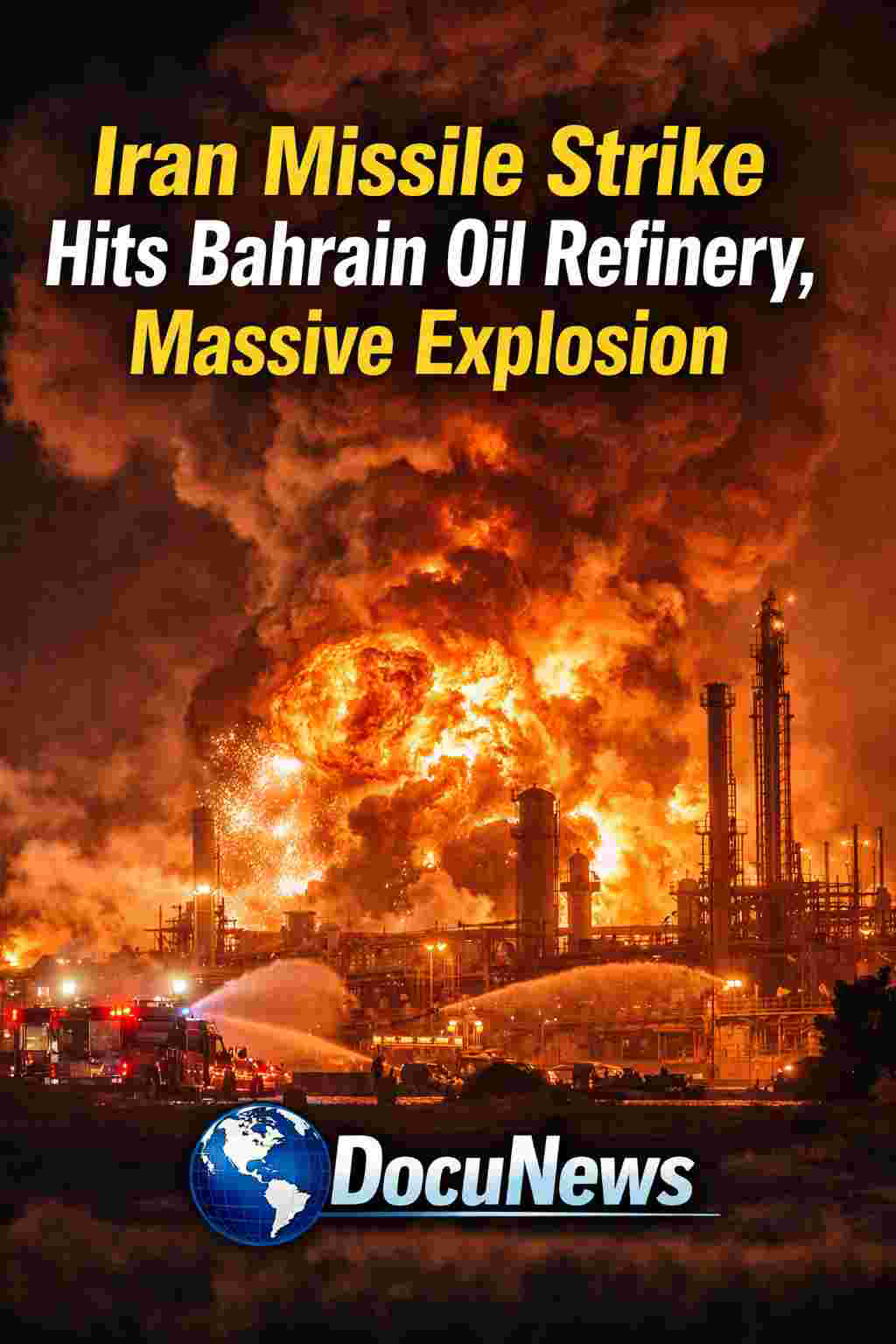
A major security incident has shaken the global energy market after reports confirmed a missile attack on a key oil installation in the Gulf region. Energy infrastructure across the Middle East remains highly sensitive due to ongoing geopolitical tensions. In this developing situation, Iran Missile Strike Hits Bahrain Oil Refinery, Massive Explosion has quickly become one of the most searched topics online as analysts assess the impact on oil supply, regional security, and global energy prices. The incident has raised serious concerns among governments, investors, and military observers monitoring the escalating confrontation in the region.
Watch the video here
According DocuNews Central, On March 6, 2026. Authorities in Bahrain confirmed that a missile strike hit the country’s largest petroleum refinery, triggering a powerful explosion followed by a large fire. Emergency teams responded quickly to contain the blaze at the facility operated by the Bahrain Petroleum Company (BAPCO). Officials reported that the attack caused significant damage to part of the refinery complex, although initial statements suggested that firefighters managed to prevent the flames from spreading across the entire installation.
Furthermore, early intelligence assessments pointed to Iran as the source of the missile strike. Security agencies began a rapid investigation to determine the exact launch location and the type of missile used. Regional defense analysts also reviewed satellite imagery and radar data to confirm the trajectory of the weapon. As a result, military officials across several Gulf nations placed their forces on high alert.
Explosion at Bahrain’s Largest Oil Refinery
The explosion occurred inside the main processing zone of the refinery complex. According to eyewitnesses, a loud blast shook nearby districts before thick smoke rose above the facility. Residents reported hearing a powerful shockwave moments before flames became visible across the refinery’s industrial towers.
Shortly afterward, emergency responders rushed to the scene. Fire engines, rescue teams, and security forces surrounded the area while refinery personnel evacuated several sections of the facility. Authorities quickly established safety zones to prevent civilians from approaching the burning structure.
Meanwhile, officials confirmed that the refinery plays a central role in Bahrain’s energy industry. The plant processes hundreds of thousands of barrels of crude oil each day. Therefore, any disruption at the site could affect regional fuel supply and international oil markets.
Strategic Importance of Bahrain’s Oil Infrastructure
Bahrain’s refinery stands among the most important energy facilities in the Gulf region. The installation refines crude oil into multiple petroleum products including gasoline, diesel, jet fuel, and petrochemical feedstock. Consequently, the facility supports both domestic consumption and international exports.
In addition, the refinery serves as a vital economic pillar for Bahrain’s economy. Energy revenue contributes heavily to government income, industrial development, and employment. For that reason, attacks targeting oil infrastructure generate immediate concern among financial analysts and policy makers.
Furthermore, Bahrain’s refinery connects to international shipping routes through the Persian Gulf. Tankers transport refined products from the facility to markets across Asia, Europe, and Africa. Any interruption in production could therefore influence global energy supply chains.
Rising Middle East Tensions
Regional tensions have increased sharply over the past months. Several incidents involving drones, missiles, and naval confrontations have raised fears of a broader conflict across the Middle East. Security experts note that energy infrastructure often becomes a target during such confrontations.
Moreover, attacks on oil facilities can create immediate economic pressure. When investors fear supply disruption, oil prices often rise rapidly. Therefore, traders closely monitored energy markets after news of the explosion spread across international media platforms.
For example, analysts at the International Energy Agency frequently warn that geopolitical risks in the Gulf region can influence global oil prices. Consequently, energy markets respond quickly to any report involving missile strikes or refinery damage.
Emergency Response and Fire Containment
Emergency services in Bahrain reacted swiftly after the blast. Firefighters worked continuously to bring the refinery fire under control. Specialized industrial firefighting units used chemical suppressants and high-pressure water systems to cool overheated equipment.
Meanwhile, refinery operators shut down several processing units as a precaution. Engineers began safety checks to prevent further explosions within the complex. Officials also inspected nearby storage tanks to ensure that fuel supplies remained secure.
Government authorities later announced that the situation had stabilized. However, investigators continued assessing structural damage across the facility. Repair teams prepared to evaluate pipelines, processing towers, and electrical systems affected by the explosion.
Impact on Global Oil Markets
News of the missile strike quickly influenced international energy markets. Traders reacted within hours as reports confirmed damage at Bahrain’s largest refinery. Oil prices often respond rapidly when critical infrastructure faces disruption.
Furthermore, global investors consider the Gulf region essential to the world’s petroleum supply. Countries across the area produce a significant share of the oil consumed worldwide. Therefore, any threat to refineries or shipping routes attracts immediate attention from financial markets.
Organizations such as OPEC monitor supply stability closely because refinery damage can disrupt fuel distribution. Market analysts continue reviewing production data to estimate whether the Bahrain incident will influence overall output.
Military and Security Reactions
Defense officials across the Gulf region reacted quickly after the attack. Several countries strengthened air defense monitoring and increased patrol operations near critical energy infrastructure. Military commanders also reviewed missile detection systems following the strike.
In addition, regional allies discussed coordinated security responses. Intelligence sharing among partner nations plays a crucial role in detecting potential threats before they reach strategic facilities.
Defense experts frequently emphasize that refineries represent vulnerable targets due to their large industrial structures. Therefore, governments often install radar networks and missile interception systems around such facilities.
International Diplomatic Response
Global leaders reacted to the refinery strike with concern. Diplomats urged restraint while calling for an investigation into the attack. Several governments emphasized the need to protect civilian infrastructure and maintain stability across international energy markets.
Meanwhile, international organizations encouraged dialogue to prevent further escalation. Experts argue that diplomatic engagement remains essential for reducing tensions in the region.
Security analysts also warned that continued attacks on energy facilities could disrupt global supply chains. As a result, policymakers across Europe, Asia, and North America continue monitoring the situation closely.
Energy Security Concerns
Energy security has become a central issue following the refinery explosion. Governments depend on stable oil supply to maintain transportation, industry, and electricity generation. When refineries face damage, fuel availability can become uncertain.
Consequently, many countries maintain strategic petroleum reserves. These emergency stockpiles help stabilize supply during unexpected disruptions. International agencies often coordinate with governments to manage such reserves when major incidents occur.
Energy analysts continue evaluating whether the Bahrain attack could create temporary shortages. However, early assessments suggest that global reserves remain sufficient for now.
DocuNews Central Opinion
According to DocuNews Central, the refinery strike highlights the fragile nature of energy infrastructure in geopolitically sensitive regions. Modern economies depend heavily on stable oil production and transportation networks. Therefore, attacks on refineries create consequences far beyond the immediate location of the incident.
Furthermore, the situation demonstrates how quickly regional conflicts can influence global markets. Investors, governments, and security agencies now watch the Gulf region closely as tensions evolve. The incident also reinforces the importance of diplomatic engagement and improved defense systems protecting critical infrastructure.
In addition, DocuNews Central analysts emphasize the need for international cooperation to reduce risks surrounding energy facilities. Strengthening surveillance, intelligence sharing, and crisis response mechanisms could help prevent similar incidents in the future.
Conclusion
The missile strike on Bahrain’s largest oil refinery marks a serious development in the evolving security landscape of the Middle East. The powerful explosion and resulting fire exposed the vulnerability of vital energy infrastructure in a region central to global oil production.
Although emergency teams successfully controlled the blaze, investigators continue evaluating the full extent of the damage. At the same time, international markets and governments remain alert as the geopolitical situation unfolds.
Ultimately, the event serves as a reminder that stability in the Gulf region remains essential for global energy security. As diplomatic discussions continue and security agencies strengthen monitoring efforts, the world will closely watch how regional leaders respond to this latest crisis.
Disclaimer
This report is published for informational and journalistic purposes only. While every effort has been made to ensure accuracy, details may evolve as new information becomes available. Readers are encouraged to consult official government statements and verified international sources for the latest updates regarding the incident.
