
Security
Troops Defeat Terror Ambush, Recover ₦37m Cash, other logistics

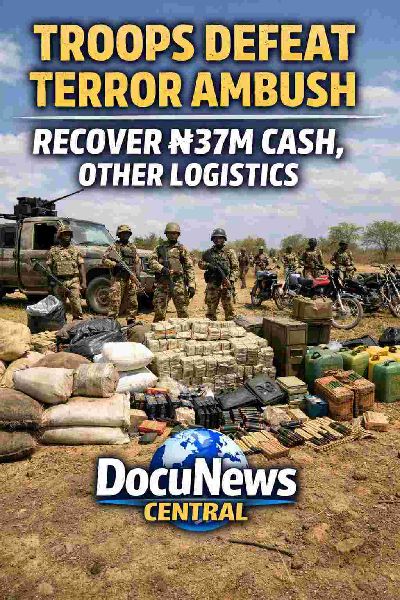
This is one of the best news in Nigeria this week. people are happy to hear this because since last week we only hear bad news. The News that Troops Defeat Terror Ambush, Recover ₦37m Cash, and Other Logistics has dominated security headlines this week after Nigerian soldiers foiled a deadly attack and seized millions of naira meant to finance terrorist activities in the country’s troubled North-East region. The operation highlighted the growing effectiveness of Nigeria’s counterterrorism strategy while delivering a painful blow to insurgent networks.
According to Docunews Central, The incident occurred on Monday, February 16, 2026, when troops intercepted armed fighters attempting to ambush a routine patrol. Acting on timely intelligence, troops engaged the attackers and forced them to flee, leaving behind ₦37 million in cash, fuel supplies, communication devices, and other logistics.
Military sources confirmed that no soldier was injured during the encounter. More importantly, commanders described the recovery as a major disruption of terror financing pipelines that support attacks on civilians and security personnel.
How Troops Neutralised the Ambush
First, surveillance teams noticed unusual movement near a known insurgent route. Shortly afterward, field commanders alerted patrol units already deployed in the area. Consequently, soldiers adjusted their positions and advanced cautiously.
Meanwhile, the terrorists attempted to open fire. However, troops responded immediately with coordinated counter-maneuvers. Within minutes, the attackers retreated into surrounding bushland.
As soldiers swept the area, they discovered bags filled with cash, motorcycles, jerry cans of petrol, dry food items, medical kits, and several mobile phones. Intelligence officers believe the equipment was meant to sustain prolonged operations in remote communities.
According to analysts told Docunews Central, the ₦37 million seizure represents more than a financial loss. It weakens recruitment efforts, disrupts logistics planning, and limits the ability of terror cells to reorganize.
For official updates on military operations, readers can visit the Defence Headquarters website at https://www.defencehq.mil.ng.
Recovered Items Expose Terror Supply Chains
Beyond the cash, troops recovered multiple tools used for coordination and survival in hostile terrain. These included radios, power banks, navigation materials, fuel containers, and food supplies.
Each item offered valuable intelligence.
For instance, the radios suggest organized communication networks. Fuel reserves point to mobility plans across long distances. Meanwhile, the food stockpiles indicate preparations for extended hideouts.
Security experts say such recoveries provide insight into how extremist groups fund operations through extortion, illegal taxation, and kidnapping schemes.
Follow-up raids are already underway in nearby locations to prevent regrouping.
Additional verified information from the Nigerian Army is available at https://www.army.mil.ng.
North-East Remains Under Pressure
Although security operations have intensified, Nigeria’s North-East still faces persistent threats. Communities across Borno, Yobe, and Adamawa continue to endure sporadic attacks on highways, farms, and remote settlements.
Nevertheless, sustained pressure from ground troops has weakened terror supply routes.
Joint patrols with local vigilantes now provide early warnings, while aerial surveillance supports rapid-response units. Consequently, soldiers can intercept threats before they reach population centers.
Humanitarian agencies estimate that millions remain displaced across the region. UNICEF continues to support affected families, as detailed on its emergency response page at https://www.unicef.org/nigeria/emergencies/northeast-conflict.
Despite these challenges, commanders insist recent victories show insurgents are losing operational momentum.
Community Intelligence Plays a Critical Role
Equally important, residents provided quiet but vital support.
Local informants reportedly alerted security forces to suspicious movement days before the ambush attempt. As a result, commanders repositioned patrol teams and reinforced vulnerable routes.
This growing cooperation between civilians and soldiers continues to expose hidden camps and supply corridors.
Traditional leaders now encourage villagers to report abandoned motorcycles, unfamiliar visitors, and nighttime activity. Meanwhile, civil society groups educate communities on safe information sharing.
These partnerships save lives.
Economic Impact of Seized Terror Funds
While ₦37 million may appear modest on a national scale, it represents a substantial operating budget for terror cells.
That money would have funded transportation, weapons procurement, recruitment, and propaganda. Therefore, cutting off these funds directly weakens attack capabilities.
Security economists explain that extremist groups function like informal businesses. They collect revenue, manage logistics, and reinvest profits. When troops intercept cash, the cycle collapses.
Consequently, planned assaults fail, morale drops, and internal trust erodes.
Military Strategy Shifts Toward Proactive Engagement
Recently, Nigeria’s armed forces transitioned from reactive defense to proactive engagement.
Instead of waiting for attacks, troops now conduct continuous patrols, route-clearance missions, and night surveillance. Intelligence units analyze communication patterns to anticipate movement.
This approach has produced measurable results.
More camps have fallen. More hostages have regained freedom. More weapons caches have been dismantled.
Readers can follow national defence policies via the Ministry of Defence portal at https://www.mod.gov.ng.
The Role of Independent Journalism
Accurate reporting also shapes public awareness.
Platforms such as DocuNews Central continue to deliver verified updates, educate communities, and promote accountability within security institutions.
By publishing factual stories and field reports, DocuNews Central helps Nigerians understand both risks and progress on the ground.
Reliable journalism strengthens trust during uncertain times.
Psychological Blow to Terror Networks
Beyond material losses, operations like this damage extremist morale.
When fighters lose money, supplies, and escape routes, fear spreads. Some abandon camps. Others surrender. A few seek rehabilitation.
Meanwhile, civilians regain confidence in security agencies.
This psychological shift matters because it reduces recruitment and increases cooperation.
Regional Cooperation Against Extremism
Nigeria also works with neighboring countries through regional security frameworks.
Chad, Niger, Cameroon, and Nigeria share intelligence and conduct joint patrols to block cross-border movement.
This cooperation prevents militants from exploiting porous frontiers.
More details on continental peace efforts are available on the African Union website at https://au.int/en/peace-and-security.
DocuNews Central Opinion
DocuNews Central Opinion: This successful operation represents more than a tactical victory. It reflects improved intelligence coordination and stronger community engagement.
However, authorities must sustain momentum.
Government agencies should expand youth employment programs, strengthen rehabilitation initiatives for repentant fighters, and increase support for displaced families. Poverty and exclusion still fuel instability.
Furthermore, transparent communication remains essential. Citizens deserve timely updates. Victims deserve assistance. Soldiers deserve modern equipment.
If government, military, media, and communities continue working together, lasting peace becomes achievable.
Conclusion
The defeat of the terror ambush and recovery of ₦37 million in cash and logistics marks another decisive chapter in Nigeria’s ongoing security campaign.
Through coordination, courage, and community cooperation, troops disrupted a dangerous plot and denied extremists vital resources.
Although challenges persist, this operation sends a clear message: terrorism will not define Nigeria’s future.
Instead, resilience, unity, and sustained action will.
