
Politics
Why Bola Tinubu Forced Inspector-General Kayode Egbetokun to Resign- Full Details

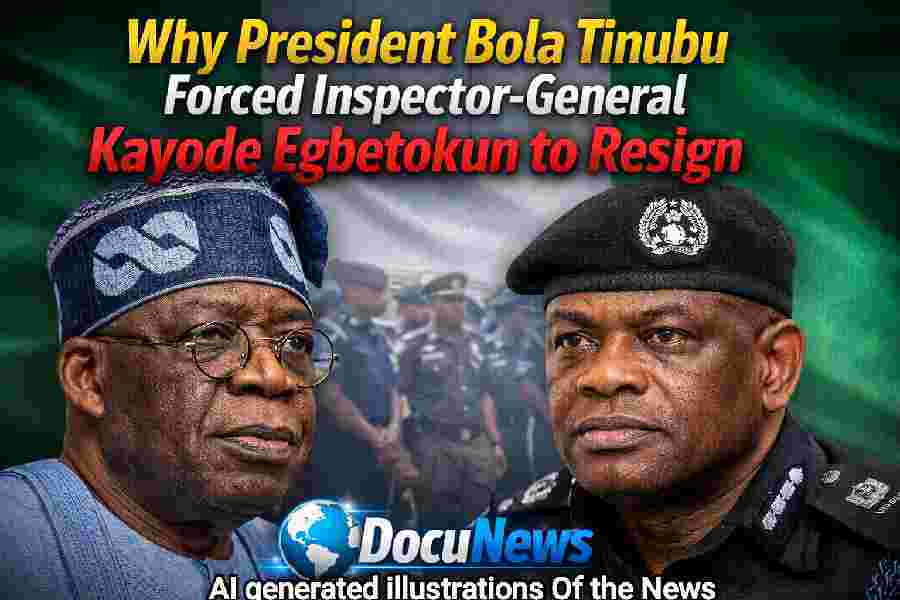
Why President Bola Tinubu Forced Inspector-General Kayode Egbetokun to Resign has become one of the most searched political and security questions in Nigeria. The sudden leadership change at the top of the Nigeria Police Force sparked nationwide debate, policy analysis, and political interpretation. This development has placed Bola Ahmed Tinubu, IGP Kayode Egbetokun, and Nigeria Police leadership crisis at the center of public discourse. Nigerians are demanding clarity, accountability, and strategic direction as security challenges continue across the country.
On February 23rd, 2026: President Bola Ahmed Tinubu directed Inspector-General of Police Kayode Egbetokun to step down from office during a high-level meeting at the Presidential Villa. The resignation was immediately submitted and officially acknowledged. According to reports published by The Guardian Nigeria, the move was described as necessary for administrative and strategic reasons.
While the Presidency cited personal and family considerations as the primary reason for the resignation, political observers and security analysts believe deeper factors influenced the decision. Therefore, understanding the broader national security landscape becomes essential in analyzing why this leadership change occurred.
Official Explanation from the Presidency
The Presidency stated that IGP Egbetokun requested time to focus on pressing family responsibilities. However, because the resignation followed months of rising security concerns, public interpretation quickly expanded beyond the official narrative.
According to DocuNews Central, the decision was framed as part of broader security restructuring under President Tinubu’s administration.
Nevertheless, in political governance, leadership exits rarely occur without layered motivations. Consequently, analysts began reviewing recent developments within the Nigeria Police Force.
Escalating Security Challenges Under Egbetokun’s Tenure
During IGP Kayode Egbetokun’s tenure, Nigeria faced increasing security threats. Banditry intensified in parts of the Northwest. Kidnapping networks expanded along major highways. Community attacks in rural states continued to generate fear.
For instance, large-scale abductions in Niger State and persistent armed attacks in several northern communities raised serious concerns. Reports compiled by independent observers and national newspapers pointed to operational gaps and delayed response times.
As a result, public confidence in police leadership began to decline. Citizens demanded improved coordination between intelligence agencies, better deployment of officers, and stronger enforcement mechanisms.
Read also Farmer Killed in Enugu Herdsmen Attack – Full details
Public Confidence and Accountability Pressure
Trust in national institutions plays a critical role in democratic stability. Therefore, when citizens perceive lapses in protection, pressure mounts on leadership.
Security experts repeatedly argued that Nigeria required structural reform within its policing framework. Civil society organizations also called for enhanced accountability, transparency, and measurable performance benchmarks.
Moreover, the 2024 amendment to the Police Act, which clarified tenure structures, triggered fresh debates about institutional independence. Detailed background on the legal framework can be found via Pulse Nigeria.
Presidential Authority and Legal Backing
Under Nigeria’s constitutional structure, the President holds the authority to appoint and remove the Inspector-General of Police, subject to due process. Therefore, President Tinubu acted within constitutional boundaries.
The Nigeria Police Council plays an advisory role. However, final authority rests with the Presidency. Consequently, the resignation request carried full executive weight.
This legal backing eliminated uncertainty about procedural legitimacy, although political interpretation continued.
Strategic Political Calculations
Political governance requires visible responsiveness. When national security concerns intensify, executive leaders often recalibrate leadership teams.
Firstly, the timing suggests a desire to project decisive leadership. Secondly, reshuffling security leadership can signal reform commitment. Thirdly, administrative restructuring can restore morale within the force.
Therefore, beyond personal reasons, strategic recalibration likely influenced the decision.
Replacement and Forward Strategy
Following the resignation, Assistant Inspector-General Tunji Disu emerged as successor. His background in investigative operations and urban crime management positions him as a reform-oriented leader.
Observers anticipate operational restructuring, intelligence-driven policing, and renewed coordination with military and paramilitary agencies.
International perspectives on leadership transitions in democratic security institutions can be reviewed through reports by BBC News Africa, which frequently analyze governance reforms across the continent.
National Reaction and Political Debate
Public reaction remains mixed. Supporters commend President Tinubu for decisive action. Critics demand greater transparency regarding performance metrics used in evaluating the outgoing IGP.
Nevertheless, both sides agree that Nigeria’s security challenges require urgent solutions.
Consequently, expectations for measurable results under new leadership remain high.
Broader Implications for Nigeria’s Security Landscape
The resignation underscores three major realities:
- Security leadership remains performance-driven.
- Public accountability shapes executive decisions.
- Reform expectations continue to grow.
Furthermore, Nigeria’s evolving security environment demands modernization, intelligence coordination, and community policing integration.
DocuNews Central Opinion
At DocuNews Central, we believe this development represents a strategic turning point rather than a routine administrative shift. Leadership accountability strengthens democratic institutions. However, leadership change alone will not resolve systemic security weaknesses.
Comprehensive reform must include improved training, advanced technology adoption, welfare enhancement for officers, and judicial efficiency.
For more in-depth governance and security analysis, visit DocuNews Central.
Conclusion
Why President Bola Tinubu Forced Inspector-General Kayode Egbetokun to Resign reflects a combination of official explanations, escalating security concerns, legal authority, political calculation, and national expectation for reform.
Although family reasons were publicly cited, contextual evidence suggests broader strategic considerations influenced the decision. Ultimately, the success of this leadership transition will depend on measurable improvement in national security outcomes.
.
