
World
Night Attack: Iranian Drone Hits Radar Tower at US Base in Kuwait.

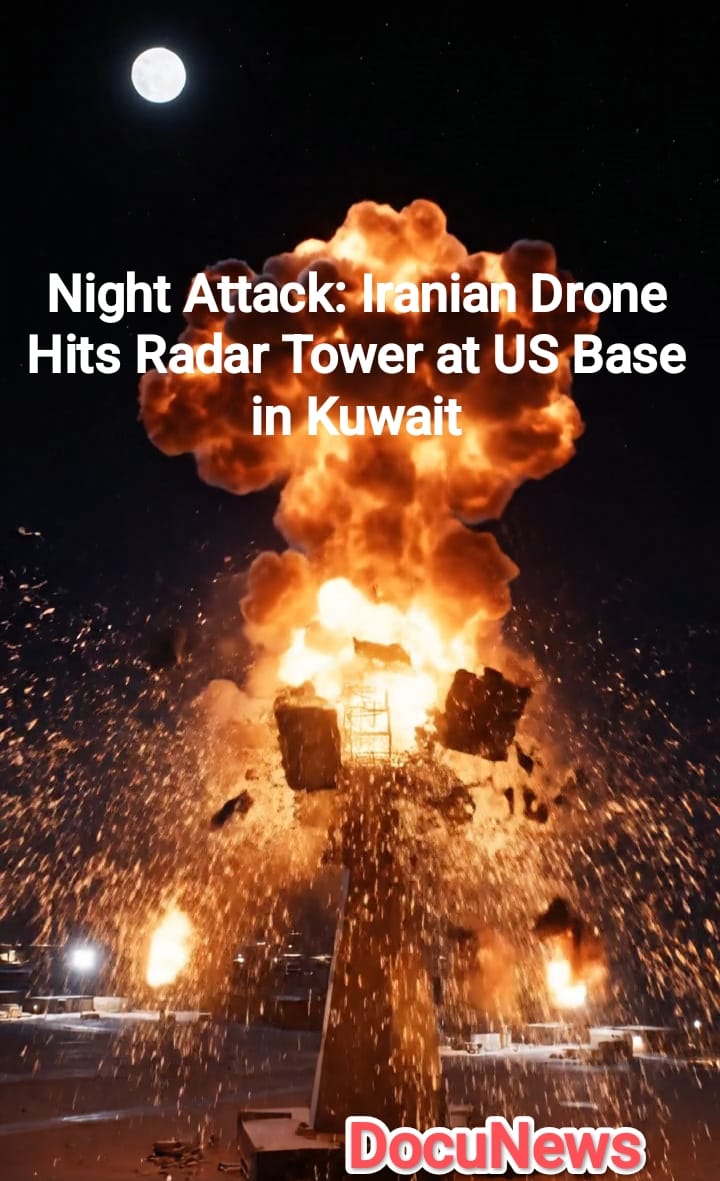
A sudden escalation in Middle East tensions has drawn global attention after reports confirmed that an Iranian drone attack targeted a strategic military installation in the Gulf region. Security analysts say the incident highlights rising confrontation between Iran and the United States as military activity intensifies across the region. But the bold question is, when will this end? As we have Acknowledged, The Night Attack: Iranian Drone Hits Radar Tower at US Base in Kuwait has triggered renewed debate about regional security, air defense readiness, and the possibility of further retaliatory actions.
According to Docunews Central, On March 8, 2026. Military officials and regional observers reported that an Iranian drone strike hit a radar installation at a U.S. base in Kuwait late at night. The attack damaged a radar tower responsible for monitoring aerial threats across the Gulf airspace. As a result, the incident immediately heightened fears of a broader military confrontation in the Middle East.
Initial reports suggest the drone flew at low altitude before striking the radar structure. Defense personnel detected the aircraft moments before impact, yet the short reaction window limited defensive options. Consequently, the strike succeeded in damaging the radar tower even though base security systems attempted interception.
Also read Iran Claims $1 Billion U.S. Radar Destroyed at Al-Udeid Base in Qatar
Rising Security Concerns Across the Gulf
The Iranian drone attack on a US base in Kuwait represents one of the most direct confrontations involving American infrastructure in the region this year. Military analysts argue that the strike illustrates how drone warfare continues to reshape modern conflict.
In recent years, unmanned aerial systems have transformed battlefield strategy. Nations deploy drones because they cost less than traditional aircraft and can evade some radar networks. Therefore, the technology allows smaller strike teams to challenge major military powers.
Furthermore, drone operations often create political ambiguity. Governments sometimes deny direct responsibility or attribute actions to proxy groups. As a result, tensions increase while official declarations remain limited.
Security experts stress that radar installations remain crucial targets. Radar towers track aircraft, drones, and incoming missiles. When such systems suffer damage, the surrounding area loses part of its early warning capability. Consequently, the strike in Kuwait carries strategic implications far beyond a single structure.
Why Radar Towers Are Critical Military Targets
Military bases depend on advanced surveillance systems. Radar towers serve as the eyes of the defense network. They monitor airspace, track movement, and guide interception systems.
When a radar tower at a US base in Kuwait becomes compromised, defense planners face temporary gaps in monitoring coverage. Although backup systems exist, commanders still prefer uninterrupted surveillance.
In addition, radar stations coordinate with regional air defense networks. These networks connect multiple allied facilities. Therefore, a single damaged radar site can disrupt information sharing between cooperating forces.
Modern warfare also emphasizes electronic intelligence. Radar installations collect valuable data about aircraft movement. Opposing forces often target them to weaken detection capabilities. Because of these reasons, the Iranian drone strike on the radar tower immediately attracted international attention.
Growing Pattern of Drone Warfare in the Middle East
Drone warfare has expanded rapidly across the Middle East. Several governments and non-state actors now operate advanced unmanned aircraft capable of long-range surveillance and precision strikes.
Analysts frequently point to Iran as one of the region’s most active drone developers. Over the past decade, the country invested heavily in domestic drone production. As a result, Iranian military planners gained new tools for surveillance and long-range operations.
Meanwhile, United States forces maintain numerous bases throughout the Gulf region. These facilities support naval patrols, air operations, and intelligence missions.
Because of this presence, tensions often center on military infrastructure. Drone attacks provide adversaries with a method to challenge those installations without launching full-scale air campaigns. Moreover, the relatively small size of many drones makes detection difficult. They often fly at low altitude and move slowly. Therefore, traditional air defense systems sometimes struggle to respond quickly.
Timeline of the Night Strike
Witness accounts and preliminary military reports suggest the incident unfolded quickly. Surveillance systems first noticed unusual movement near the base perimeter shortly before midnight.
Moments later, security teams detected an incoming aerial object. Radar operators attempted to track the aircraft as it approached the installation.
However, the drone traveled at low altitude. Consequently, the base had very little reaction time. Within seconds, the aircraft struck the radar tower. The explosion caused visible structural damage and briefly disrupted monitoring equipment.
Emergency crews quickly secured the area. Engineers inspected the site while defense personnel searched for additional threats. Early reports indicate that no casualties occurred. Nevertheless, the incident caused serious concern among military planners.
Strategic Importance of US Bases in Kuwait
American military bases in Kuwait play a critical role in regional operations. These installations support missions across the Middle East.
For decades, Kuwait has served as a logistical hub for American forces. Troops, aircraft, and equipment frequently move through the country during regional deployments.
In addition, radar stations located there monitor Gulf airspace. They help track potential threats and support coordinated defense efforts.
Therefore, any attack on a US base in Kuwait immediately raises alarms among military officials. Even limited damage can disrupt operations or force temporary adjustments. Furthermore, such incidents often influence diplomatic relations because regional governments closely watch how Washington responds to attacks against its installations.
Regional Reactions to the Incident
Governments across the Middle East reacted cautiously after reports of the strike emerged. Officials emphasized the importance of stability while calling for careful investigation.
Several defense analysts noted that the region already faces heightened tensions. Therefore, even a limited strike could trigger wider consequences if misinterpreted.
Meanwhile, international observers urged restraint from all sides. Many analysts warned that rapid escalation could threaten energy infrastructure and shipping routes in the Gulf.
Energy markets also monitor these developments closely. The region supplies a large share of global oil exports. Consequently, security incidents near major transport corridors often affect economic expectations.
Air Defense Systems Under Scrutiny
The Iranian drone attack on a US base in Kuwait has renewed debate about air defense technology. Military experts question whether current systems adequately protect installations from small drones.
Traditional missile defense networks focus on large aircraft or ballistic missiles. However, smaller drones often evade detection due to their size and speed.
As a result, defense planners increasingly invest in specialized counter-drone technology. These systems include electronic jamming equipment, advanced radar sensors, and rapid-response interceptors.
Research programs connected to the U.S. Department of Defense continue to examine improved detection tools and interception methods.
Learn more about U.S. defense initiatives here:
https://www.defense.gov
Intelligence Questions After the Strike
Military investigators now face several critical questions. Analysts want to determine the exact launch point of the drone and whether it originated from nearby territory or from a distant location.
Investigators will also examine aircraft components. These parts could reveal manufacturing origin and technological features.
In addition, analysts will study the navigation system. The findings could show whether the aircraft used satellite guidance, remote control, or pre-programmed coordinates.
Security agencies will also review radar recordings and communication logs to reconstruct the precise timeline of events.
Global defense research from the International Institute for Strategic Studies can be explored here:
https://www.iiss.org
The Broader Geopolitical Context
The Night Attack: Iranian Drone Hits Radar Tower at US Base in Kuwait occurred during a period of complex geopolitical competition.
Relations between Iran and the United States have remained tense for years. Disputes involve nuclear policy, regional influence, and security alliances.
Additionally, the Middle East hosts numerous military bases belonging to international forces. These installations support counter-terrorism operations and regional defense cooperation.
Because of this environment, even smaller incidents can carry strategic implications. Diplomatic observers frequently warn that miscommunication presents a major risk when unexpected military actions occur.
International Monitoring and Media Coverage
News organizations around the world quickly reported the Iranian drone strike on the US base in Kuwait. International media outlets described the event as a potential flashpoint in the Gulf.
Security experts often rely on independent monitoring groups to verify such incidents. These organizations analyze satellite imagery, radar data, and eyewitness reports.
One of the widely recognized monitoring groups is the International Crisis Group, which studies global conflict developments.
Further global conflict analysis can be found here:
https://www.crisisgroup.org
Impact on Military Strategy
The strike may influence how military planners protect infrastructure across the Gulf region.
First, commanders could strengthen drone detection networks by combining radar systems, optical sensors, and artificial intelligence monitoring tools.
Second, bases may expand electronic warfare capabilities. Electronic jamming can disrupt drone communications and navigation signals.
Third, defense teams may redesign base layouts. Important structures such as radar towers may receive additional protective barriers or redundant monitoring systems.
These adjustments reflect a broader shift toward layered defense strategies designed to counter emerging technological threats.
DocuNews Central Analysis
According to analysis published by DocuNews Central, the Iranian drone attack on the US base in Kuwait demonstrates how modern conflicts increasingly rely on asymmetric tactics.
The publication notes that drone strikes allow actors to challenge stronger military forces without deploying traditional aircraft. As technology spreads, more governments and armed groups gain access to these tools.
DocuNews Central also highlights that radar infrastructure will remain a primary target during future conflicts. When surveillance systems become compromised, attackers gain operational advantages.
For more information, visit Israeli-Iran-U.S War
DocuNews Central Opinion
From the perspective of DocuNews Central, the Night Attack: Iranian Drone Hits Radar Tower at US Base in Kuwait shows how technological change continues to reshape warfare.
Drones now function as strategic military tools rather than experimental devices. Consequently, nations must adapt quickly to defend critical infrastructure.
The analysis also emphasizes the importance of diplomatic communication. Without stable dialogue channels, smaller military incidents could escalate into larger confrontations.
Conclusion
The Iranian drone attack on a US base in Kuwait highlights the fragile security balance across the Middle East. A single drone strike damaged a radar installation that supports regional surveillance operations.
Although the incident caused limited physical destruction, its strategic significance remains considerable. Military planners will likely reassess drone defense systems and infrastructure protection across the region.
Meanwhile, international observers will continue monitoring diplomatic responses from governments and security organizations. The coming weeks may reveal more details about the aircraft, its launch origin, and the broader geopolitical consequences.
Disclaimer
This report is based on currently available information from security analysts, open-source monitoring, and early reports. Details surrounding the Iranian drone strike on the US base in Kuwait may change as official investigations release further findings. Readers are encouraged to consult multiple verified sources for the most accurate and updated information regarding this developing story.
Also read Iran Confirms Missile Stores Are Fully Intact – Ready to strike
