
National
Plateau Mining Accident Kills 35+ in Wase

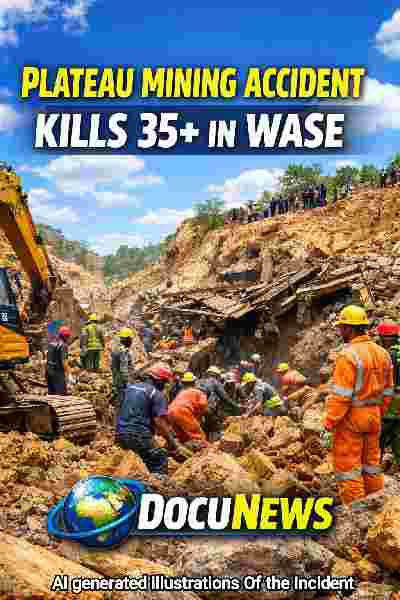
Nigeria faces renewed concerns over industrial safety as authorities respond to a devastating mining disaster in Plateau State. The incident has drawn national attention, triggered regulatory discussions, and intensified calls for stronger compliance measures across extraction sites. The tragic Plateau Mining Accident Kills 35+ in Wase has shocked communities and officials alike. Reports confirm that more than 35 miners lost their lives during the incident in Wase, located within Plateau State. Investigations continue while families mourn their losses and demand answers.
According to DocuNews Central, the disaster occurred in Wase Local Government Area of Plateau State, Nigeria. Emergency teams arrived at the site shortly after the event, yet many victims did not survive. Authorities have launched a full investigation to determine the exact cause. Officials have not released a final technical conclusion.
Details of the Incident
Preliminary findings suggest that structural instability may have contributed to the tragedy. Witnesses who don’t want to mentioned reported to DocuNews Central that there has been an unusual activity at the mining location before the collapse. Rescue efforts began immediately, and local volunteers assisted emergency personnel.
The mining site operated within a region known for mineral deposits. However, safety monitoring in some locations remains inconsistent. This reality raises serious questions about supervision, training, and enforcement standards.
Government representatives confirmed that inspectors will review operational permits and compliance documentation. They will also evaluate licensing conditions and safety protocols. Authorities aim to identify gaps that may have contributed to the fatal outcome.
Official Response and Investigation
The National Orientation Agency expressed deep sorrow over the deaths. The agency emphasized the need for stricter adherence to safety guidelines. Officials urged operators to prioritize worker protection above production targets.
Investigators continue collecting evidence at the scene. Technical experts are reviewing the geological structure of the area. They are also examining equipment usage, supervision records, and emergency preparedness systems.
Authorities stated that transparency remains essential. They encouraged community members to provide credible information that may assist the inquiry. Meanwhile, officials promised periodic updates as findings emerge.
Impact on Families and Community
The loss of more than 35 miners has left families devastated. Many victims served as primary breadwinners. Their absence now creates financial and emotional hardship for dependents.
Local leaders organized support efforts for affected households. Community members gathered to offer condolences and assistance. Religious institutions also held prayer sessions in memory of the deceased.
Residents requested accountability. They want clear explanations regarding safety measures in place before the collapse. They also expect improvements that will prevent future tragedies.
Mining Safety Concerns in Nigeria
Mining contributes to Nigeria’s economic activity. It provides employment opportunities and supports local markets. However, safety enforcement often faces challenges.
Experts argue that stronger regulatory oversight will reduce risks. Routine inspections, certification requirements, and mandatory safety training can improve operational standards. Clear guidelines must apply uniformly across all regions.
International organizations provide useful benchmarks for workplace safety. For example, the World Health Organization offers health-related guidance at: https://www.who.int
Similarly, the International Labour Organization promotes global labor standards at: https://www.ilo.org
These frameworks encourage safe working environments. They emphasize prevention, monitoring, and compliance. Stakeholders can adapt these principles to local conditions.
Economic Consequences of the Disaster
The tragedy may affect productivity in Wase. Mining activities support local income streams. When operations pause, workers experience financial setbacks.
Suppliers and traders also feel indirect effects. Reduced extraction reduces demand for equipment, transport, and services. Therefore, safety improvements must balance economic continuity with human protection.
Authorities intend to review operational procedures. They will examine permit validity and site management practices. Strengthened oversight may restore confidence among investors and residents.
Government Commitment to Reform
Officials have pledged to enhance monitoring systems. They will evaluate inspection frequency and enforcement capacity. Policy discussions may lead to updated regulatory frameworks.
The government continues emphasizing compliance across all mining zones in Plateau State. Leaders encourage companies to implement preventive strategies. These strategies include structural assessments and risk evaluations.
Transparency remains a priority during investigations. Authorities will share verified updates to prevent misinformation. Public communication strengthens trust between communities and institutions.
Community Reaction and Ongoing Concerns
Residents continue expressing concern about operational standards. They request clarity regarding oversight mechanisms. Many community members now advocate for increased awareness campaigns.
Educational programs can improve understanding of workplace hazards. Training initiatives can teach workers how to identify early warning signs. Preventive education reduces accident probability.
Local leaders encourage collaboration between regulators and operators. Cooperation can produce sustainable outcomes. Shared responsibility enhances safety culture.
National Discussion on Regulatory Strengthening
The disaster has sparked broader discussions nationwide. Analysts examine enforcement gaps and administrative limitations. Civil society groups propose stronger monitoring policies.
Lawmakers may consider amendments to existing mining regulations. Increased funding for inspection units could improve compliance tracking. Technology-based reporting systems may also enhance transparency.
Stakeholders agree that prevention must remain the central focus. Accidents can decline when supervision improves. Structured planning supports long-term stability.
Read also Disease Outbreak, Food Shortage Weakens Northern Nig. Bandits
DocuNews Central Opinion
At DocuNews Central, we believe this tragedy demands immediate and measurable reform. The Plateau Mining Accident Kills 35+ in Wase highlights the urgent need for strict enforcement and continuous monitoring.
Authorities must increase inspection frequency. Operators must comply with established guidelines. Communities must participate in reporting unsafe practices. When all stakeholders collaborate, safety improves significantly.
We encourage regulators to adopt advanced monitoring systems. We also recommend transparent communication throughout investigations. Public trust depends on accountability and consistent action.
Conclusion
The Plateau Mining Accident Kills 35+ in Wase remains a painful reminder of the importance of workplace safety. The incident in Wase, within Plateau State, Nigeria, has prompted official investigations and national reflection.
The National Orientation Agency continues urging stronger compliance across mining operations. Authorities have committed to reviewing policies and improving oversight structures. Communities expect meaningful reforms that protect lives.
This tragedy should lead to lasting improvements. Strong enforcement, consistent monitoring, and responsible management can reduce future risks. Safety must remain the foundation of every mining operation across the country.
For Security Updates In Nigeria Visit Security updates Nigeria
