
National
Zero-Tolerance Policy: “No Ransom, No Negotiation”- Tinubu

Published Date: July 31, 2026. Publisher: DocuNews Central
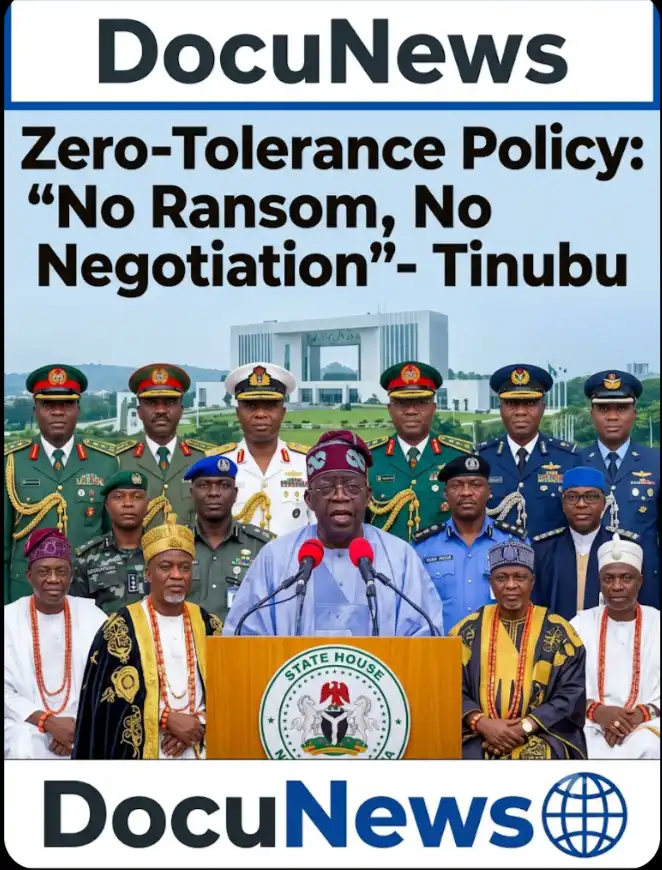
President Bola Ahmed Tinubu has formally declared a hardline zero-tolerance national stance against kidnapping and armed banditry, asserting that the Federal Government of Nigeria will neither negotiate with terrorist syndicates nor pay financial ransoms under any circumstances. Speaking from the Presidential Villa in Abuja during a high-level security meeting with traditional rulers, the Commander-in-Chief emphasized that conceding to criminal demands only serves to fund illicit arms networks, embolden terror syndicates, and perpetuate violence across vulnerable rural communities.
The President’s declaration comes in the wake of successful tactical operations by Nigerian joint security forces, notably the high-profile rescue of abducted school children and teachers along the Oriire axis in Oyo State. Reaffirming the state’s unwillingness to compromise with illegal non-state actors, President Tinubu revealed that during the Oriire hostage crisis, abductors attempted to force the federal authorities into dual demands—insisting on both massive cash ransoms and the immediate release of high-value detained gang leaders from state custody. The Federal Government rejected the terms outright, ordering intelligence-led tactical interventions instead.
“We refused to pay ransom,” President Tinubu stated directly during the briefing. “These criminals wanted us to release from detention members of their criminal gangs that were already arrested… and we said no deal. We are not going to negotiate with criminals. We have the geography of the forest. We know what it is, and we will confront terrorism from a position of overwhelming national strength.”
Also read Kwara Joint Security Forces Rescue 9 Abductees, Kill 3 Bandits
To back the administration’s non-negotiation policy with decisive tactical capacity, President Tinubu announced a major structural expansion of the Nigerian Armed Forces. Under the newly approved security map, the Nigerian Army is officially transitioning from an eight-division operational structure to twelve full military divisions nationwide.
This organizational overhaul is engineered to drastically shorten troop deployment lead times, eliminate logistical operational lags, and provide rapid-response capability when confronting armed groups hiding in vast, remote forest reserves across North-Central, North-West, and South-West transit zones.
By establishing localized divisional headquarters—such as the recently activated 5 Division Headquarters stationed in Makurdi, Benue State—the armed forces aim to maintain continuous tactical pressure across dangerous border corridors spanning Benue, Nasarawa, Kogi, Kwara, Oyo, and Niger states. The numerical and geographical expansion of army divisions will be accompanied by an aggressive recruitment drive, bringing an additional 28,000 active-duty personnel into frontline military formations to fortify vulnerable rural sectors.
“Every security challenge we face teaches us new methods, opens our eyes, and challenges us to examine and re-examine our security architecture, strategy, and operational map,” the President observed. “From eight divisions, we are now moving to 12 divisions to shorten the response time, to give that response time the teeth that is needed for us to defeat terrorism and banditry.”
In addition to expanding federal military formations, President Tinubu confirmed that the Federal Government is accelerating legislative and structural frameworks to formalize State Police across Nigeria’s 36 states. Long championed by governance experts and civil society groups as a vital step toward genuine decentralized policing, state-level police forces are expected to bridge critical manpower gaps in rural communities.
Addressing persistent public concerns regarding potential political overreach or partisan abuse of localized law enforcement by state governors, the President assured citizens that robust federal regulatory mechanisms will be embedded into the enabling legislation.
“There will be state police, and that state police will have guardrails against abuse,” Tinubu declared. “We will protect it from abuses, and you traditional rulers too will have a vital role to play to make the system highly effective, accountable, and transparent.”
Under the proposed framework, traditional institutions, community development associations, and grassroots council elders will be integrated into local police oversight boards to ensure community trust, combat local corruption, and enhance direct intelligence sharing with law enforcement officers on the ground.
Repurposing Forest Guards for Combat Operations
Recognizing that armed bandit networks historically exploit deep forest reserves and national parks as operational safe havens, the administration is executing a fundamental policy shift regarding the role of Nigeria’s Forest Guards.
Rather than functioning strictly as environmental rangers or wildlife conservation officers, state and federal forest guards are being retrained, re-equipped, and tactical-aligned alongside federal security agencies to conduct continuous counter-terrorism clearance missions. Equipped with specialized tactical gear, terrain navigation tools, and inter-agency communications equipment, forest personnel will serve as frontline combat units tasked with flushing out criminal syndicates hiding within dense border corridors.
The operational success of this hybrid strategy was recently demonstrated in Kwara State, where state-recruited Forest Guards working alongside Department of State Services (DSS) operatives and local vigilantes successfully combated an armed cell along the Ekiti LGA border corridor, rescuing nine abductees and neutralizing three bandits.
“We are equally enhancing the capacity and capability of the forest guards,” President Tinubu noted. “They are no longer there merely to protect wildlife. We are enhancing their capacity to pursue criminals and deny them safe havens in our forests.”
Addressing Regional Insecurity and Small Arms Proliferation
During his address to the council of traditional rulers, President Tinubu contextualized Nigeria’s internal security difficulties within broader sub-regional instability impacting the West African Sahel. Political volatility and ongoing counter-insurgency struggles in neighboring nations—including Mali, Burkina Faso, and Niger Republic—have led to an influx of foreign mercenary elements, transnational criminal syndicates, and illegal small arms across porous international borders into northern and central Nigeria.
To counter the illegal flow of military-grade weaponry into local communities, federal law enforcement bodies have intensified nationwide confiscation and destruction drives. The National Centre for the Control of Small Arms and Light Weapons (NCCSALW), operating under the Office of the National Security Adviser (ONSA), recently destroyed thousands of decommissioned, seized, and illegal firearms in Abuja, bringing the total number of illicit weapons permanently removed from circulation to nearly 19,000 units.
“Some of these criminal elements are non-Nigerians,” the President highlighted. “The problem of insecurity in Mali, Burkina Faso, and Niger Republic is adding more fuel to our domestic challenges. But we are firming up our border security, dismantling weapons pipelines, and tightening intelligence monitoring across transit states.”
Community Engagement, Grassroots Intelligence, and Public Trust
Concluding the presidential briefing, Oba Rashidi Adewolu Akanmu Ladoja, the Olubadan of Ibadanland who led the Oyo State delegation of traditional rulers to the Villa, commended the Commander-in-Chief for refusing to yield to terrorist ransom demands. The royal fathers expressed gratitude for the successful rescue operations in Oyo State and urged the Federal Government to sustain joint military-forest operations across the dense forest reserves joining Oyo, Kwara, and Niger states.
President Tinubu urged traditional rulers and local council leaders to mobilize their domains in support of state security personnel by fostering an active culture of civic vigilance. He called on rural citizens to promptly report unfamiliar individuals, suspicious camp setups, and abnormal movement patterns to nearby security posts.
“I want you to take it back to our people to be extra vigilant,” President Tinubu urged the royal fathers. “Know your neighborhoods, know your areas, report strange people to our officers. The immediate challenge is monumental, but we are getting a firm grip on it. Any time you come across our soldiers and police officers on duty, pat them on the back and say thank you—they are sacrificing much to keep our nation safe.”
Citizens monitoring national security directives, federal legislative reforms, and public safety announcements can consult the Federal Republic of Nigeria Official Portal.
Official defense releases, military operational updates, and counter-terrorism briefings are published regularly on the Federal Ministry of Information Portal.
DocuNews Central will continue to monitor presidential security decrees, defense deployments, and grassroots law enforcement updates across all geopolitical zones.
You may like Study Abroad: Top Fully Funded Scholarships Open for 2027
DNC
Written by The Editorial Team | DocuNews Central
The DocuNews Central Desk delivers investigative reporting, grassroots policy updates, and fact-checked news to keep citizens informed with accurate, actionable truth across the nation.
