
Security updates Nigeria
Nigerian Military Recovers Boko Haram Spy Drone in Borno

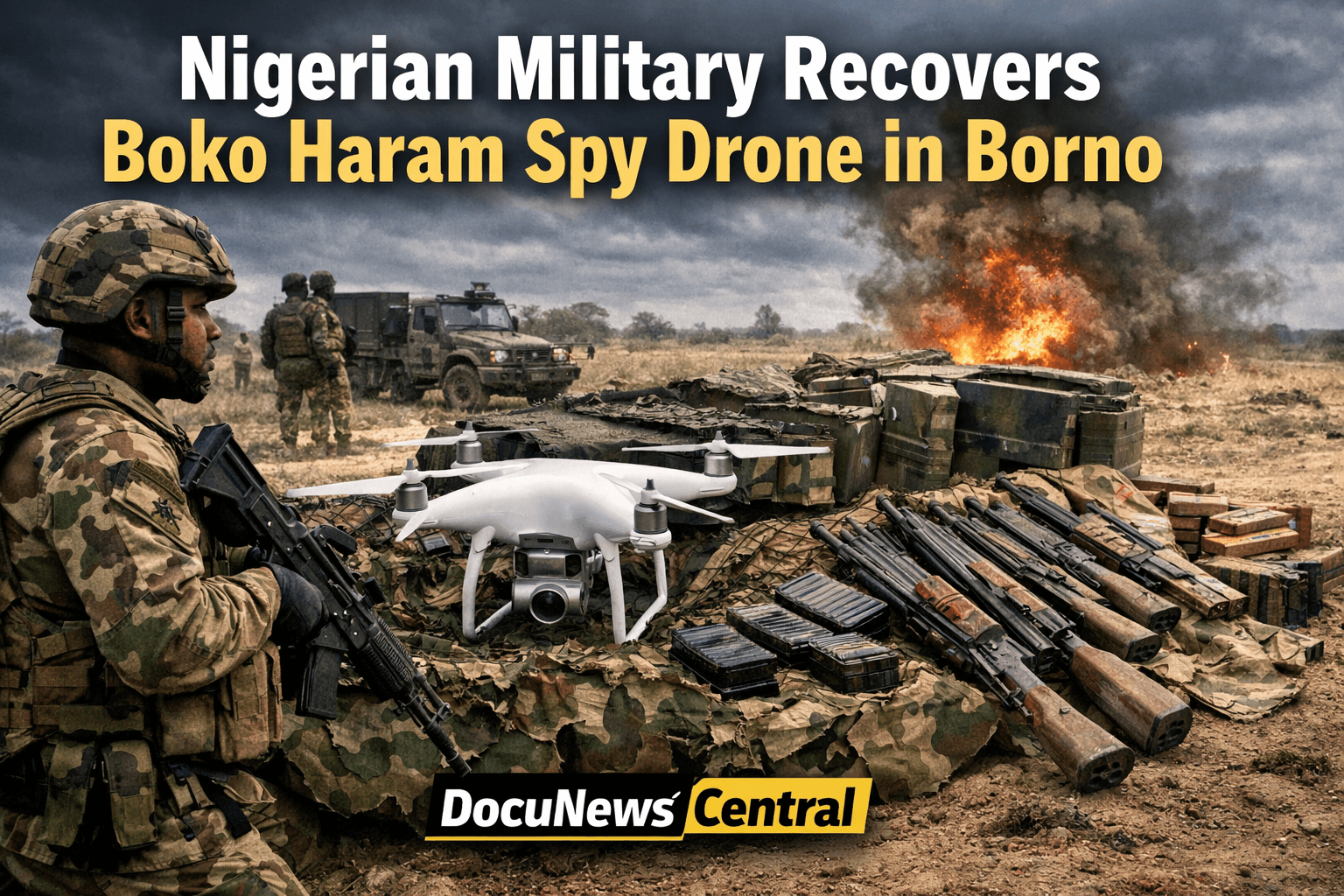
Nigerian Military Recovers Boko Haram Spy Drone in Borno
Nigerian Military Recovers Boko Haram Spy Drone in Borno following a coordinated security operation carried out by troops operating in Nigeria’s North-East. The recovery occurred during an intelligence-led patrol aimed at dismantling insurgent surveillance routes that had drawn growing concern among security planners and local communities.
The development represents another measurable step in ongoing efforts to reduce the operational reach of Boko Haram and its splinter factions. In recent years, these groups have increasingly relied on improvised technology to compensate for losses in manpower and territory. The seizure of the drone, combined with the discovery of an arms cache, disrupted that adaptation cycle.
Security officials confirmed that the operation ended without civilian casualties or property damage. This outcome aligns with current operational priorities that emphasize precision, restraint, and community protection while sustaining pressure on terrorist elements.
Beyond its immediate tactical value, the recovery provides insight into how insurgents continue to monitor troop movement, assess local vulnerabilities, and plan activities across remote areas of Borno State. Read also Nigeria Strengthens Fight Against Terror with 45 Drones
How Nigerian Military Recovers Boko Haram Spy Drone in Borno
The operation followed weeks of layered intelligence gathering. Patrol units reported unusual movement patterns near abandoned settlements and isolated routes that had seen reduced civilian traffic. These observations suggested surveillance-related activity rather than routine travel.
At the same time, community-based sources reported sightings of unfamiliar equipment being transported during late hours. Such reports often form an early warning network that complements formal intelligence channels.
Once analysts confirmed overlapping indicators, field commanders approved a controlled search operation. Troops advanced in phases, using staggered movement to secure access points and reduce exposure.
Engineering teams accompanied the patrol to check for improvised explosive threats, a common tactic used to protect stored equipment. Their work allowed soldiers to proceed safely and methodically.
The drone was eventually found inside a concealed shelter built to blend with surrounding terrain. It had been carefully wrapped and stored alongside spare batteries and simple tools used for maintenance.
A short distance from the shelter, troops uncovered sealed containers holding firearms, ammunition, and related supplies. The placement indicated deliberate planning rather than random storage. Read this too because many people are reacting to this headline. Amotekun Intercepts 39 Suspects Escaping Sokoto After US Strikes
Boko Haram Spy Drone Tactics Exposed in Borno
The recovered drone highlights how Boko Haram continues to adapt accessible technology for reconnaissance. While not comparable to military-grade systems, such devices provide sufficient aerial visibility to track patrol routines and observe defensive layouts.
Security analysts explain that drones of this nature often serve as early-warning tools. They allow operators to detect troop movement from a distance and relay information to ground elements.
In open terrain like parts of Borno, even limited aerial coverage can influence tactical decisions. Militants can delay movement, avoid patrols, or reposition supplies based on visual cues.
The removal of this capability therefore carries immediate operational consequences. Without aerial observation, hostile groups face higher uncertainty and increased risk during movement.
Military sources note that drone recoveries also provide intelligence value. Examination of equipment can reveal usage patterns, range limitations, and operational habits.
Arms Cache Linked to Boko Haram Spy Drone in Borno
The arms cache discovered alongside the drone included rifles, magazines, and ammunition stored to withstand weather conditions. Such storage methods suggest preparation for sustained use rather than short-term engagement.
Weapons caches serve as force multipliers. They reduce the need for frequent resupply, allowing armed groups to remain active even under pressure.
By removing these stockpiles, security forces limit both immediate threats and future operational flexibility. Each recovery narrows the options available to insurgent units.
The proximity of the weapons to the drone indicates a coordinated surveillance-and-response framework. Surveillance likely guided decisions on when and where to deploy the stored arms.
Commanders stress that dismantling such frameworks weakens planning cycles and reduces the likelihood of coordinated attacks.
Borno Security Operations After Spy Drone Recovery
Borno State remains central to Nigeria’s counter-insurgency strategy. Its geography, size, and history of extremist activity continue to shape operational planning.
Security forces have increased joint patrols, improved intelligence sharing, and adjusted deployment patterns to respond to evolving threats.
The operation in which the Nigerian Military Recovers Boko Haram Spy Drone in Borno reflects improved coordination between intelligence units and field commanders.
Following the recovery, patrols expanded across surrounding areas to prevent the re-establishment of surveillance routes.
Officials indicate that such follow-up actions help consolidate gains and reduce the likelihood of immediate retaliation. You may also like to read this information Many Feared Dead as Suspected Terrorists Invade Kebbi Village
Civilian Safety and Community Cooperation in Borno
Civilian safety remains a core consideration during all operations. Authorities emphasized that community engagement played a role in the successful outcome.
Local leaders were informed before and after troop movement, helping to reduce fear and misinformation.
Such engagement builds trust and encourages continued information sharing, which remains critical for early detection of threats.
Residents in affected areas reported minimal disruption, reinforcing confidence in security operations conducted with restraint.
Countering Improvised Surveillance Technology
The recovery underscores ongoing efforts to counter low-cost surveillance tools used by insurgent groups. Training programs now include visual detection techniques and response protocols.
Troops are taught to recognize signs of aerial observation and adjust movement patterns accordingly.
Security planners emphasize that denying surveillance limits hostile planning and increases operational uncertainty.
As insurgents adapt, countermeasures continue to evolve through training, equipment upgrades, and intelligence sharing.
Regional Implications of Boko Haram Spy Drone Recovery
Security developments in Borno carry regional implications. The state lies within a broader zone affected by cross-border movement and shared threats.
Disrupting surveillance and arms networks limits coordination across the Lake Chad Basin.
Information gathered from recovered equipment supports collaboration with regional partners.
Such cooperation strengthens collective responses to evolving security challenges.
Related Reports
- Latest Security Updates
- Borno State Reports
- Counter-Insurgency Analysis
- Defence Headquarters Nigeria
- UN OCHA Nigeria
- ReliefWeb Nigeria
Conclusion
The recovery of the surveillance drone and arms cache represents a meaningful operational gain within a complex security environment.
Intelligence-led patrols, community cooperation, and disciplined execution combined to produce tangible results.
Nigerian Military Recovers Boko Haram Spy Drone in Borno, disrupting hostile surveillance efforts and reinforcing confidence in sustained security operations across the North-East.