
Breaking news
Military Patrol Hit Hard as ISWAP Captures 13 Soldiers in Borno

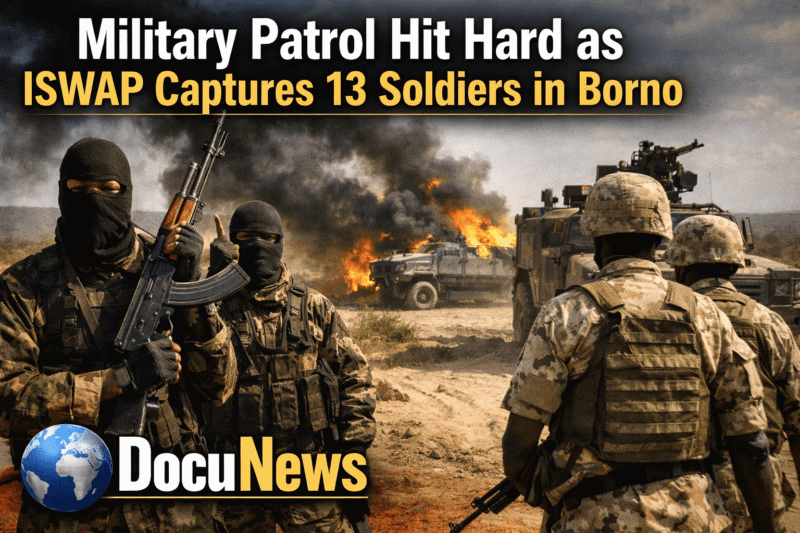
Photo Credit Visit Disclaimers: Use Of AI Images In Our Newsletters
Military Patrol Hit Hard as ISWAP Captures 13 Soldiers in Borno
The sound of gunfire broke a fragile calm and instantly changed everything. What should have been a controlled military movement turned into a deadly encounter that once again exposed the harsh realities of Nigeria’s long-running insurgency in the northeast. Within minutes, lives were lost, soldiers were taken captive, and another painful chapter was added to the country’s security struggle.
On Monday, January 26, 2026, suspected fighters of the Islamic State West Africa Province (ISWAP) launched a carefully planned ambush against Nigerian soldiers near Damasak, in Mobbar Local Government Area of Borno State. The attack left seven soldiers dead and 13 others captured alive, including a senior commanding officer.
The incident has sparked renewed concern among security experts, military families, and citizens, especially as it highlights persistent vulnerabilities along Nigeria’s northern borders. More importantly, it raises serious questions about patrol strategies, intelligence coordination, and troop protection in high-risk zones.
ISWAP Ambush Near Damasak Overwhelms Military Patrol
The soldiers had moved out with focus and discipline, expecting a routine patrol through a familiar but dangerous area. However, ISWAP fighters were already watching. According to security sources, the insurgents had studied the patrol route and positioned themselves strategically before striking.
The ambush began with the detonation of improvised explosive devices. Almost immediately, heavy gunfire followed from multiple directions. As a result, confusion spread through the unit, making it difficult for the soldiers to organize an effective response.
Despite attempts to regroup and return fire, the attackers maintained the upper hand. Their speed, coordination, and use of terrain proved decisive. Consequently, several soldiers fell during the initial exchange, while others became isolated.
By the time reinforcements could react, the attackers had already withdrawn with their captives. In total, seven soldiers lost their lives, while 13 were taken hostage, marking one of the most significant ISWAP attacks in the area in recent months.
Read Also Six Killed, Twenty Kidnapped as Bandits Strike Gombe Communities
Source: Premium Times Nigeria
Damasak and Mobbar LGA: Why This Area Remains Dangerous
Damasak occupies a sensitive position on Nigeria’s map. Located close to the border with Niger Republic, the town sits along routes frequently used by insurgents to move fighters, supplies, and weapons across national boundaries. This strategic importance has made the area a repeated target for attacks.
Over the years, both Boko Haram and its splinter faction, ISWAP, have operated extensively in and around Mobbar Local Government Area. The terrain, which includes vast open spaces and limited infrastructure, often works in favor of armed groups.
Furthermore, sparse civilian presence in some sections reduces early warning signals that could alert security forces. As a result, patrols in this region face constant threats, even when they follow standard operational procedures.
How the Deadly Ambush Unfolded
According to accounts from security sources familiar with the incident, the patrol comprised roughly 30 soldiers. Initially, the movement progressed without incident. However, the situation changed abruptly when an explosion ripped through the convoy’s path.
Gunfire erupted almost immediately afterward. ISWAP fighters reportedly attacked from concealed positions, forcing the soldiers into a defensive posture. Meanwhile, attempts to maneuver out of the kill zone proved difficult due to the attackers’ control of surrounding routes.
Several soldiers attempted to cover their colleagues. Others tried to retreat to safer ground. Unfortunately, the insurgents anticipated these actions and adjusted their positions accordingly.
Within a short period, casualties mounted. Those captured were forcibly separated from the rest of the unit and taken toward insurgent-controlled areas, leaving behind a scene of devastation.
Source: Nigerian Bulletin
Commanding Officer Among the Captured Soldiers
One aspect of the attack has drawn particular attention within military circles. Among the 13 captured soldiers was a commanding officer who had recently been promoted from the rank of major to lieutenant colonel.
Although authorities have not publicly disclosed his identity, sources confirmed that his leadership role made him a significant target. His capture represents not only a tactical setback but also a psychological blow to troops operating in the region.
Military analysts warn that such incidents can affect morale if not addressed decisively. Therefore, swift and transparent communication from authorities remains essential.
You may have missed this Deadly ISWAP Attack in Borno Leaves 7 Soldiers Dead, 13 Taken Hostage
ISWAP’s Tactical Evolution and Growing Confidence
ISWAP has demonstrated increasing tactical sophistication over the past few years. Unlike earlier insurgent operations that focused heavily on civilian targets, the group now prioritizes military engagements.
This strategy allows ISWAP to seize weapons, undermine security forces, and project strength. Moreover, by targeting patrols and isolated units, the group sends a clear message about its continued presence.
Security experts note that the Damasak ambush reflects careful planning, intelligence gathering, and coordination. These traits suggest that ISWAP remains a formidable threat despite sustained military pressure.
Source: Al Jazeera
Military Patrols Face Mounting Risks in Borno State
Troops deployed across Borno State operate under constant danger. Long distances between bases, limited visibility, and unpredictable terrain complicate operations. Even with armored vehicles and aerial support, patrols remain exposed.
In addition, insurgents often monitor troop movements for extended periods before striking. This patience allows them to exploit weaknesses and choose the most effective moment to attack.
The Damasak incident reflects these challenges clearly. It also highlights the need for continuous adaptation in counter-insurgency tactics.
Many people are reacting to this Seven Soldiers Including Lieutenant Colonel, Killed as Boko Haram Attacks Convoy
Official Response and Ongoing Operations
Following the ambush, military authorities initiated internal assessments and operational reviews. While officials have yet to release detailed public statements, security sources indicate that efforts are underway to track insurgent movements.
Historically, such incidents prompt intensified operations under Operation Hadin Kai, Nigeria’s primary counter-insurgency campaign in the northeast.
Source: PRNigeria
Families of Captured Soldiers Await Answers
For the families of those captured, uncertainty remains the most painful reality. Many relatives have expressed fear and frustration, while holding onto hope for the safe return of their loved ones.
Past incidents show that prolonged captivity increases emotional strain on families and intensifies public pressure on authorities. Therefore, the coming days will be critical.
Public Reaction and National Debate
News of the ambush spread rapidly across Nigeria. Social media platforms filled with reactions ranging from anger to grief. Many Nigerians questioned the adequacy of patrol support and intelligence coordination.
At the same time, messages honoring the fallen soldiers emerged, reflecting widespread respect for their sacrifice. The incident has reignited national conversations about defense funding, troop welfare, and border security.
Regional and International Security Implications
Nigeria’s insurgency challenge affects the wider Lake Chad region. Neighboring countries face similar threats, making cross-border cooperation essential.
International partners continue to provide training and intelligence support. However, analysts stress that local knowledge and adaptive strategies remain crucial to long-term success.
What the Damasak Ambush Means Going Forward
The ambush near Damasak sends a stark message. Despite years of military operations, ISWAP retains the ability to strike with precision and impact.
Experts recommend improved intelligence sharing, enhanced surveillance, and stronger coordination among units. Above all, protecting troops must remain a top priority.
Looking Ahead
Nigeria now faces difficult choices. The deaths of seven soldiers and the capture of 13 others underline the urgency of reviewing counter-insurgency strategies.
For now, families wait anxiously. Soldiers remain on alert. Communities in Borno hope for lasting peace. What happens next will shape security operations in the region for months to come.