
Security updates Nigeria
Major Victory in Borno as Nigerian Troops Kill Boko Haram Deputy Leader Abu Khalid in Sambisa

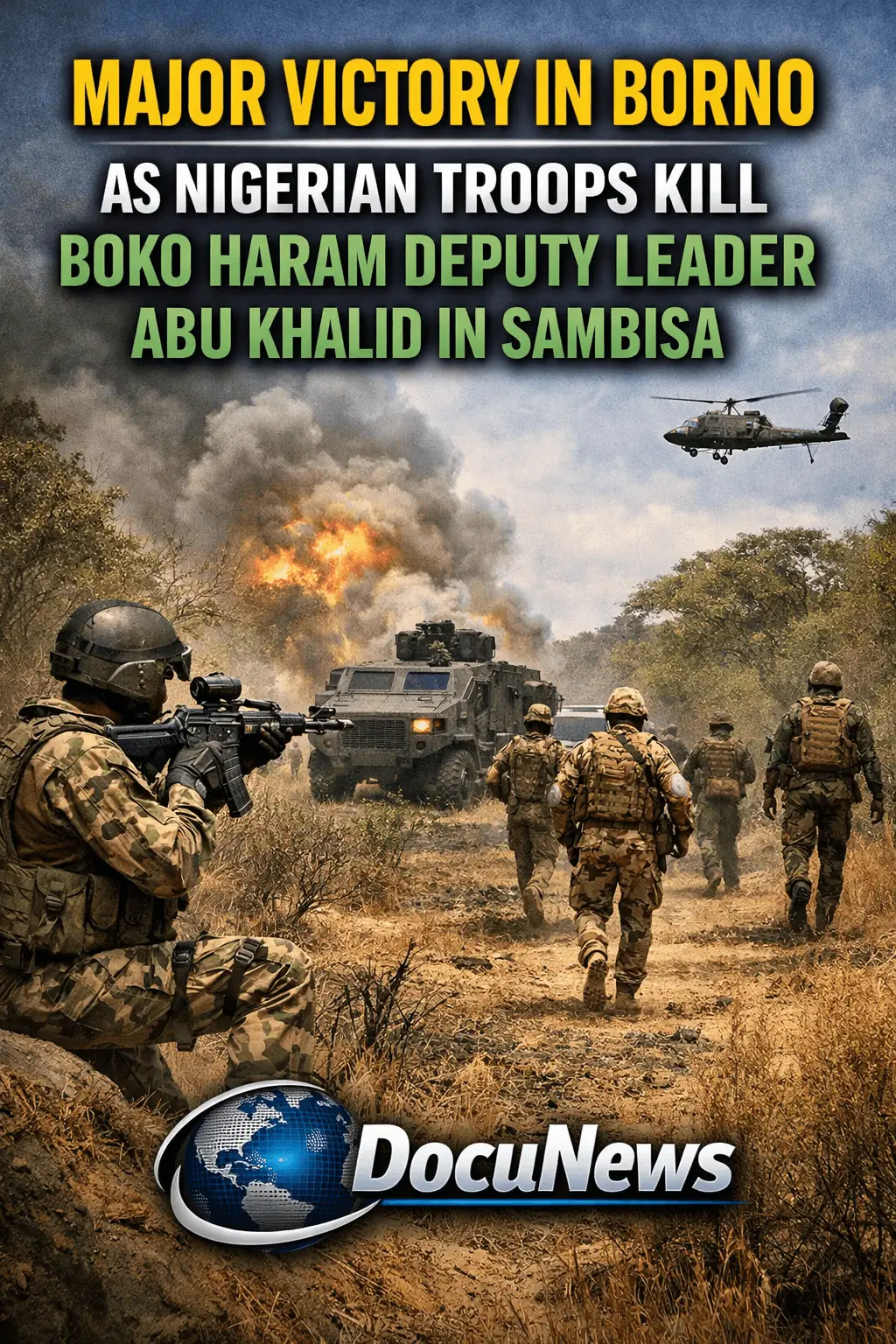
Photo Credit Visit Disclaimers: Use Of AI Images In Our Newsletters
Major Victory in Borno as Nigerian Troops Kill Boko Haram Deputy Leader Abu Khalid in Sambisa has reshaped Nigeria’s counter-terrorism narrative and delivered one of the most decisive blows against Boko Haram in recent years. The successful military offensive weakened the extremist group’s leadership, disrupted its internal command chain, and reaffirmed the growing effectiveness of Nigeria’s security strategy in the North-East. More importantly, the operation restored confidence among affected communities while sending a clear signal that no hideout remains beyond reach.
The carefully coordinated operation occurred in Sambisa Forest, Borno State, in late January 2026, following days of intelligence-led surveillance and strategic troop deployment across critical access routes. Acting on verified field reports, Nigerian troops advanced into hostile terrain, engaged armed insurgents, and neutralised Abu Khalid alongside several fighters during a prolonged confrontation inside the forest.
The Strategic Importance of Sambisa Forest
Sambisa Forest has remained a symbol of Boko Haram’s endurance for over a decade. Thick vegetation, complex pathways, and remote encampments allowed insurgents to evade detection and regroup after repeated losses. However, Nigerian forces gradually dismantled these advantages through sustained pressure, improved intelligence coordination, and persistent ground operations.
Over time, security agencies narrowed escape corridors and reclaimed areas once considered inaccessible. Consequently, senior insurgent figures faced mounting pressure. Abu Khalid, who relied heavily on Sambisa’s cover, became increasingly exposed as military surveillance intensified.
Moreover, the forest’s shrinking operational space limited Boko Haram’s ability to stage large-scale attacks. Each territorial loss further constrained logistics, recruitment, and internal communication networks.
Read Also Borno bombing: Boko Haram targets military convoy, casualties reported
Who Was Abu Khalid?
Abu Khalid served as Boko Haram’s deputy operational commander within the Sambisa axis. He coordinated armed raids, supervised supply movement, and maintained contact with splinter cells operating around southern Borno. His role placed him at the centre of tactical planning and execution.
Security analysts described him as a seasoned field operative with extensive local knowledge. Because of this, his elimination created a leadership vacuum that the group will struggle to fill quickly.
In addition, Abu Khalid reportedly managed internal discipline among fighters. Therefore, his absence increases the likelihood of internal mistrust, fragmentation, and declining morale within Boko Haram’s remaining ranks.
You may have missed this Five Abducted as Bandits Burn Police Station and Church in Niger Community
How the Military Operation Unfolded
The mission followed weeks of intelligence fusion involving ground surveillance, aerial reconnaissance, and human sources. Nigerian troops identified movement patterns that pointed to Abu Khalid’s location within a cluster of temporary camps.
Subsequently, soldiers secured access routes and established forward positions. They moved cautiously yet decisively, preventing escape while maintaining constant communication across units. When contact occurred, troops engaged firmly and sustained pressure until resistance collapsed.
Importantly, the operation prioritised civilian safety. Troops adhered to strict rules of engagement, avoided residential zones, and limited collateral damage. As a result, nearby communities reported minimal disruption during the engagement.
Military Assessment and Official Reaction
Senior military officials described the operation as a major operational success. They praised troop discipline, leadership coordination, and intelligence accuracy that guided the mission.
According to defence sources, the outcome demonstrated improved operational readiness and adaptability in complex terrain. Officers also highlighted inter-agency cooperation, which enhanced situational awareness throughout the mission.
For official security updates and defence policy insights, readers can consult the Nigerian Defence Headquarters via https://www.defencehq.mil.ng.
Impact on Boko Haram’s Operational Capacity
The loss of a deputy commander significantly weakens Boko Haram’s ability to coordinate attacks. Leadership attrition disrupts planning cycles, reduces command efficiency, and creates uncertainty among fighters.
Furthermore, insurgent groups often struggle to replace experienced leaders quickly. New commanders lack established authority and battlefield familiarity, which increases operational errors and internal disputes.
Consequently, security analysts expect a decline in organised assaults within the Sambisa corridor as remaining cells attempt to reorganise.
Many people are reacting to this Police Reveal Identities of Dismissed Army Officers Arrested Over Armed Robbery in Oyo State
Community Reactions Across Borno
Residents across affected communities welcomed the development with cautious optimism. Years of displacement, disrupted livelihoods, and insecurity left deep scars. Therefore, the news provided renewed hope for lasting stability.
Local leaders expressed confidence that sustained military pressure would reduce attacks on farms, markets, and highways. Traders anticipated safer travel routes, while farmers looked forward to returning to abandoned fields.
Humanitarian organisations also acknowledged the security gains. Improved access enables aid delivery to previously unreachable settlements.
For humanitarian updates in North-East Nigeria, information is available through the United Nations Office for the Coordination of Humanitarian Affairs at https://www.unocha.org.
Regional Security Implications
Boko Haram’s activities extend beyond Nigeria’s borders. Therefore, leadership losses in Sambisa affect the broader Lake Chad Basin security landscape.
Reduced coordination limits cross-border movements and weakens alliances with allied factions. As a result, neighbouring countries benefit from diminished spillover threats.
Regional cooperation remains essential. Joint patrols and intelligence sharing through multinational frameworks continue to strengthen collective security.
More details on regional security collaboration are available via the Multinational Joint Task Force at https://www.mnjtf.org.
The Role of Intelligence and Technology
The Sambisa operation highlighted the growing role of intelligence-driven warfare. Real-time data, aerial surveillance, and coordinated ground reporting enabled precise decision-making.
However, technology alone did not guarantee success. Training, discipline, and leadership ensured effective execution under challenging conditions.
As Nigerian forces continue to modernise, intelligence fusion remains a cornerstone of counter-insurgency efforts.
Psychological and Propaganda Effects
Beyond physical losses, leadership eliminations damage extremist propaganda. Boko Haram often relies on narratives of invincibility to recruit and intimidate.
Each confirmed defeat undermines that image. Consequently, potential recruits may reconsider involvement, while existing members lose confidence.
Counter-narrative efforts gain credibility when security achievements align with community engagement and development initiatives.
Sustaining Momentum After the Victory
Security experts caution against complacency. Insurgent groups adapt quickly and seek alternative hideouts.
Therefore, Nigerian forces must consolidate reclaimed territory, maintain patrols, and prevent re-infiltration. Civil authorities also play a crucial role in restoring governance.
Long-term peace depends on infrastructure rehabilitation, education access, and economic opportunities that reduce vulnerability to radicalisation.
For insights into development and security linkages, readers can explore reports by the World Bank at https://www.worldbank.org.
Human Rights and Accountability Considerations
Professional conduct during military operations strengthens legitimacy. Adherence to humanitarian standards builds trust among affected populations.
Nigerian authorities continue to emphasise accountability, transparency, and civilian protection as core operational principles.
Guidance on humanitarian law remains available through the International Committee of the Red Cross at https://www.icrc.org.
Media Responsibility and Information Integrity
Accurate reporting plays a vital role during security operations. Balanced coverage informs the public without amplifying extremist messaging.
Independent platforms continue to monitor developments across the region. Readers seeking in-depth security analysis and verified reporting can follow updates from DocuNews Central, which tracks security, governance, and humanitarian issues across Nigeria.
Lessons From the Sambisa Operation
Several lessons emerge from the successful mission. Intelligence precision saves lives. Coordination enhances effectiveness. Community trust improves access.
Most importantly, sustained leadership attrition weakens insurgent resilience over time.
These insights guide future operations across remaining hotspots.
The Road Ahead for Borno State
Borno remains central to Nigeria’s security priorities. While attacks have declined in some areas, challenges persist.
Authorities continue reopening markets, supporting resettlement, and expanding safe corridors. Each step strengthens confidence and stability.
When security improvements align with development efforts, peace becomes sustainable.
Conclusion
Major Victory in Borno as Nigerian Troops Kill Boko Haram Deputy Leader Abu Khalid in Sambisa represents a defining moment in Nigeria’s fight against terrorism. The operation weakened a dangerous network, boosted morale, and reinforced national resolve.
Nevertheless, responsibility follows success. Sustained security, accountable governance, and inclusive development remain essential.
With persistence and unity, Borno can move steadily toward lasting peace.