
Breaking news
Borno bombing: Boko Haram targets military convoy, casualties reported

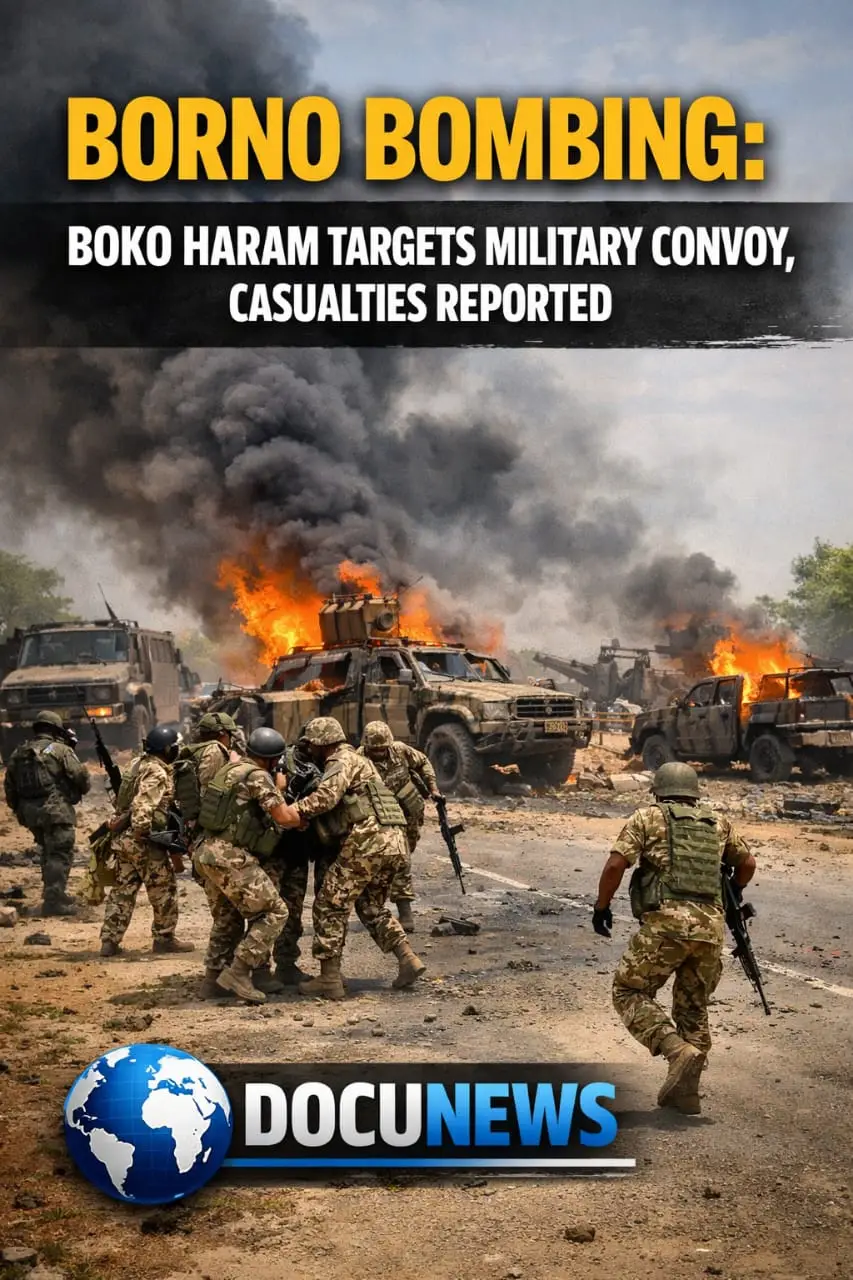
Photo Credit Visit Disclaimers: Use Of AI Images In Our Newsletters
Borno bombing: Boko Haram targets military convoy, casualties reported has once again drawn national attention to the persistent security challenges facing Nigeria’s North-East, after insurgents struck a military convoy with an explosive device, causing multiple casualties and damaging operational vehicles. The attack underscored the continuing threat posed by Boko Haram despite years of sustained counterinsurgency operations and renewed regional cooperation.
The bombing triggered an immediate security response, halted traffic along a strategic route, and forced emergency medical evacuation for wounded personnel. Although the military swiftly regained control of the area, the incident reignited concerns about convoy safety, intelligence gaps, and the evolving tactics of extremist groups operating in Borno State.
As details emerged, residents near the scene described a loud blast followed by rapid deployment of soldiers, armored vehicles, and surveillance assets. While authorities urged calm, the attack served as a stark reminder that the insurgency remains active and capable of striking hardened targets.
Date, location, and early developments
The attack occurred on Tuesday in Borno State, along a key military supply route linking forward operating bases within the Marte–Dikwa axis, an area long considered vulnerable due to repeated insurgent activity. Security sources confirmed that the convoy was on routine operational movement when the explosion occurred.
The blast reportedly went off during the early hours of the morning, a period often exploited by insurgent cells due to reduced civilian movement and limited visibility. Troops immediately sealed off the area, suspecting the possibility of secondary devices, a common tactic used to target responders.
Following clearance operations, injured personnel were evacuated to military medical facilities in Maiduguri, while damaged vehicles were recovered. Authorities later confirmed that operations along the route resumed under reinforced security.
Read Also Five Abducted as Bandits Burn Police Station and Church in Niger Community
Nature of the attack and weapons used
Preliminary investigations indicate that the attack was carried out using an improvised explosive device concealed along the roadside. Experts believe the device was likely triggered remotely as the convoy passed, suggesting prior surveillance and planning.
Roadside explosives remain one of the most lethal tools employed by Boko Haram factions. Over the years, insurgents have refined concealment methods, embedding devices under sand, vegetation, or damaged road surfaces to evade detection.
Security analysts note that such attacks require logistical coordination, intelligence gathering, and local support networks, highlighting the continued presence of sleeper cells within rural parts of Borno.
Casualties and medical response
Casualty figures were still being verified at the time of reporting. Military officials confirmed injuries among personnel, while emphasizing that accurate numbers would be released only after proper documentation.
Medical teams activated emergency trauma protocols immediately after the blast. Field medics stabilized the wounded before air and ground evacuation to advanced facilities equipped to handle blast injuries.
Military hospitals in Maiduguri were placed on alert, while blood banks and surgical units prepared for extended treatment. Family liaison officers were also deployed to provide updates and support to relatives.
You may have missed this Police Reveal Identities of Dismissed Army Officers Arrested Over Armed Robbery in Oyo State
Immediate military response and containment
Troops at the scene responded within minutes, establishing a security cordon and initiating counter-ambush drills. Engineers conducted route clearance to ensure no additional explosive devices remained.
Air surveillance assets provided overwatch, scanning surrounding terrain for suspicious movement. This coordinated response helped prevent follow-up attacks and allowed for controlled evacuation.
Commanders later commended the professionalism of personnel involved, noting that adherence to standard operating procedures reduced further casualties.
Strategic importance of convoy movements
Military convoys play a vital role in sustaining operations across Borno State. They transport personnel, food supplies, fuel, ammunition, and humanitarian escorts to remote garrisons.
Disruption of convoy routes can isolate bases, slow response times, and affect morale. For insurgents, such attacks serve both tactical and psychological objectives.
As a result, convoy protection remains a central pillar of Nigeria’s counterinsurgency strategy, with continuous adjustments based on threat assessments.
people are reacting to this Scores Killed as Boko Haram Terrorists Storm Construction Site in Borno
Evolving insurgent tactics in Borno
Boko Haram factions have adapted their methods over time. Direct assaults on fortified positions have given way to asymmetric tactics such as roadside bombings and hit-and-run attacks.
Security experts observe that insurgents now rely heavily on intelligence gathered from local terrain familiarity, exploiting predictable movement patterns.
To counter this, the military increasingly varies routes, schedules, and convoy compositions, making it harder for hostile elements to plan attacks.
Regional security implications
Borno’s security situation affects the wider Lake Chad region, including Niger, Chad, and Cameroon. Insurgent movements often cross porous borders, complicating response efforts.
Multinational cooperation under frameworks such as the Multinational Joint Task Force has improved intelligence sharing and joint patrols.
However, analysts argue that sustained coordination remains essential to prevent insurgents from exploiting jurisdictional gaps.
Government reaction and official statements
State authorities condemned the attack and reiterated their commitment to restoring lasting peace in the North-East. Officials praised security forces for their swift response.
The federal government emphasized ongoing investments in equipment, training, and welfare for troops deployed in high-risk areas.
Authorities urged the public to rely on verified updates rather than speculation, stressing the importance of responsible information sharing.
Impact on civilians and local communities
Although the attack targeted a military convoy, nearby communities felt the effects immediately. Movement restrictions temporarily disrupted trade and transport.
Residents expressed concern over recurring violence, calling for increased patrols and community engagement.
Humanitarian organizations monitored the situation to ensure continued access to essential services, including food distribution and healthcare.
Economic and logistical consequences
Security incidents along major routes increase operational costs for both military and civilian logistics. Delays affect supply chains and contractor schedules.
Transport operators often face higher insurance premiums and fuel costs when routes are deemed high risk.
Authorities continue to engage stakeholders to minimize disruption and maintain economic activity.
Countermeasures and future prevention strategies
Following the incident, military commanders ordered a comprehensive review of convoy procedures across Borno State.
Enhanced detection technologies, improved armor, and expanded intelligence networks form part of ongoing reforms.
Training programs now emphasize early warning systems, rapid casualty care, and community-based intelligence gathering.
Role of intelligence and community cooperation
Intelligence remains the backbone of counterinsurgency success. Timely information can disrupt plots before execution.
Community leaders play a critical role by encouraging residents to report suspicious activities without fear.
Authorities have expanded outreach initiatives to strengthen trust and cooperation.
Media responsibility and accurate reporting
Responsible journalism plays a crucial role during security incidents. Accurate reporting prevents panic and misinformation.
International outlets such as BBC Africa and Al Jazeera Nigeria provide verified regional coverage.
Analytical insights from International Crisis Group help contextualize the conflict beyond breaking news.
Internal reporting and follow-up coverage
Within Nigeria’s digital news space, platforms such as DocuNews Central continue to provide background reporting, security analysis, and policy-focused follow-ups that deepen public understanding.
Such internal coverage supports informed discourse and counters sensationalism.
Legal and policy framework
Nigeria’s counterterrorism laws provide the legal basis for prosecuting insurgents and their financiers.
Security agencies continue to collaborate with judicial authorities to ensure due process.
Policy reviews following incidents like this often result in updated operational guidelines.
Psychological impact and troop welfare
Beyond physical injuries, attacks carry psychological effects on personnel and civilians alike.
The military has expanded counseling and mental health support services for deployed troops.
Officials stress that morale remains strong despite ongoing risks.
Long-term outlook for Borno State
While attacks persist, authorities maintain that progress has been made compared to earlier years of the conflict.
Reconstruction efforts continue alongside security operations, focusing on education, agriculture, and infrastructure.
Stability, analysts argue, will depend on sustained security pressure combined with economic opportunity.
Conclusion
The Borno bombing targeting a military convoy highlights both the resilience of Nigeria’s security forces and the adaptive nature of Boko Haram insurgents.
Although casualties were recorded, swift response prevented escalation and restored control.
As investigations continue, the incident reinforces the need for vigilance, intelligence-led operations, and credible information as Nigeria works toward lasting peace in the North-East.
Miesha Vukcevic
February 9, 2026 at 2:06 pm
You have noted very interesting details! ps nice internet site.