
National
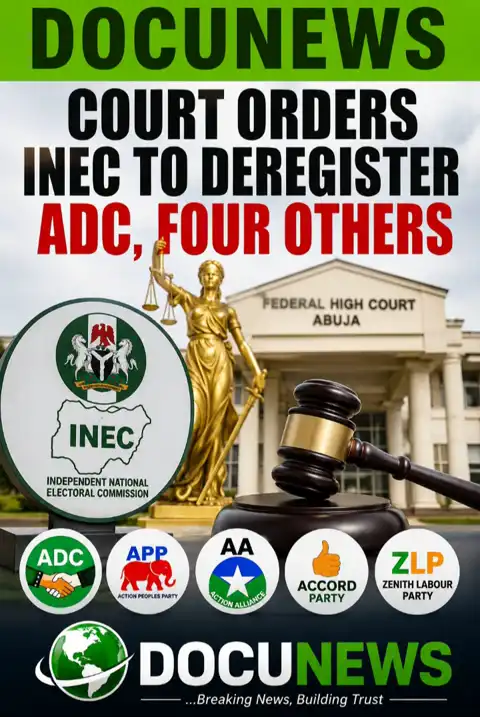
Court Orders INEC to Deregister ADC, Four Others

By Jonadab
Publisher: DocuNews Central
2026-06-15
A Federal High Court in Abuja has ordered the Independent National Electoral Commission (INEC) to deregister five political parties, including the African Democratic Congress (ADC), over their failure to meet constitutional requirements for continued recognition.
The ruling was delivered by Justice Peter Lifu on Monday following a suit filed by the Incorporated Trustees of the National Forum of Former Legislators. The court held that the affected parties failed to satisfy electoral performance benchmarks required under Nigerian law.
The judgment was delivered on June 15, 2026, at the Federal High Court in Abuja, Nigeria’s Federal Capital Territory. The decision immediately drew national attention because it affects parties that have participated in previous elections and could influence preparations for future polls.
Court decision
The court directed INEC to remove the African Democratic Congress (ADC), Action Peoples Party (APP), Action Alliance (AA), Accord Party, and Zenith Labour Party (ZLP) from the official register of political parties.
According to the judgment, the affected parties failed to meet constitutional thresholds required to retain their registration. The court agreed with arguments presented by the plaintiffs that the parties did not demonstrate the level of electoral performance required by law.
As a result, Justice Lifu ordered INEC to carry out the deregistration process. The court also directed that the affected parties should not participate in future elections if the ruling remains in force.
Where Did It Happen?
The case was heard and decided at the Federal High Court in Abuja. The proceedings followed months of legal arguments concerning the constitutional obligations of INEC regarding political parties that fail to meet electoral benchmarks.
Earlier court schedules had delayed the delivery of judgment. However, the matter returned before Justice Peter Lifu, who eventually delivered the final ruling.
The judgment came at a time when political parties across Nigeria have begun positioning for future electoral contests. Consequently, the decision has generated significant discussion within political circles.
Who Is Involved?
The major institutions involved in the case include the Federal High Court, INEC, and the Incorporated Trustees of the National Forum of Former Legislators.
The five affected political parties are the African Democratic Congress (ADC), Action Peoples Party (APP), Action Alliance (AA), Accord Party, and Zenith Labour Party (ZLP).
Justice Peter Lifu presided over the case and delivered the judgment. Meanwhile, INEC was named as a key defendant because the commission maintains the official register of political parties in Nigeria.
Basis of the Court’s Decision
The court examined constitutional provisions relating to the registration and continued recognition of political parties. The plaintiffs argued that political parties must achieve specific electoral performance standards to remain registered.
They maintained that the affected parties failed to secure the required level of electoral support during previous elections. Furthermore, they argued that continued recognition of such parties would contradict constitutional provisions.
The court accepted those arguments and concluded that INEC has a constitutional responsibility to enforce the relevant provisions governing political party registration and deregistration.
Electoral Performance Requirements
Under Nigerian law, political parties are expected to demonstrate measurable electoral performance. Such requirements were introduced to prevent the proliferation of inactive political parties.
The plaintiffs argued that the affected parties neither secured the required percentage of votes nor won sufficient elective positions to justify continued registration.
Consequently, the court ruled that the constitutional conditions for retaining registration had not been satisfied by the affected parties.
Impact on the ADC
The ruling carries particular significance for the African Democratic Congress because of its growing national profile in recent political discussions.
ADC has attracted attention in recent months due to developments involving prominent opposition figures. Therefore, the court’s decision could have wider political implications if it survives the appeals process.
Nevertheless, the judgment does not automatically conclude the legal process because the party retains the right to challenge the decision before a higher court.
ADC Reacts to Judgment
Shortly after the ruling, ADC officials rejected the court’s decision and signaled plans to pursue legal remedies.
According to party spokesperson Bolaji Abdullahi, the ruling would be challenged through constitutional and legal channels. He criticized the judgment and argued that the party would continue to defend its position in court.
The planned appeal means the matter could proceed to the Court of Appeal and possibly the Supreme Court if further legal questions arise.
Also read Police Kill Two Bandits, Rescue Five Kidnapped Victims in Abuja
What Happens Next?
INEC is expected to review the judgment and determine the appropriate administrative steps required under the law.
However, legal experts note that an appeal could affect how quickly the ruling is implemented. Therefore, the next actions by both INEC and the affected political parties will be closely monitored.
The commission has not yet issued a comprehensive public statement outlining how it intends to proceed following the court’s directive.
Political Implications
The judgment could reshape Nigeria’s political landscape if it remains in force. Fewer registered political parties could alter electoral competition and political alliances.
In addition, politicians affiliated with the affected parties may need to consider alternative political arrangements depending on the outcome of future legal proceedings.
Several analysts also expect increased legal scrutiny of political party compliance with constitutional requirements in the coming months.
According to DocuNews Central
According to DocuNews Central, the ruling represents one of the most significant court interventions involving political party registration in recent years. The decision directly affects five registered political parties and places renewed focus on constitutional requirements governing electoral participation.
While the judgment currently stands, the final outcome may depend on subsequent appeals and any actions taken by INEC. Therefore, political stakeholders across the country are expected to monitor developments closely.
For now, the Federal High Court’s directive remains a major development in Nigeria’s political and electoral environment. Additional updates are expected as the affected parties pursue legal options and INEC reviews the judgment.
Sources:
Reuters: https://www.reuters.com/world/africa/nigerian-court-orders-electoral-body-deregister-main-opposition-party-four-2026-06-15/
INEC: https://www.inecnigeria.org
