
Israeli-Iran-U.S War
Kuwait Air Defense Systems Destroy Dozens Of Iranian Missiles and Hundreds of Drones

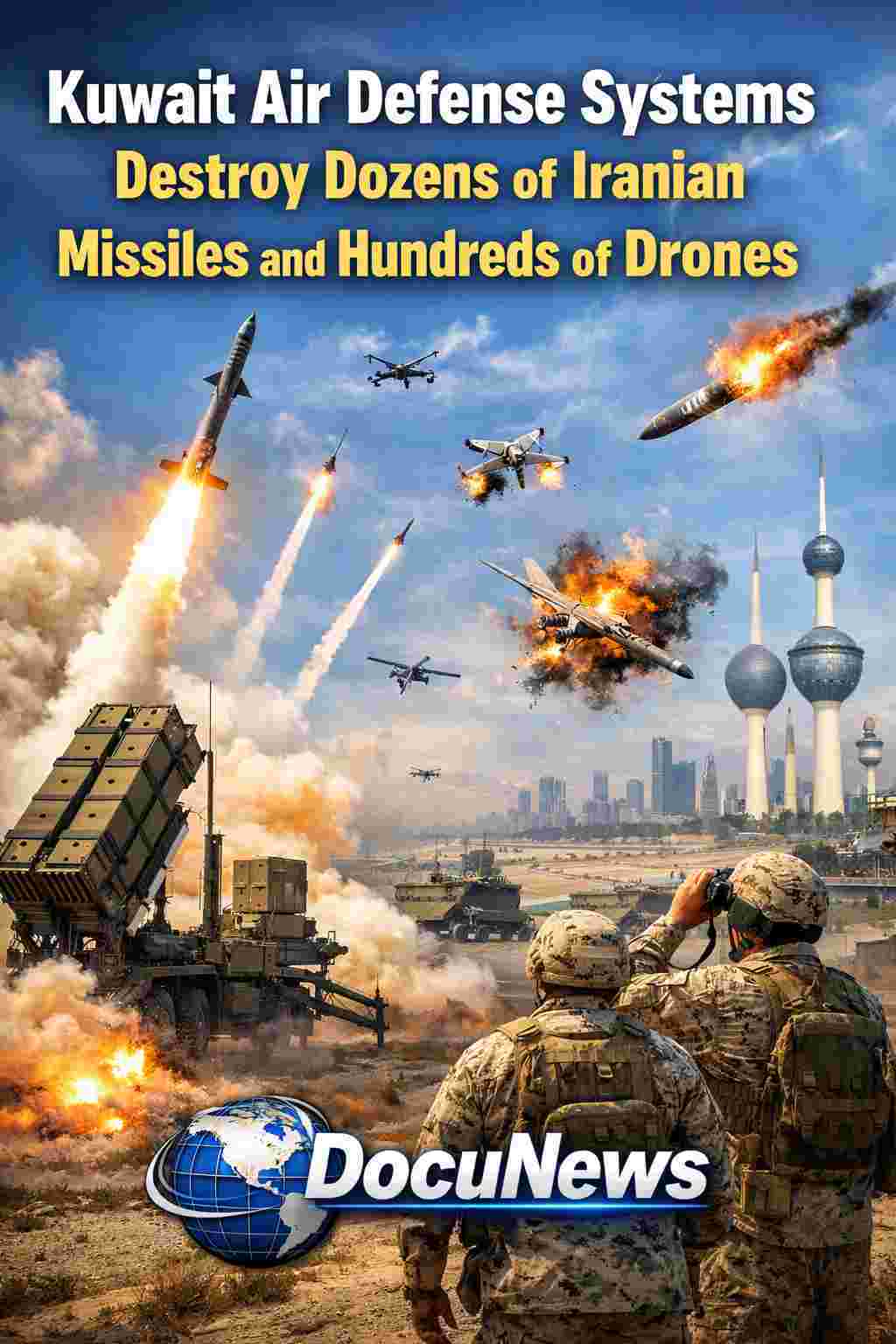
Tension is rising seriously in the Middle east. Kuwait Air Defense Systems Destroy Dozens of Iranian Missiles and Hundreds of Drones this has emerged as the dominant security headline across the Gulf as tensions continue to rise in the Middle East. The large-scale aerial interception highlights the growing threat of missile and drone warfare while underscoring Kuwait’s military preparedness. More importantly, the successful defense operation prevented damage to critical infrastructure and civilian areas.
According to DocuNews Central, on March 2, 2026. Authorities confirmed that air defense units activated advanced radar systems shortly after multiple aerial objects entered monitored airspace from the northern maritime corridor near the Persian Gulf. Within minutes, command centers identified the projectiles as hostile. Defense batteries deployed interceptors immediately. As a result, officials reported the destruction of dozens of missiles and hundreds of drones before they could reach strategic targets.
Although early warning systems detected the threat in time, the scale of the coordinated assault surprised security analysts. Nevertheless, Kuwait’s military maintained full operational control. Officials credited layered defense architecture, rapid coordination, and continuous surveillance for preventing a major crisis.
Read also Iran Hit Israeli Military Headquarter, US Bases in Sixth Retaliatory Wave- Full Details
Massive Coordinated Aerial Assault
Radar installations first detected multiple flight signatures traveling at different speeds and altitudes. Some objects moved at high velocity, consistent with ballistic missiles. Others flew slower, indicating long-range unmanned aerial vehicles. Because the assault combined several technologies, defense planners classified it as a hybrid strike.
Furthermore, the high number of incoming targets created a complex combat environment. However, Kuwait’s interception strategy relied on staggered engagement zones. Long-range systems targeted high-altitude threats first. Medium-range interceptors eliminated lower-flying drones next. Finally, point-defense systems shielded vital infrastructure.
Emergency services remained on standby throughout the night. Residents reported loud explosions overhead as interceptors neutralized threats mid-air. Fortunately, officials confirmed no significant casualties or infrastructure damage.
How Kuwait’s Air Defense Network Responded
Kuwait invested heavily in Kuwait Air Defense Systems after previous regional crises exposed vulnerabilities in Gulf airspace. Consequently, its integrated shield now combines radar arrays, anti-ballistic missile platforms, and drone countermeasure units.
Commanders followed strict engagement protocols. Once sensors confirmed hostile intent, units launched interceptors in coordinated waves. Because the assault involved hundreds of drones, electronic warfare teams jammed navigation signals to disrupt guidance systems. As a result, many unmanned aircraft lost control before interception.
Military doctrine often references models discussed by the U.S. Department of Defense regarding layered missile defense. However, Kuwaiti officials emphasized that domestic command directed all operations independently.
Rising Gulf Tensions
This incident reflects broader instability across the region. Diplomatic relations have deteriorated in recent months. Meanwhile, military drills intensified along several strategic corridors. Because Gulf states depend on maritime trade and energy exports, any disruption raises serious economic concerns.
Leaders within the Gulf Cooperation Council condemned the attack and reaffirmed commitments to collective security. Analysts suggest the strike may have aimed to test readiness rather than cause immediate destruction. Even so, the scale signals escalating tension.
You may have missed this Iranian Leader Ayatollah Ali Khamenei Has Been Confirmed Dead – Full Details
Strategic and Economic Implications
Kuwait hosts vital oil production facilities and export terminals. Therefore, any successful strike could destabilize global energy markets. Fortunately, air defense systems neutralized threats before they reached refineries or shipping ports.
Energy analysts monitored crude futures closely after the news broke. Prices fluctuated briefly. However, markets stabilized once authorities confirmed successful interceptions. According to the U.S. Energy Information Administration (https://www.eia.gov), uninterrupted supply plays a crucial role in preventing market panic.
Geopolitical risk premiums may still influence trading behavior. Nevertheless, Kuwait’s swift response prevented broader economic shock.
International Reactions
Several governments expressed concern following the attempted strike. The United Nations called for de-escalation and urged diplomatic dialogue. Western allies reiterated support for regional stability while monitoring developments closely.
Security think tanks including the Center for Strategic and International Studies (https://www.csis.org) and the International Institute for Strategic Studies (https://www.iiss.org) continue analyzing evolving missile and drone warfare trends.
Evolution of Drone and Missile Warfare
Over the past decade, military planners observed dramatic changes in aerial combat. Missile accuracy improved significantly. Drone production costs declined sharply. Consequently, hybrid assaults that combine both systems have become more common.
Such tactics attempt to overwhelm radar coverage and exhaust interceptor inventories. Therefore, layered defense remains the most effective deterrent against saturation attacks. Reports from RAND Corporation (https://www.rand.org) highlight the importance of electronic countermeasures alongside kinetic interception.
Civilian Communication and Crisis Management
Authorities quickly reassured residents through official briefings. Emergency alert systems functioned properly, advising temporary indoor sheltering. After defense units neutralized all threats, officials lifted precautionary measures.
Transparent communication prevented misinformation from spreading across social media platforms. Accurate reporting strengthens public trust during volatile situations.
Energy Security and Maritime Monitoring
Because Kuwait ranks among major oil exporters, stability within its territory influences global supply chains. Maritime authorities continue monitoring vessel traffic near strategic corridors. The International Maritime Organization (https://www.imo.org) maintains oversight of shipping safety standards worldwide.
DocuNews Central Opinion
DocuNews Central believes preparedness prevented catastrophe. Kuwait demonstrated disciplined command, rapid response, and strong investment in national defense. However, military capability alone cannot guarantee lasting peace. Regional dialogue must complement deterrence. Furthermore, transparent governance builds confidence among citizens and international partners.
Looking Ahead
Although immediate danger subsided, long-term implications remain. Gulf governments will reassess threat models and upgrade air defense coordination. Diplomatic channels may intensify in response to rising instability.
Kuwait’s successful interception marks a defining moment in Gulf security history. Nevertheless, sustained stability will depend on continuous modernization, strategic cooperation, and diplomatic restraint.
For verified updates and in-depth analysis, visit: DocuNews Central
Also visit here for updates on this ongoing war Israeli-Iran War