
Politics
Supreme Court to Decide Party Leadership Disputes

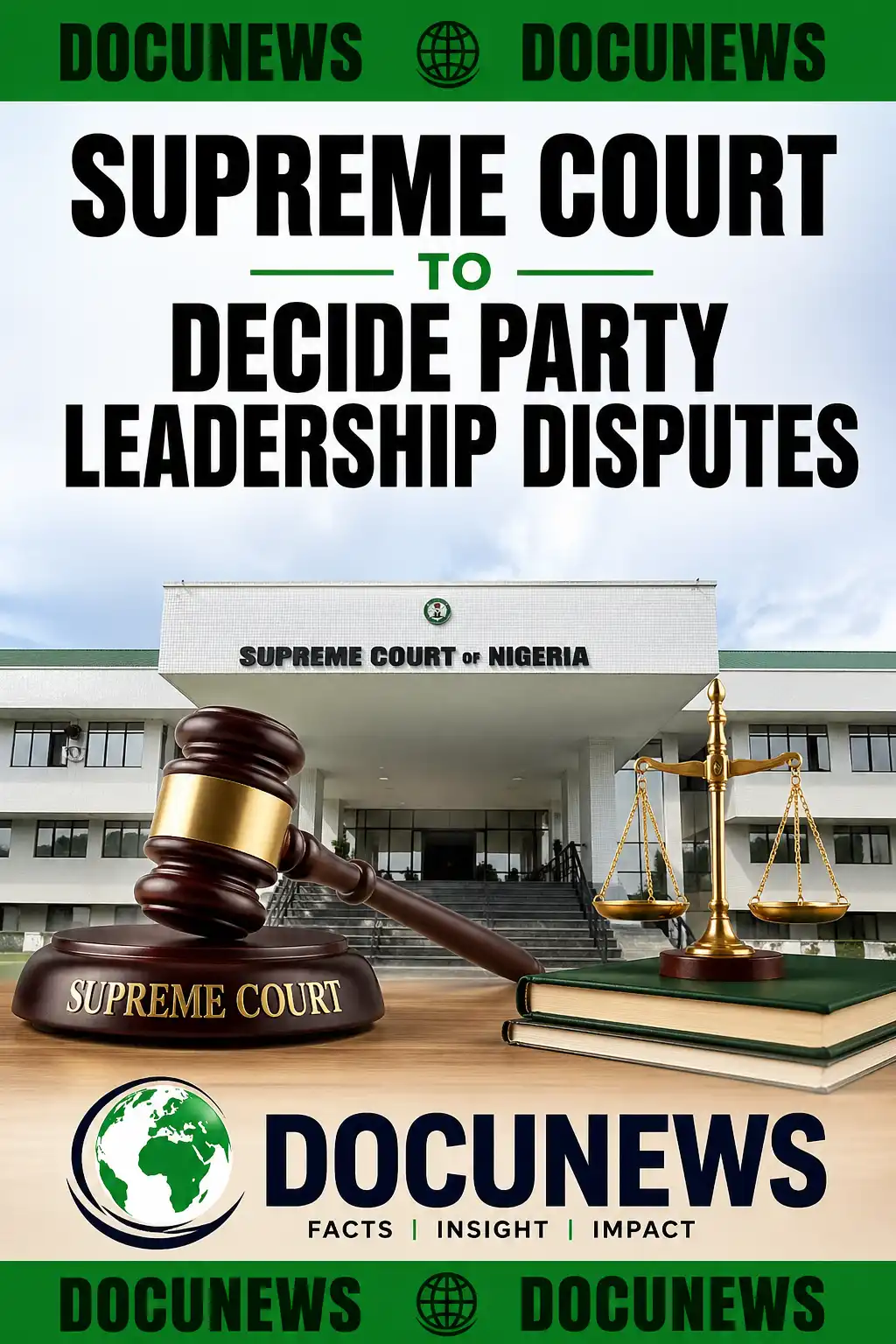
Author: Jonadab
Date: April 30, 2026
Publisher: DocuNews Central
Supreme Court Faces Landmark Decision on Political Party Leadership Crisis
The Supreme Court is preparing to deliver a decisive judgment on multiple political party leadership disputes that have continued to generate tension within Nigeria’s political space. Moreover, the case is expected to address conflicting claims over legitimate party executives, internal party control, and disputed congress outcomes across several political organizations.
In addition, the ruling comes at a time when political stakeholders are closely monitoring internal party stability ahead of future elections. Consequently, attention has shifted toward how judicial interpretation may influence party structures and democratic processes moving forward.
Furthermore, as of April 30, 2026, in Abuja, Nigeria, the apex court has reportedly concluded hearing arguments from affected parties, while judgment is now anticipated. Meanwhile, legal representatives from various political groups have presented documentation challenging or defending leadership positions within their respective parties.
Accordingly, this development has intensified national discussions about party autonomy, internal democracy, and compliance with electoral guidelines established by regulatory institutions such as the Independent National Electoral Commission (INEC).
Also read Police Sack ASP Ogbegbe, Move to Prosecute Over Misconduct
What Happened?
The situation emerged following prolonged disagreements within several political parties over leadership legitimacy. Specifically, rival factions have continued to claim recognition as the authentic executive arm of their respective parties.
Additionally, disputes originated from contested party congresses, parallel leadership structures, and conflicting court rulings from lower judicial levels. As a result, multiple cases were escalated to the Supreme Court for final interpretation and resolution.
Moreover, the Supreme Court consolidated various appeals into a unified hearing process in order to streamline judgment delivery. Consequently, legal arguments focused on constitutional provisions, electoral guidelines, and internal party constitutions.
In the same vein, legal teams argued over whether political parties fully complied with due process during leadership selection exercises. Meanwhile, opposing counsel maintained that certain congresses were either valid or improperly conducted.
Therefore, the apex court’s final interpretation is expected to establish legal clarity on how internal party disputes should be resolved in line with Nigeria’s constitutional framework.
Where Did It Happen?
The proceedings took place at the Supreme Court of Nigeria, located in Abuja, the Federal Capital Territory. The court remains the highest judicial authority in the country, empowered to deliver final rulings on constitutional and electoral matters.
Furthermore, Abuja has recently become the central point for multiple politically sensitive legal matters involving party governance and electoral compliance. Consequently, security presence around judicial premises has remained heightened during major hearings.
In addition, legal observers and political analysts have closely monitored proceedings both physically and through official court communications. Meanwhile, stakeholders across different states have expressed strong interest in the outcome due to its potential national impact.
For official reference, more information about the judiciary can be accessed through the Supreme Court of Nigeria portal: http://www.supremecourt.gov.ng.
Who Is Involved?
The case involves multiple political parties with internal leadership disputes, represented by different legal teams and party factions. Although specific names vary across the consolidated cases, the central issue remains the legitimacy of party executives and congress outcomes.
Additionally, the Independent National Electoral Commission (INEC) has played a regulatory role by providing records, monitoring compliance, and verifying party congress submissions. Consequently, INEC documentation has become a key reference point during court proceedings.
Furthermore, senior legal practitioners representing various factions have argued extensively on constitutional interpretation and party autonomy. Meanwhile, the court has examined procedural compliance, electoral guidelines, and prior judgments from lower courts.
In the broader context, political stakeholders, party members, and observers remain indirectly involved as the outcome could reshape internal party leadership structures nationwide. Therefore, the ruling carries implications beyond the immediate parties under dispute.
For additional regulatory context, INEC’s official website provides relevant electoral guidelines and updates: https://www.inecnigeria.org.
Legal and Political Implications of the Supreme Court Decision
The anticipated ruling is expected to clarify the legal boundaries governing internal party leadership selection in Nigeria. Moreover, it may redefine how political parties handle internal elections and dispute resolution mechanisms.
In addition, legal analysts suggest that the judgment could strengthen institutional accountability within party structures. Consequently, parties may be required to adopt stricter compliance measures to avoid future disputes reaching the judiciary.
Furthermore, the decision may influence upcoming political preparations as parties seek to stabilize leadership ahead of future electoral cycles. Meanwhile, uncertainty surrounding leadership claims has already affected party operations in several regions.
Accordingly, observers believe that a clear judicial pronouncement could reduce internal conflicts and improve democratic processes within political organizations. However, enforcement will remain a critical factor in determining long-term impact.
National Attention and Ongoing Expectations
Across the country, political stakeholders continue to await the Supreme Court’s final decision with heightened anticipation. Moreover, civil society organizations have emphasized the importance of judicial clarity in strengthening democratic governance.
Additionally, political commentators have noted that the ruling may set a precedent for future party disputes. Consequently, the judgment is being described as a potential reference point for internal political conflict resolution.
Meanwhile, party members at different levels are closely monitoring developments, as leadership outcomes may directly affect party administration, candidate selection, and strategic planning.
Therefore, the case remains one of the most significant judicial matters involving political party governance in recent times, drawing national attention due to its broad implications.
The Supreme Court is expected to announce its judgment after final internal deliberations. Until then, all parties involved remain bound by legal restraint as the nation awaits clarity on the disputed leadership structures.
DocuNews Central continues to monitor developments and will provide updates as the Supreme Court delivers its final ruling.
