
Question And Answers
When Education Is Not Liberating

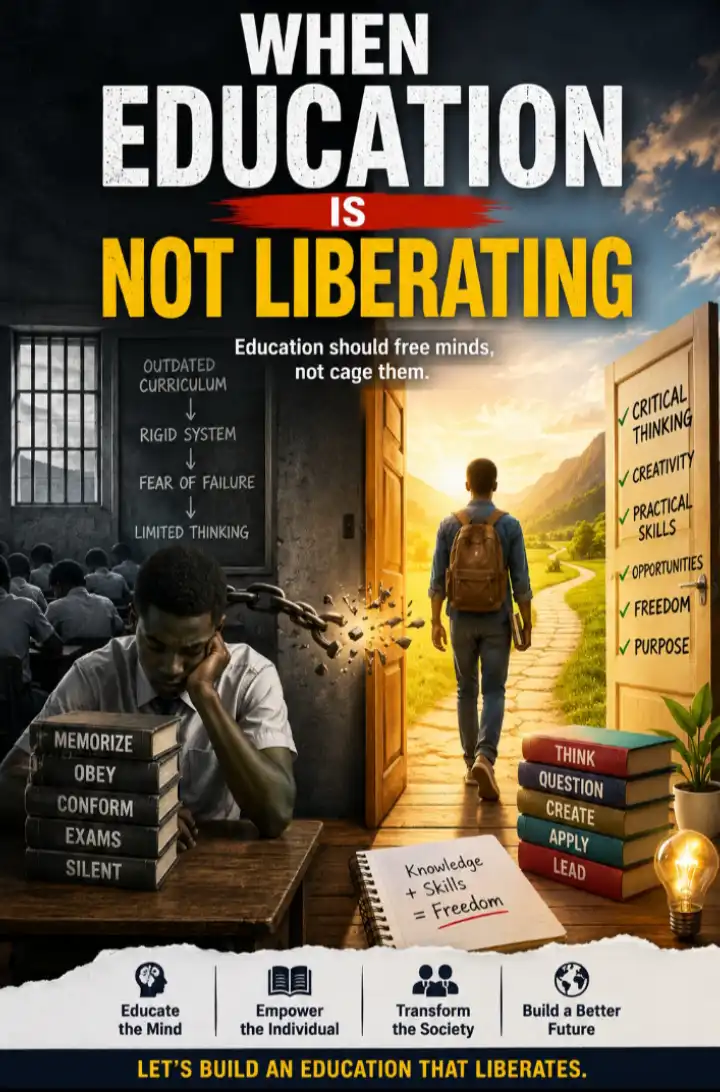
Education is often described as the key to freedom. It is expected to open doors, expand opportunities, encourage critical thinking, and help people improve their lives. However, education is not always liberating. In some situations, it can become restrictive instead of empowering.
When education is not liberating means that the education system fails to help people think independently, solve real-world problems, or improve their economic and social conditions. Instead of producing confident, creative, and capable individuals, it may create graduates who memorize facts but struggle to apply knowledge, question ideas, or adapt to change.
An education system is not liberating when it rewards obedience over curiosity, values examination scores more than understanding, teaches outdated information, ignores practical skills, or leaves graduates unprepared for employment and life. True education should develop the whole person—not just academic knowledge but also character, creativity, communication, problem-solving, and lifelong learning.
Also read What Is Digital Marketing?
Question 1: Who Is This Blog Post For?
This blog post is intended for students, parents, teachers, school administrators, policymakers, employers, and anyone interested in improving education. It is especially valuable for people who believe education should prepare individuals not only for examinations but also for meaningful careers, responsible citizenship, and lifelong personal growth.
Question 2: What Does “Education Is Not Liberating” Mean?
Education is not liberating when it teaches people what to think instead of how to think. It becomes limiting when students leave school with certificates but without practical skills, confidence, creativity, or the ability to solve real-life problems.
Liberating education encourages independent thinking, innovation, and personal responsibility. Restrictive education encourages memorization, conformity, and dependence on instructions.
many people wants to know What Is a Digital Product? A Simple Guide for Beginners.
Question 3: Have You Observed a Situation Where Education Failed to Improve Someone’s Life?
Across many countries, there are graduates who earn university degrees yet struggle to find employment because their education did not match labour market needs. Some possess impressive academic qualifications but lack communication skills, digital literacy, financial knowledge, or practical experience.
This demonstrates that education alone does not guarantee success. The quality and relevance of education matter just as much as the certificate itself.
Question 4: A Real Example
In Nigeria and many other developing countries, thousands of graduates complete university every year but remain unemployed or underemployed for long periods. Many employers report that applicants have strong theoretical knowledge but lack practical experience, critical thinking, teamwork, and problem-solving abilities.
As a result, many graduates must learn new skills after graduation through internships, vocational training, online courses, or entrepreneurship before becoming employable. This illustrates how an education system can produce qualifications without fully preparing learners for real-world challenges.
People are reacting to this Six Individuals Apprehended in Sokoto Over Domestic Burglary.
Question 5: Why Does Education Sometimes Fail?
Several factors contribute to education becoming less liberating:
- Outdated curricula that do not reflect modern workplaces.
- Overemphasis on memorization instead of understanding.
- Limited practical and hands-on learning.
- Poor teacher training and inadequate resources.
- Inequality in access to quality education.
- High unemployment despite increasing educational attainment.
- Political interference in educational policy.
- Insufficient emphasis on digital skills and entrepreneurship.
- Lack of career guidance and financial education.
When these challenges exist, education may produce graduates who possess knowledge but struggle to apply it effectively.
Question 6: Is Formal Education Still Important?
Yes. Formal education remains essential because it provides foundational knowledge, literacy, numeracy, scientific understanding, and social development. Schools also help individuals learn discipline, teamwork, and communication.
However, education must evolve. Schools should place greater emphasis on:
- Critical thinking.
- Creativity.
- Digital literacy.
- Financial literacy.
- Entrepreneurship.
- Practical problem-solving.
- Emotional intelligence.
- Collaboration.
- Lifelong learning.
Education should prepare students not only to pass examinations but also to thrive in an ever-changing world.
Question 7: How Would You Redesign the Education System?
To make education truly liberating, I would introduce the following changes:
- Replace excessive memorization with critical thinking and problem-solving.
- Integrate practical skills, internships, and real-world projects into every level of education.
- Teach financial literacy, entrepreneurship, and digital skills from an early age.
- Encourage creativity, innovation, and independent research instead of rote learning.
- Regularly update school curricula to reflect technological advances and labour market needs.
These reforms would produce graduates who are adaptable, confident, and prepared for both employment and entrepreneurship.
Question 8: Advice for Students and Graduates
If you believe your education has not fully prepared you for today’s world:
- Continue learning beyond the classroom.
- Develop digital and technology skills.
- Read widely across different subjects.
- Learn communication and leadership skills.
- Gain practical experience through volunteering or internships.
- Build a professional network.
- Consider entrepreneurship instead of relying only on traditional employment.
- Use online learning platforms to acquire new skills throughout your career.
Remember that graduation is not the end of education—it is only the beginning of lifelong learning.
Question 9: Influential Thinkers and Ideas
Many educators and scholars have influenced discussions about education and freedom, including:
- Paulo Freire, who argued that education should empower people to think critically rather than simply memorize information.
- John Dewey, who believed learning should be practical, experiential, and connected to real life.
- Maria Montessori, who emphasized independence, curiosity, and child-centred learning.
- Modern research on critical thinking, lifelong learning, and workforce development also supports the idea that education should prepare people for continuous change rather than fixed careers.
Their work reminds us that education should develop independent thinkers, not passive recipients of information.
Question 10: Final Takeaway
Education should do far more than award certificates. Its highest purpose is to develop people who can think independently, solve meaningful problems, adapt to change, contribute positively to society, and continue learning throughout life.
When education fails to encourage curiosity, creativity, critical thinking, and practical competence, it loses much of its liberating power. But when education inspires people to question, innovate, and serve others, it becomes one of the greatest forces for personal freedom, economic opportunity, and social progress.
True education does not simply fill minds with information—it equips people with the wisdom, skills, and confidence to shape a better future for themselves and for society.
For breaking news visitLegit.ng
and more importantly questions answered visit Question And Answers
